
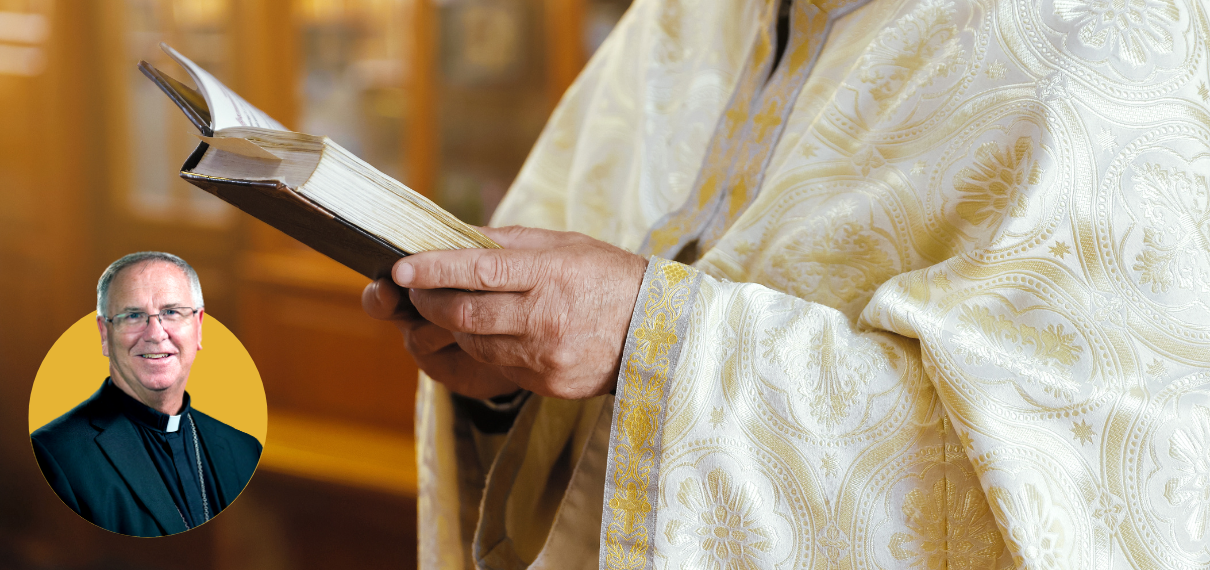
Top photo caption: Phoenix Bishop John P. Dolan smiles as he delivers the homily during a Mass at St. Mary’s Basilica last summer during the Catholic Media Conference in Phoenix. OSV News photo/Bob Roller
This article is second in a series leading up to the New Jersey Catholic Mental Health Conference May 2, highlighting the Church’s response to the growing mental health crisis. To read all of the articles, see the links below. For more information visit: http://www.njconf.com/
When reflecting on the Church’s role in supporting those facing mental health struggles, Bishop John P. Dolan of the Diocese of Phoenix recalled comments from Pope Francis.
“The Church is called to be a field hospital, as Pope Francis reminded us. That means we meet people where they are, tend to their wounds and walk with them toward hope,” Bishop Dolan said. “And hope, as Saint Paul tells us, does not disappoint.”
Bishop Dolan has made supporting mental health a key component of his ministry, and was instrumental in founding a diocesan Office of Mental Health Ministry in Phoenix – the first of its kind in the United States. The impetus, he shared, came from his observations as a priest.
“Over the years as a priest and now as a bishop, I have walked with individuals and families carrying profound burdens – anxiety, depression, addiction, and, tragically, suicide. These are not abstract issues; they are deeply human experiences that touch the Body of Christ,” Bishop Dolan said. “I have come to see mental health through the lens of Christian anthropology: the human person as body and soul, created for communion. When that communion is fractured – through isolation, trauma or illness – we suffer deeply. The Church must be a place not only of truth, but of belonging.”
He added, “I often say: isolation kills, but communion heals.”
Bishop Dolan will serve as the keynote speaker during an upcoming one-day conference, “From Isolation to Belonging, Mental Health and the Catholic Church.” The program will be held May 2, from 8:30 a.m. to 3:15 p.m. at the Saint John Neumann Pastoral Center, 146 Metlars Lane, Piscataway. Registration is limited, so those interested in attending are encouraged to register online at www.njconf.com.
Bishop Dolan’s inspiration to launch an Office of Mental Health Ministry in the Diocese of Phoenix came from both urgency and hope.
“Too many people were suffering silently, and too often the Church did not know how to respond,” he said. “The hope came from recognizing that the Church is uniquely positioned – not to diagnose or treat – but to accompany.”
When the office was established in 2022, it was designed to educate, accompany and advocate – with the goal of providing clergy and laity with the tools to recognize when someone is struggling, to respond compassionately, and to walk with individuals toward healing. The issue is personal for the bishop, too, as he has spoken openly on numerous occasions of losing four members of his family to suicide.
Bishop Dolan believes clergy “should be formed to recognize basic signs of mental distress and to respond appropriately, including referring individuals to professional help when needed. But perhaps most importantly, they must embody the presence of Christ: one who sees, who accompanies, and who does not abandon.”
In many ways, priests might be the first source of support for someone who is suffering – and he believes an “available, attentive and compassionate” priest can be a lifeline in these encounters.
“Clergy are not clinicians, but they are often the first line of encounter,” he said. “Their role is to create a culture where it is safe to speak about suffering. This begins with listening – truly listening – without judgment.”
Bishop Dolan also sees tremendous value in clergy speaking about the topic when preaching to their flock.
“When clergy speak about mental health from the pulpit, something powerful happens: the silence is broken,” he said. “Many people in the pews are quietly struggling, wondering if their suffering has a place in the Church. When a priest names these realities, he gives permission for others to come forward.”
Preaching about the importance of mental health can also dismantle stigma, he said, and can reinforce that seeking help is not a sign of weakness – but rather, an act of courage.
When mental health struggles are connected with trauma, poverty or abuse, the need for a response of support and acceptance from the Church and clergy becomes more important, he added.
“This includes collaborating with professionals, offering support groups, and ensuring that our ministries are trauma-informed,” he explained. “We must also be attentive to the dignity of each person – what I often describe as their ontological dignity, which no circumstance can erase.”
Bishop Dolan encourages clergy to view mental health ministry as essential, and to examine the culture of their parishes to consider if it is a space where faithful would feel comfortable sharing their struggles and seeking help.
As the Church increases its ministerial efforts around mental health, Bishop Dolan also hopes that those in the pews will come to have a better understanding of the topic and its intersection with faith, as well.
“I wish more Catholics understood that mental health struggles do not diminish one’s faith or worth,” he said. “In fact, the experience of suffering can become a place of deep encounter with Christ.”
If you are experiencing a crisis, dial 988. For information about mental health resources available through Catholic Charities South Jersey, visit catholiccharitiessouthjersey.org/resources-2/mentalhealth/.