
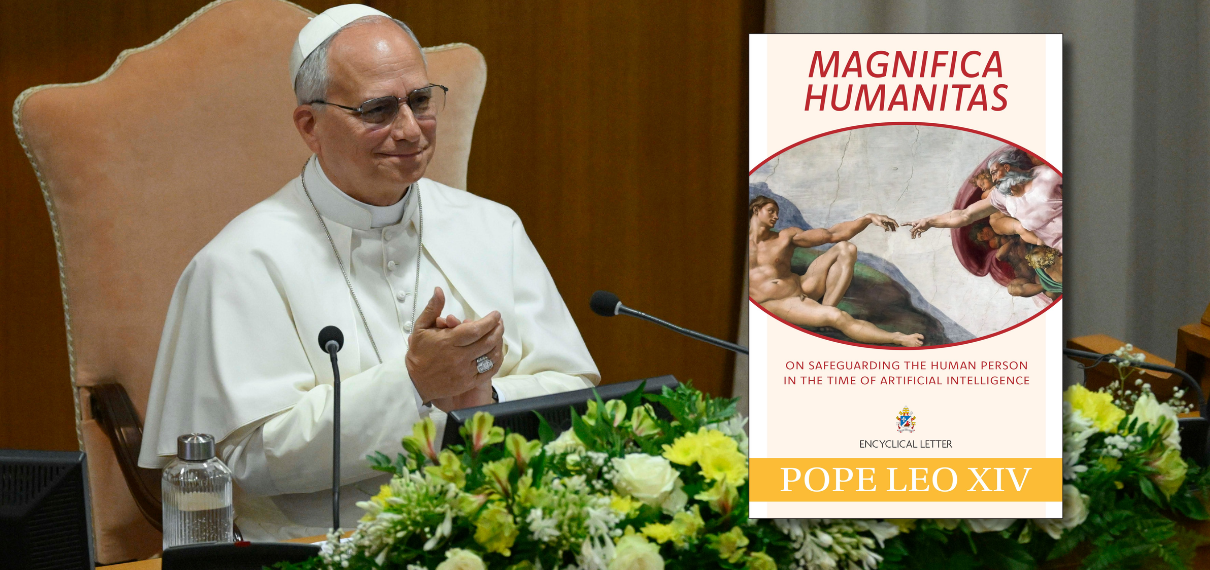
Top photo caption: Pope Leo XIV applauds as he attends the presentation of “Magnifica Humanitas” at the Vatican’s Synod Hall May 25, 2026, the first encyclical of his papacy, which focuses on the rise of artificial intelligence. OSV News photo/Simone Risoluti, Vatican Media
By Bishop David M. O’Connell, C.M.,

Papal encyclicals have long served as a privileged means by which the Successor of Peter offers guidance to the Church and the world. Addressed primarily to bishops but intended for all the faithful, they illuminate moral, theological and social questions that require thoughtful discernment. While not typically issued as infallible ex cathedra (from the chair) teachings, encyclicals carry significant doctrinal authority as expressions of the Pope’s ordinary Magisterium and often set the pastoral priorities of a pontificate.
On May 25, 2026, Pope Leo XIV released his first encyclical, Magnifica Humanitas: On Safeguarding the Human Person in the Time of Artificial Intelligence (MH). In this landmark document, the Holy Father offers a profound meditation on the opportunities and dangers emerging technologies present. He insists that the dignity of the human person must remain the central criterion for evaluating and guiding technological progress — a theme that has marked his teaching from the earliest days of his pontificate.
Read “Magnifica Humanitas” HERE.
Pope Leo XIV has consistently spoken with both hope and caution about artificial intelligence. He recognizes its enormous potential for good, yet he warns that it can also become a force of dehumanization, especially for the young.
In a 2025 address to university students gathered in Rome for the Jubilee of the World of Education, he urged them not to surrender their agency to algorithms: “Do not let the algorithm write your story! Be the authors yourselves… learn to humanize the digital.” He reminded them that while AI may be one of the rerum Novarum — the “new things” — of our age, it cannot replace emotional, spiritual, social or ecological intelligence.
Similarly, speaking to young people Nov. 21, 2025 at the National Catholic Youth Conference in Indiana, he cautioned that AI can never replace the human capacity for wonder, moral judgment or authentic friendship. It must be used in ways that foster growth, not diminish it.
At the heart of Magnifica Humanitas lies a simple but urgent question: What direction will humanity choose? Pope Leo observes that “never before has humanity had so much power over itself” (MH 6). Such power demands responsibility, humility, and collaboration. No individual or nation can bear the weight of today’s challenges alone (MH 13).
When human dignity is threatened by new forms of dehumanization, he writes, we must “remain profoundly human” and “lovingly safeguard the grandeur of humanity… which no machine can ever replace” (MH 15).
To illustrate the stakes, the Pope offers two biblical images:
a new Tower of Babel (Genesis 11:1-9) — a technological project built without God and without regard for human dignity
or the rebuilding of Jerusalem — a cooperative work rooted in God’s presence, fraternity and hope
The choice between these two paths will define our moment in human history.
Pope Leo situates his reflections within the rich tradition of Catholic social teaching, which he describes as “embodying God’s love in the concrete events of life” (MH 47). Every human person, he insists, is “planned and willed by God to enter into communion with him” (MH 50). This truth must guide our discernment of technological innovation.
Thus, he asks: “Do technological innovations truly help individuals and peoples become more humane and fraternal, while respecting our common home and future generations?” (MH 85)
This becomes the fundamental moral question regarding AI in the digital age.
AI may assist us, but it cannot replace the human heart. It does not experience joy or suffering or any emotion. It has no conscience. It cannot bear moral responsibility. It has no soul. It cannot love. For this reason, decisions affecting life, justice and peace must never be relegated to machines.
The encyclical highlights three essential goods that require vigilant protection:
Truth — in a world where information can be manipulated or distorted
Work — which must always honor the dignity of the worker, even amid automation
Freedom — threatened by subtle forms of surveillance, control, and behavioral prediction
These gifts are not optional; they are pillars of human flourishing.
Pope Leo warns against a culture of power that uses technology to make war more distant, impersonal or seemingly “clean.” “No algorithm can make war morally acceptable (MH,198),” he writes. Instead, he calls humanity to build the “civilization of love” envisioned by Pope St. Paul VI — a society rooted in justice, fraternity and peace. “Nothing is lost with peace, whereas with war everything can be lost” (MH 219).
Ultimately, Magnifica Humanitas leads us back to the mystery at the center of Christian faith: the Word became flesh. God enters human history not through power or efficiency but through vulnerability and love. This truth reveals the measure of all human greatness and the standard by which all technologies must be judged.
As we navigate the digital frontier, Pope Leo invites us to become builders of communion rather than architects of Babel. The Church’s mission is to help the world rediscover the magnificence of every human heart — the dwelling place where God desires to live.
As Bishop, I invite all the clergy and faithful of the Diocese of Trenton to embrace that mission as we consider the profound thought and wisdom contained in Pope Leo XIV’s first encyclical letter, Magnifica Humanitas.