
By Patrick T. Brown | Correspondent
When Superstorm Sandy hit nearly four years ago, news of the disaster unleashed a torrent of a different sort – donations of clothes, food, furnishings and more, all given by well-intended and concerned people from around the region and the nation.
Because the relief effort was expansive enough to absorb and manage a good deal of the material goods that were delivered to impacted regions by the truckload, many of those donations found their way to the people who needed them and supplied ongoing efforts coordinated by Catholic and other agencies in response to the persistent needs by displaced residents.
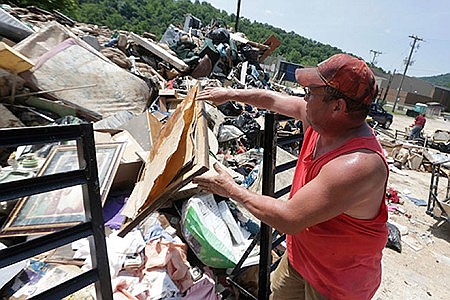
But that is not the typical experience when disaster strikes in many other places – the infrastructure often doesn’t exist to collect and distribute material goods to the people who need them most. In fact, the massive amounts of donations that come in after a catastrophic event can often turn into a second wave of disaster, placing an unmanageable burden on the people and systems trying to respond and slowing down the recovery process in the long run.
Moreover, giving material goods does not respond to all of the needs of those impacted, particularly those who are put out of their homes and jobs because of the disaster.
“Sending tangible goods creates the need for storage, which [on-the-ground] staff must manage,” said Maria Vorel, senior vice president of Disaster Operations for Catholic Charities USA. “This adds to the resource need of response.”
Expert Advice
CCUSA was designated by the U.S. bishops to be the point agency to handle the response to any domestic man-made or natural disaster relief and rebuilding operations. For example, following Hurricane Katrina’s devastation in New Orleans and the Gulf Coast, the Catholic Charities network reported providing assistance to more than 300,000 victims in the weeks, months and years following the storm.
Internationally, relief aid is provided in disaster’s aftermath by Catholic Relief Services, whose personnel have been deployed to respond to crises caused by drought in Ethiopia, conflict in Ukraine, an earthquake in Ecuador and more global hotspots in the last year alone.
“CRS implements a wide array of disaster responses, which we tailor to the needs of each community,” says material on its website. “We are especially known for our work in market-based responses and shelter.”
Disaster recovery work can actually be hindered by donations of material goods, which Vorel says often aren’t targeted for the unique needs of a given community.
“Charitable and well-meaning donors can sometimes send products that are not needed,” she said. “Funds or gift cards allow great flexibility for the agency passing on the donations and for the individuals purchasing needed items.”
There’s another benefit to giving donations of cash, rather than material items, Vorel pointed out. Local businesses can be helped on the road to recovery by infusions of cash used to purchase needed items, a boost that is forgone when donated items are sent directly to impacted areas.
“Providing an agency like Catholic Charities with funds allows a donor to give twice” Vorel said, “because the agency passes funds to local disaster survivors, who in turn purchase needed items from local businesses, thus assisting the local economy.
“Enabling disaster survivors to use a gift card [also] gives them control over recovery after an event in which they lost control,” which strengthens the individual’s sense of dignity and autonomy, she said.
Rebuilding Communities
Both CRS and CCUSA pride themselves on responding to the initial crisis after disaster strikes, but also staying with the communities impacted through the recovery and rebuilding process.
“We take a comprehensive approach to emergency response and recovery,” CRS’ website explains, claiming that nearly one-third of the organization’s programming goes toward emergency relief and recovery.
“Once we meet immediate needs for food, water and shelter, we transition to rebuilding and reconstruction, supporting the survivors of natural disasters and chronic emergencies in reclaiming their lives…Then we help people obtain the tools and skills they need to manage their own recovery. Our projects build on local systems to ensure long-term success.”
CCUSA outlines a six-step plan to caring for families and communities in the wake of a disaster, including providing immediate relief, employing disaster case managers to work with survivors over the long-term, collaborating as a national network of social-service agencies and with other nonprofit groups, working closely with government disaster-response agencies, and empowering agencies and communities to prepare in advance.
“Disaster survivors often need a long time for recovery,” Vorel said, using the still-ongoing recovery from 2012’s Superstorm Sandy as an example of local efforts still making a difference.
Following the storm, CCUSA administered a national grant from the U.S. Conference of Catholic Bishops grant to all of the dioceses impacted by the storm. Two grants were earmarked for social services in the Diocese of Trenton – one for Catholic Charities Diocese of Trenton and another to the diocesan Office of Catholic Social Service.
According to a 2014 report in The Monitor, the long-term assistance resulted in the distribution of $1.7 million in funds and services in the form of food, clothing, utilities, car repairs, house repairs, building materials and labor to help families in impacted communities.
Supporting communities for the long-term, as well as responding to immediate crises, is what differentiates Catholic Charities, Vorel says, and those impacted by storms or other disasters are grateful for the support. “They may need to rebuild not only their homes, but also their lives.”