
By EmmaLee Italia, Contributing Editor
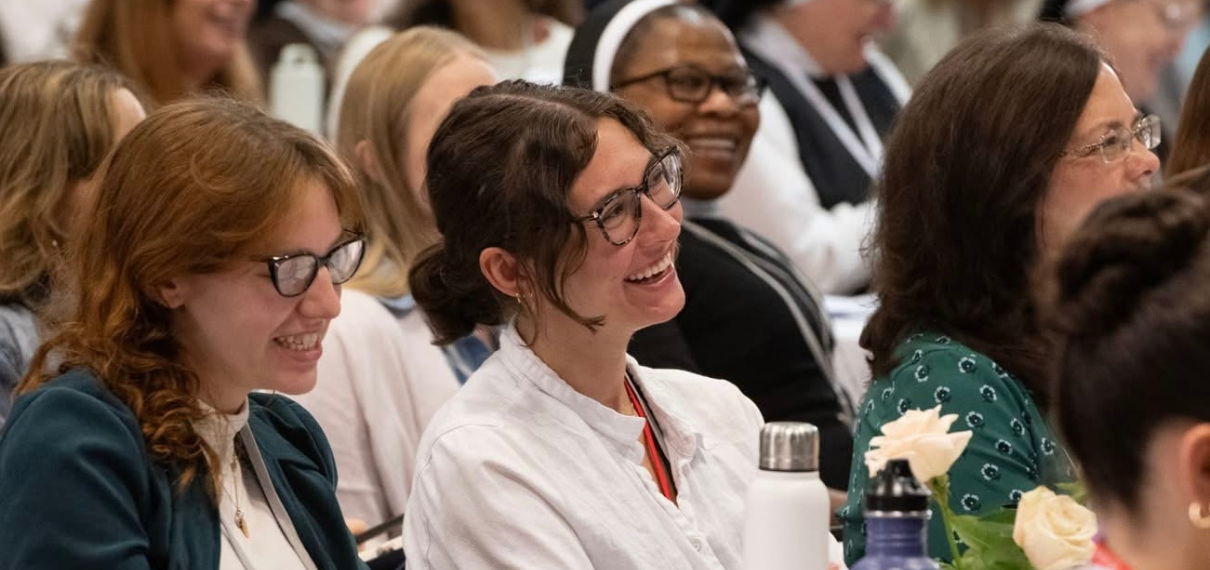
Top photo caption: Grace Huegel, center, attends a forum for adult women leaders in Washington, D.C. Huegel is developing a mental health resource for priests’ use. Jeffrey Bruno photo
In observance of this month’s World Mental Health Day (Oct. 10), Pope Leo XIV dedicated his October prayer intention to mental health ministry, calling on the Church to respond in intentional ways on behalf of those who suffer.
In his prayer, the Holy Father asks of God, “Send your Spirit upon us, that we may learn to welcome and integrate care for mental health into the life and ministry of our communities and of the whole Church.”
That same prayer has long been written on the heart of Grace Huegel, a pastoral minister in the Diocese of Trenton who has dedicated much of her professional studies to mental health and counseling. A parishioner of St. Robert Bellarmine Co-Cathedral in Freehold and youth minister in St. Leo the Great Parish, Lincroft, Huegel is also a professional counseling graduate student who is working on a project to assist priests in their efforts to recognize and respond to mental health concerns in the context of pastoral ministry.
Huegel has been recognized as the 2026-27 Msgr. Edward Ciuba Fellow by the Center for Catholic Studies at Seton Hall University, South Orange. Utilizing this fellowship and its $5,000 stipend, Huegel will develop a practical pastoral mental health resource, using conversations with priests of the Diocese, consultation with Catholic mental health professionals and established frameworks such as Mental Health First Aid.
“The Lord calls us all, clergy and laity, to be both holy and whole,” she said. “With our growing understanding of holistic wellness, we have the opportunity to integrate faith and mental health in a way that supports the flourishing of the whole person.”
A Growing Need
While serving as a mental health graduate intern at The Samaritan Center at the Jersey Shore, Huegel provided outpatient psychotherapy, intake and risk assessments, treatment planning, crisis stabilization, safety planning and suicide risk assessment. She previously served as a graduate assistant with the Seton Hall University Center for Catholic Studies, supporting research, communications and interdisciplinary programming.
“I have been interested in the intersection of faith and mental health since college,” Huegel said. “As a religion major at Princeton University, I wrote my senior thesis about the complicated relationship between spiritual mortification and mental health considerations in the life of St. Gemma Galgani.
“From there, I saw this nuanced dynamic in my work as a mental health counselor, in which many of my clients were referred to me from priests. Priests already carry a tremendous personal, spiritual and pastoral load, so one goal of my project is to lighten the weight in a small, tangible way.”
Huegel’s concern for those in mental health crisis and the priests who minister to them is borne of a deep connection to her faith and ministry background.
At one time she discerned religious life as a candidate with the Salesian Sisters of St. John Bosco, an active religious community dedicated to serving the young people.
“While I was ultimately not called to the consecrated religious vocation, my time in the convent helped develop my identity both as a counselor and catechist,” she reflected.
In addition to her current position in St. Leo the Great Parish, Huegel has served as a catechist in St. Mary Parish, Colts Neck; her alma mater, St. Benedict School, Holmdel; St. Gabriel Parish, Marlboro, and St. Robert Bellarmine Co-Cathedral Parish. She also taught theology in St. Benedict School and was the pastoral associate and director of OCIA in St. Robert Bellarmine.
“Most of my interactions with priests regarding faith and mental health have been outside of my ‘official’ church work,” Huegel acknowledged. “Rather, priests have reached out to me in a case consultation format, often about specific people they are accompanying. I have learned both through my academic research and pastoral conversations that many Catholics struggle with a mix of spiritual and psychological concerns and, in turn, voice these realities to priests.”
Welcome Resource
Huegel’s booklet for priests in the Diocese of Trenton, planned for release by June 2027, will be both short and accessible.
“The booklet will be broken down into three parts,” she noted, “mental health first aid for pastoral workers; the intersection of spiritual struggles and mental health concerns, and a directory of social workers, counselors and community agencies dedicated to integrating faith and mental health in their work.”
The GIVEN Institute, a non-profit organization dedicated to developing young adult women leaders in the Church, “has provided me a mentor to accompany me in this project and hosted a leadership forum in Washington, D.C., this past June,” she said. “The Ciuba fellowship offers financial assistance and mentorship in developing and implementing the project.”
It is through efforts such as these that Pope Leo’s prayers may be answered, that the Church would “become a living sign of (God’s) mercy, which never abandons and always restores.”
A press release from Seton Hall University was used for parts of this article.