
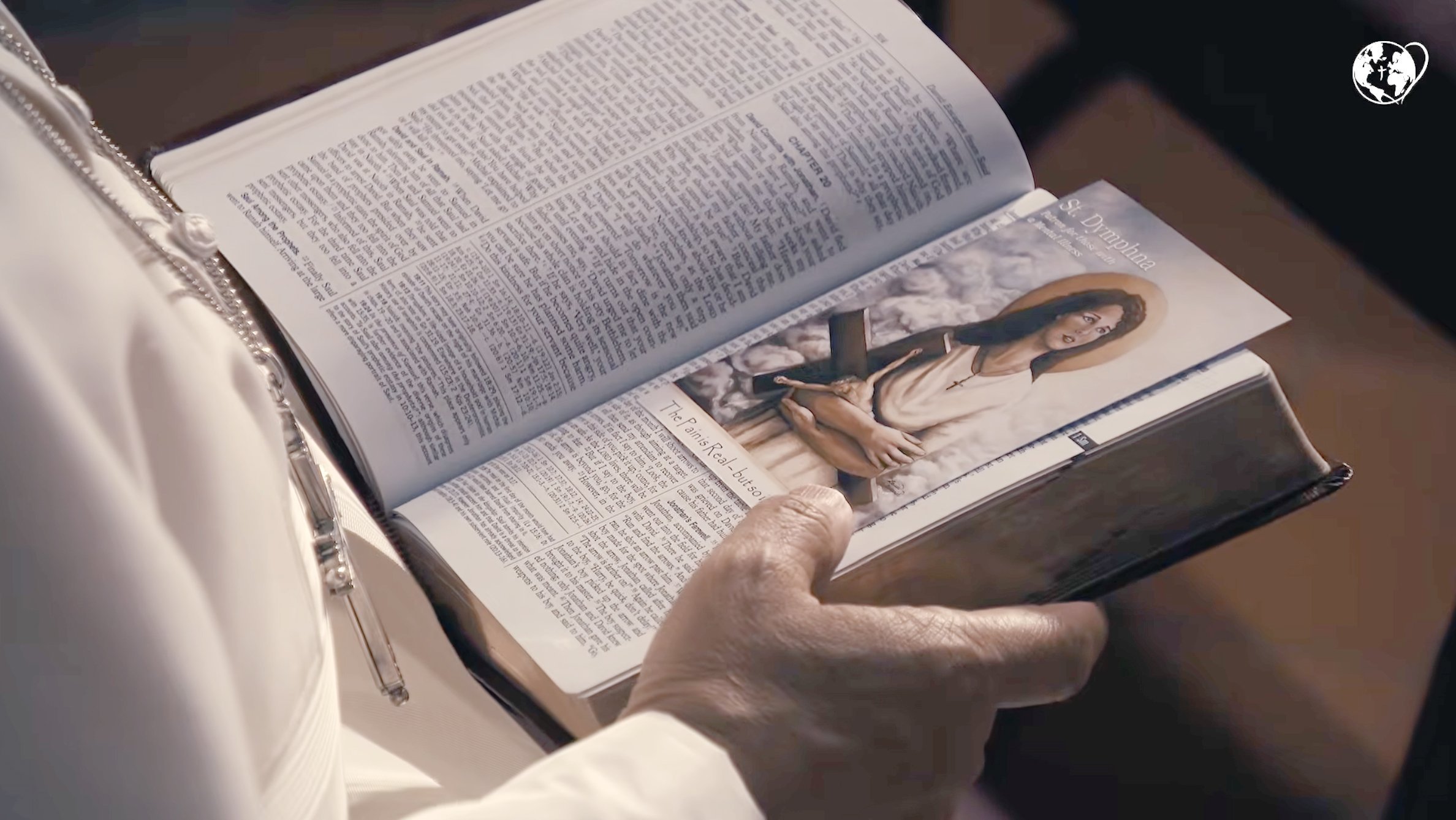
Top photo caption: Pope Leo XIV is pictured praying his October 2026 prayer intention dedicated to mental health. Holding an image of St. Dymphna, patroness of people suffering from mental disorders and of mental health professionals, Pope Leo addressed the Lord, saying that it is he who knows the innermost depths of our hearts and “the silent wounds that sometimes no one sees.” OSV News screenshot /Pope’s Worldwide Prayer Network
By Cecilia Cicone, OSV News
When you’re sick, it impacts nearly every aspect of your life. If you can’t get out of bed in the morning, you can’t go to work, you can’t socialize with other people and you can’t cook your own meals. It takes all of your energy just to heal.
It’s probably pretty easy to imagine a time when you were so sick that you couldn’t get out of bed. Everything hurt, and you just wanted to feel better, whether it was tea with honey, flu medication or painfully taking a shot of apple cider vinegar. You were willing to do whatever it took to feel better.
God made us whole beings: body, mind and spirit. When one part is a little bit off, it impacts everything else. It’s difficult to have a strong body without also having a strong mind and spirit. For those of us who experience mental illness, it’s natural that it would affect the other aspects of our being as well: our body and our soul.
I was a novice in formation for religious life in a convent when I started to have mental illness symptoms seven years ago. When I first started having trouble sleeping, I wasn’t exactly sure what was going on. For weeks on end, I wouldn’t get more than an hour or so at night, and naturally, that impacted my prayer. It impacted my ability to live in community, to focus and build relationships, too.
Eventually, as my symptoms got worse and I experienced more panic attacks, flashbacks, nightmares and dissociation, praying like I had been used to praying became nearly impossible.
I was used to waking up every morning and immediately spending 30 minutes praying on the Gospel for the day, followed by morning prayer and Mass and then another Holy Hour at some point during the day. I also did an additional 30 minutes of personal prayer and then evening prayer. Before bed, I was used to praying with the next day’s Gospel and doing an examination of conscience.
My day had been rooted in contemplation and in closing my eyes, becoming aware of the Lord’s presence and entering into deep conversation with him. Suddenly, I couldn’t even close my eyes without descending into panic and disconnection from reality. The life of prayer that had grounded me and been such a comfort suddenly felt like torture.
Eventually, I needed to leave religious life because of my mental illness, but praying didn’t get easier, even as I went to therapy. I was diagnosed with post-traumatic stress disorder and dissociative identity disorder . Every single time that I went to see a therapist or a doctor, I said how much I just wanted to be able to pray and go back to the life that I knew.
There’s no one-size-fits-all solution for Catholics who are experiencing mental illness or for Catholics who love and want to help us. As nice as it would be to be able to say, “Just pray this novena or go on this retreat or read this book and you’ll be better,” each of us has a struggle that only God understands. Truthfully, even science hasn’t caught up to understand the root causes of many mental illnesses and exactly how to treat them.
But one thing that is always the case is that experiencing a sickness of the mind will definitely impact the soul and the ability of someone to relate to God and practice their faith. It can bring struggles with it, but it can also bring great experiences of grace.
For some people, going to Mass might be the only time during the week when they experience any kind of peace. For others, being in Mass, surrounded by other people and unpredictable noises with a social expectation of sitting quietly for an hour could be a source of panic that turns into a mental health crisis.
Just like many of us experience a great peace when we go to the sacrament of reconciliation, for some, especially those who may experience scrupulosity (which may be related to obsessive-compulsive disorder), confession can bring up some of the symptoms that are torturous for them.
Some prayers, like the holy rosary, are a great source of connection and calm in the midst of mental turmoil. For others, the repetition and rhythm of the rosary may lead to dissociation and a disconnection from reality.
There’s no one-size-fits-all solution for Catholics suffering from mental illness because Jesus is not an impersonal, one-size-fits-all healer. He’s personal and intimate, and so, just as no one’s suffering is exactly like someone else’s, the way Jesus meets and heals them is going to be unique, too. And his healing always happens in his perfect timing, which is not always in this life.
I can’t say that one prayer book or listening to a YouTube video or podcast will definitely heal you or your loved ones. But I can say this: Jesus is more gentle and more understanding and more compassionate than we could ever imagine. He has given us the sacraments and the life of the Church as great gifts even though he is not constrained to only act in these ordinary ways.
Holding on to the faith while experiencing mental illness, first and foremost, is rooted in the grace of perseverance. It’s a humble prayer of telling the Lord that you don’t want to give up, that you want to keep trying, but that you need him. Jesus will not deny that prayer, and you may be surprised in how he chooses to answer it.
Cecilia Cicone is an author and communicator who works in diocesan ministry in Northwest Indiana.
Catholic journalism is needed now more than ever. Please consider supporting this work by signing up for a SUBSCRIPTION (click HERE) or making a DONATION to The Monitor (click HERE). Thank you for your contribution.