


Father Koch: Do we, like the rich man, ignore Lazarus’ presence?
September 26, 2025 at 11:00 a.m.
Gospel reflection for Sept. 28, 2025, 26th Sunday in Ordinary Time
Though many decry what they call a wealth gap or an income gap, what we experience here in the U.S. relative to the rest of the world is far less noticeable. While there are the super wealthy billionaires, even the poorest people in our country live substantially better than the average person in the rest of the world.
Even for the many who lack the resources to properly feed their families, many resources are available to assist. Government programs can be helpful, though they are always subject to the whim of political realities. The parishes and dioceses throughout the world work to alleviate the suffering of the poor and the marginalized. The Catholic Church is indeed the largest social services organization in the world.
It is easy for us here to feel insulated from the pain of poverty in the lives of everyday people. Often people who seem to be asset rich are indeed living on the margins, as they appear more well-off than they are. The truth remains that we cannot judge a person’s wealth or status from external appearances or our judgments about what they seem to have.
Our nation is rending itself apart over issues that impact the daily lives of millions of people, many of them silent and absent any serious advocates in the legislative process. People live on the margins, not just financially, but in terms of their empowerment, their ability to seek advancement for themselves or their families, and certainly in securing their future.
To a large extent this is not much different from the world in which Jesus lived. There the wealthy and elite of society lived well. They had ample food and drink, employed servants and used the sweat of slaves to make their own lives more comfortable. However, many were forced to sell themselves or loved ones into slavery or languished in debtor’s prisons. Some lived as beggars and others were forced into petty thievery in order to have any food. We know from the ministry of Jesus that he often encountered those who were left to beg due to physical limitations. Those who were diagnosed as lepers were forced to live outside of the villages, relying solely on the generosity of others for survival. There was no adequate medical care for most people, and diseases today we call ordinary were often life-threatening.
Jesus frequently identified with the poor, and did much to alleviate their suffering, but he lacked the financial resources or political means to end the cycle of destitution.
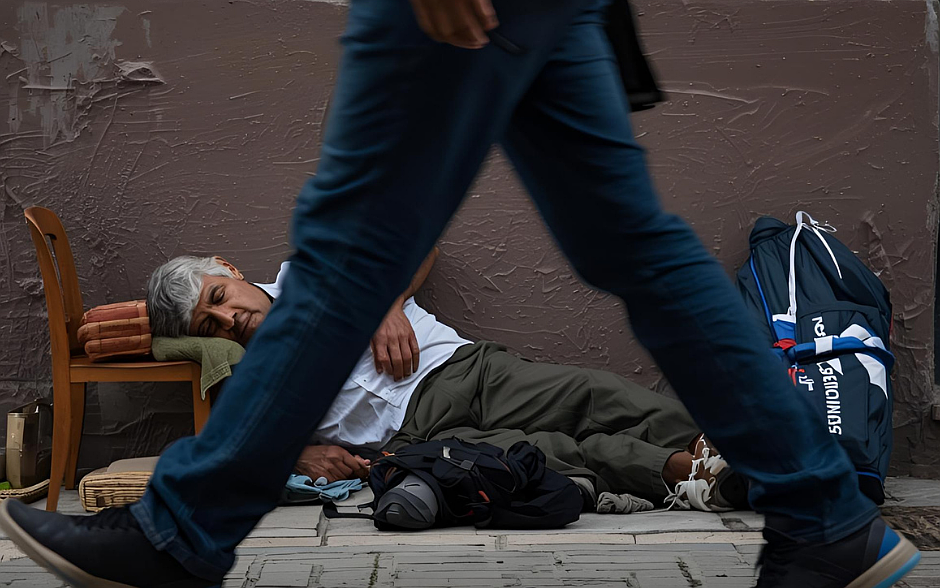
In one of his most well-known parables Jesus calls out the Pharisees, those among the wealthier in society, by challenging them with a stark image. An unnamed rich man who lived a life of gluttony and leisure, completely ignored a poor beggar named Lazarus who desired even just to eat the scraps from the rich man’s table. Yet, the rich man gave him no attention. The only comfort that Lazarus knew came from the stray dogs who would lick the sores on his body.
Upon their deaths the rich man was languishing in torment while Lazarus was seated with Abraham. The rich man pleaded with Abraham to allow Lazarus to bring him some relief and when denied then beseeched him further to send a messenger to his brothers so that they might experience conversion of mind and heart, only to be told that such was useless as well.
The rich man suffered the torment of his neglect for the least among us; the very least that Jesus identifies himself with elsewhere in his ministry.
We are judged by our treatment of the least, the marginalized, and the afflicted. We are quick to deny others basic human rights in order to preserve some romanticized version of our society, or to ease our tax burden.
In the celebration of matrimony one of the prayers of blessing for the newly married couple reads: “May you be witnesses in the world to God’s charity, so that the afflicted and needy who have known your kindness may one day receive you thankfully into the eternal dwelling of God.”
The financial health of the economy, the effects of immigration, and the mobility of society are always expressed in complex statistical analyses. This insulates us from the deeper reality that the data reflect the lives of people. We are not numbers, we are individual human persons living our lives, taking care of our families, and hoping for a better future. While the question of how many poor live among us is a politically charged one, each one of us encounters the poor every day. One of the most compelling parables of Jesus, the rich man and Lazarus, highlights our need to open our eyes and our hearts to those we encounter each day.
Father Garry Koch is pastor of St. Benedict Parish, Holmdel.
Related Stories
Sunday, December 28, 2025



E-Editions

Events
Gospel reflection for Sept. 28, 2025, 26th Sunday in Ordinary Time
Though many decry what they call a wealth gap or an income gap, what we experience here in the U.S. relative to the rest of the world is far less noticeable. While there are the super wealthy billionaires, even the poorest people in our country live substantially better than the average person in the rest of the world.
Even for the many who lack the resources to properly feed their families, many resources are available to assist. Government programs can be helpful, though they are always subject to the whim of political realities. The parishes and dioceses throughout the world work to alleviate the suffering of the poor and the marginalized. The Catholic Church is indeed the largest social services organization in the world.
It is easy for us here to feel insulated from the pain of poverty in the lives of everyday people. Often people who seem to be asset rich are indeed living on the margins, as they appear more well-off than they are. The truth remains that we cannot judge a person’s wealth or status from external appearances or our judgments about what they seem to have.
Our nation is rending itself apart over issues that impact the daily lives of millions of people, many of them silent and absent any serious advocates in the legislative process. People live on the margins, not just financially, but in terms of their empowerment, their ability to seek advancement for themselves or their families, and certainly in securing their future.
To a large extent this is not much different from the world in which Jesus lived. There the wealthy and elite of society lived well. They had ample food and drink, employed servants and used the sweat of slaves to make their own lives more comfortable. However, many were forced to sell themselves or loved ones into slavery or languished in debtor’s prisons. Some lived as beggars and others were forced into petty thievery in order to have any food. We know from the ministry of Jesus that he often encountered those who were left to beg due to physical limitations. Those who were diagnosed as lepers were forced to live outside of the villages, relying solely on the generosity of others for survival. There was no adequate medical care for most people, and diseases today we call ordinary were often life-threatening.
Jesus frequently identified with the poor, and did much to alleviate their suffering, but he lacked the financial resources or political means to end the cycle of destitution.
In one of his most well-known parables Jesus calls out the Pharisees, those among the wealthier in society, by challenging them with a stark image. An unnamed rich man who lived a life of gluttony and leisure, completely ignored a poor beggar named Lazarus who desired even just to eat the scraps from the rich man’s table. Yet, the rich man gave him no attention. The only comfort that Lazarus knew came from the stray dogs who would lick the sores on his body.
Upon their deaths the rich man was languishing in torment while Lazarus was seated with Abraham. The rich man pleaded with Abraham to allow Lazarus to bring him some relief and when denied then beseeched him further to send a messenger to his brothers so that they might experience conversion of mind and heart, only to be told that such was useless as well.
The rich man suffered the torment of his neglect for the least among us; the very least that Jesus identifies himself with elsewhere in his ministry.
We are judged by our treatment of the least, the marginalized, and the afflicted. We are quick to deny others basic human rights in order to preserve some romanticized version of our society, or to ease our tax burden.
In the celebration of matrimony one of the prayers of blessing for the newly married couple reads: “May you be witnesses in the world to God’s charity, so that the afflicted and needy who have known your kindness may one day receive you thankfully into the eternal dwelling of God.”
The financial health of the economy, the effects of immigration, and the mobility of society are always expressed in complex statistical analyses. This insulates us from the deeper reality that the data reflect the lives of people. We are not numbers, we are individual human persons living our lives, taking care of our families, and hoping for a better future. While the question of how many poor live among us is a politically charged one, each one of us encounters the poor every day. One of the most compelling parables of Jesus, the rich man and Lazarus, highlights our need to open our eyes and our hearts to those we encounter each day.
Father Garry Koch is pastor of St. Benedict Parish, Holmdel.