


Church adds Mass 'for care of creation' to missal, Pope to celebrate
July 4, 2025 at 10:41 a.m.

VATICAN CITY CNS – Catholic priests will now be able to celebrate Mass "for the care of creation" after the Vatican announced that a new formulary of prayers and biblical readings for the Mass will be added to the Roman Missal – the liturgical book that contains the texts for celebrating Mass in the Roman Rite of the Catholic Church.
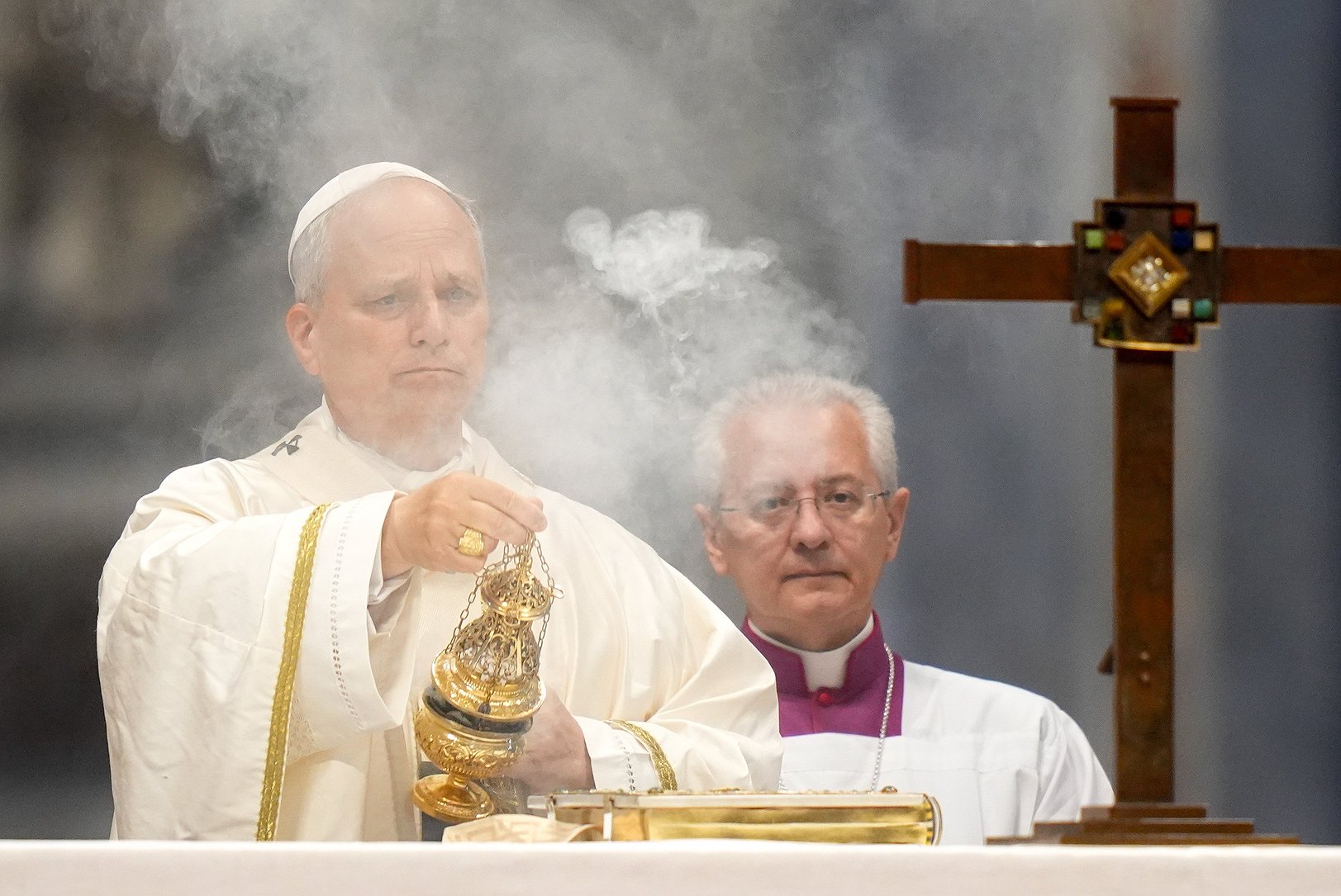 Pope Leo XIV uses incense at the altar at the beginning of Mass in St. Peter's Basilica on the feast of the Holy Trinity and for the conclusion of the Jubilee of Sport at the Vatican June 15, 2025. (CNS photo/Lola Gomez)
The new formulary, or specific set of texts and prayers for Mass, will be added among the "civil needs" section of the "Masses and Prayers for Various Needs and Occasions" listed in the Roman Missal. The current missal, approved by St. John Paul II in 2000, lists 17 "civil needs" to offer Masses and prayers for, including "for the nation or state," "after the harvest," "for refugees and exiles" and "in time of earthquake." The missal lists another 20 particular needs for the church and 12 for other circumstances.
Pope Leo XIV will use the new formulary for a private Mass July 9 with the staff of Borgo Laudato Si' ecology project – a space for education and training in integral ecology hosted in the gardens of the papal villa at Castel Gandolfo, the traditional summer residence for the Popes.
The formulary for the Mass began development during Pope Francis' pontificate in response to "requests for a liturgical way of celebrating the meaning and the message of 'Laudato si','" said Cardinal Michael Czerny, prefect of the Dicastery for Promoting Integral Human Development, who presented the new formulary at a news conference July 3.
"The true authors of this text are Scripture, the (church) fathers and 'Laudato si','" said Archbishop Vittorio Francesco Viola, secretary of the Dicastery for Divine Worship and the Discipline of the Sacraments.
The new formulary, Archbishop Viola said, "receives some of the principal themes contained in Laudato Si' and expresses them in the form of prayer within the theological framework that the encyclical revives."
He described the set of prayers as "a good antidote against a certain reading of 'Laudato si'' that risks reducing the depth of its content to a 'superficial or ostensible ecology'" that is "far from that integral ecology widely described and explained in the encyclical."
The Mass formulary begins with the entrance antiphon from Psalm 19: "The heavens declare the glory of God; the firmament proclaims works of his hands." The Collect prayer, which gathers the prayer intentions of the faithful to close the introductory rites of the Mass, asks God "that docile to the life-giving breath of your Spirit, we may lovingly care for the work of your hands."
The prayer after Communion asks for increased communion with God "so that, as we await the new heavens and the new earth, we may learn to live in harmony with all creatures."
The proposed biblical readings include Wisdom 13:1-9, Colossians 1:15-20, and selections from the Gospel of Matthew that recount Jesus calming the storm and calling people to trust in divine providence through the lilies of the field and the birds of the air.
In the decree dated June 8 issuing the new formulary, Cardinal Arthur Roche, prefect of the Dicastery for Divine Worship and the Discipline of the Sacraments, wrote, "At this time it is evident that the work of creation is seriously threatened because of the irresponsible use and abuse of the goods God has endowed to our care."
"This is why it is considered appropriate to add a Mass formulary" on the care of creation, he wrote.
However, "this Mass is a reason for joy," said Cardinal Czerny during the July 3 news conference. "It increases our gratitude, strengthens our faith and invites us to respond with care and love in an ever-growing sense of wonder, reverence and responsibility."
The new formulary "calls us to be faithful stewards of what God has entrusted to us, not only in daily choices and public policies, but also in our prayer, our worship and our way of living in the world," he added.
Related Stories
Sunday, December 14, 2025

E-Editions
Events
VATICAN CITY CNS – Catholic priests will now be able to celebrate Mass "for the care of creation" after the Vatican announced that a new formulary of prayers and biblical readings for the Mass will be added to the Roman Missal – the liturgical book that contains the texts for celebrating Mass in the Roman Rite of the Catholic Church.
Pope Leo XIV uses incense at the altar at the beginning of Mass in St. Peter's Basilica on the feast of the Holy Trinity and for the conclusion of the Jubilee of Sport at the Vatican June 15, 2025. (CNS photo/Lola Gomez)The new formulary, or specific set of texts and prayers for Mass, will be added among the "civil needs" section of the "Masses and Prayers for Various Needs and Occasions" listed in the Roman Missal. The current missal, approved by St. John Paul II in 2000, lists 17 "civil needs" to offer Masses and prayers for, including "for the nation or state," "after the harvest," "for refugees and exiles" and "in time of earthquake." The missal lists another 20 particular needs for the church and 12 for other circumstances.
Pope Leo XIV will use the new formulary for a private Mass July 9 with the staff of Borgo Laudato Si' ecology project – a space for education and training in integral ecology hosted in the gardens of the papal villa at Castel Gandolfo, the traditional summer residence for the Popes.
The formulary for the Mass began development during Pope Francis' pontificate in response to "requests for a liturgical way of celebrating the meaning and the message of 'Laudato si','" said Cardinal Michael Czerny, prefect of the Dicastery for Promoting Integral Human Development, who presented the new formulary at a news conference July 3.
"The true authors of this text are Scripture, the (church) fathers and 'Laudato si','" said Archbishop Vittorio Francesco Viola, secretary of the Dicastery for Divine Worship and the Discipline of the Sacraments.
The new formulary, Archbishop Viola said, "receives some of the principal themes contained in Laudato Si' and expresses them in the form of prayer within the theological framework that the encyclical revives."
He described the set of prayers as "a good antidote against a certain reading of 'Laudato si'' that risks reducing the depth of its content to a 'superficial or ostensible ecology'" that is "far from that integral ecology widely described and explained in the encyclical."
The Mass formulary begins with the entrance antiphon from Psalm 19: "The heavens declare the glory of God; the firmament proclaims works of his hands." The Collect prayer, which gathers the prayer intentions of the faithful to close the introductory rites of the Mass, asks God "that docile to the life-giving breath of your Spirit, we may lovingly care for the work of your hands."
The prayer after Communion asks for increased communion with God "so that, as we await the new heavens and the new earth, we may learn to live in harmony with all creatures."
The proposed biblical readings include Wisdom 13:1-9, Colossians 1:15-20, and selections from the Gospel of Matthew that recount Jesus calming the storm and calling people to trust in divine providence through the lilies of the field and the birds of the air.
In the decree dated June 8 issuing the new formulary, Cardinal Arthur Roche, prefect of the Dicastery for Divine Worship and the Discipline of the Sacraments, wrote, "At this time it is evident that the work of creation is seriously threatened because of the irresponsible use and abuse of the goods God has endowed to our care."
"This is why it is considered appropriate to add a Mass formulary" on the care of creation, he wrote.
However, "this Mass is a reason for joy," said Cardinal Czerny during the July 3 news conference. "It increases our gratitude, strengthens our faith and invites us to respond with care and love in an ever-growing sense of wonder, reverence and responsibility."
The new formulary "calls us to be faithful stewards of what God has entrusted to us, not only in daily choices and public policies, but also in our prayer, our worship and our way of living in the world," he added.