


A Saint for All People: Bishop affirms life, legacy of St. Rita of Cascia during televised Mass in national shrine
May 22, 2021 at 9:56 p.m.
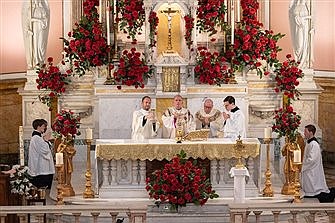
The life and mission of the 15th century woman who was canonized a saint in 1900 and went on to become known as the patron saint of impossible causes was explored during Bishop David M. O’Connell, C.M.’s May 22 visit to the national shrine that bears her name in South Philadelphia. Bishop O’Connell celebrated a Mass for the Feast of St. Rita of Cascia which was broadcast on Eternal Word Television Network and was part of the network’s Cathedrals Across America feature series.
Photo Gallery: Bishop Celebrates Feast of St. Rita of Cascia at National Shrine
The feast day Mass, which was held at noon, concluded the shrine’s solemn novena held May 13-21 and included both virtual and in-person opportunities for daily Mass and the Sacrament of Reconciliation. Each day of the novena drew an average of 350 in-person visitors to the shrine and another 900 people viewed the services online, according to Jonathan Jerome, shrine director.
Bishop O’Connell said of St. Rita in his homily, “The life she lived over six centuries ago, her history and story are as well known to us as though she had just passed away. Before she closed her eyes on this world and entered eternity on this date in 1457, St. Rita of Cascia spent her 76 years passionately devoted to her Catholic faith.”
Bishop O’Connell shared key points of St. Rita’s life, telling how she was born Margherita Lotti in Roccapareno, Italy, in 1381; how she was a very young girl when she showed great interest in entering the convent but instead obeyed her parents and was 12 years old when she entered a marriage they had arranged to a wealthy nobleman. Rita and her husband had two sons but their 18-year marriage ended when her husband was murdered.
“Although married life proved difficult for Margherita, she was widely known for her patience, piety and virtue, giving her husband’s killers a public pardon,” Bishop O’Connell said. He noted that after Rita’s sons died a year after her husband, Rita wanted to enter the monastery in Cascia but was refused until she settled resentment between her husband’s family and his enemies. Margherita was 36 years old when she was finally received into the Augustinian community of sisters and lived 40 years in religious life until her death in 1457.
“She had lived so much of her life already as a daughter, wife, mother and widow,” Bishop O’Connell said, adding that Rita encountered her share of challenges in religious life as well.
Rita, nonetheless, “persevered and grew in holiness,” Bishop O’Connell said. He shared that Rita had received the mark of a single thorn from Jesus’ crown of thorns on her forehead, which has come to be considered a stigmata. In her later life, she had suffered from bouts of illness which led to her death.
“Devotion began to spread throughout Cascia and beyond and multiple miracles were attributed to her intercession,” the Bishop said of Rita who was canonized a saint by Pope Leo XIII in 1900.
In his homily to the approximately 500 congregants in attendance, Bishop O’Connell associated the life of St. Rita with a quote from Pope Francis’ All Saints Day message from 2020. The Holy Father said, “Each saint has their own personality and developed their own life of holiness according to their own personality… Each saint, following a “personal and universal vocation to holiness,” … “proposes sure models for this journey that each person walks in a unique way, an unrepeatable way” marked by their inexhaustible variety of gifts and real life stories,” Bishop O’Connell related. Then continuing to quote Pope Francis, the Bishop said, “Each time we join our hands and open our hearts to God, we find ourselves in the company … of saints who pray with us and intercede for us as older brothers and sisters who have preceded us on this same human adventure. … we all breathe and participate in one common grace.”
“Today, in this National Shrine of St. Rita of Cascia, on her feast day, let us breathe deeply of the grace she shares with the Communion on saints,” Bishop O’Connell said.
Also participating in the Mass were Msgr. Thomas Mullelly, Trenton Diocesan episcopal vicar for clergy and consecrated life and director of seminarians, who concelebrated; Brother Jeremy Hiers, a transitional deacon for the Augustinian community, who assisted, and seminarians from St. Charles Borromeo Seminary, Wynnewood, Pa. Several members of the shrine’s choir, along with director and organist Michael Sheerin, provided the music.
To commemorate the feast day, the congregants were given roses which were blessed by Bishop O’Connell during the Mass and for the final blessing, the Bishop held a reliquary and blessed the faithful with a relic of St. Rita.
The Attraction to the National Shrine
Jerome and Augustinian Father Michael DiGregorio, who served on the shrine’s staff for 15 years from 1992 to 2007, reflected on why the shrine has drawn untold thousands of people from across the country and around the globe to South Philadelphia for the past 114 years. Among the many reasons, he said, is that the shrine appealed to many Italian immigrants in the South Philadelphia area at the time of her canonization who were heartened that the saint was Italian.
People, Father DiGregorio continued, have related to St. Rita because she was known as the saint of the impossible, and over the years, he said, stories have been shared about how parents had come to the shrine to pray for the birth of a child and mothers who had difficulty in their pregnancies.
Jerome added that the shrine’s charisms are informed by the Augustinians who have staffed the church since the beginning. The shrine’s “message, mission and our ministry are really rooted in the life of St. Rita,” he said.
All visitors to the shrine will find it to be “primarily a place of pilgrimage” where Mass and the Sacrament of Reconciliation are celebrated daily, Jerome said. In addition, the shrine is available for various groups and purposes, such as retreats for students and teachers, as well as weddings and funerals. There is also a counseling center to assist individuals dealing with such issues as sexual abuse.
Jerome noted that another unique aspect of the shrine is that it’s operated by the Augustinian order, who “are known for being of one mind and of one heart in their pursuit of God.
“We really infuse that in so many aspects of our ministry,” Jerome said. “St. Rita was an Augustinian nun and she knew better than anyone how important this charism was in her own life and the way she found God in the end.”
Relating to Rita
Both Father DiGregorio and Jerome reiterated how people over the years have related to the life of St. Rita, who was a daughter, a wife, a widow, a mother and a professed religious.
“St. Rita is a saint for all people,” Jerome said.
Her life speaks to the diversity of vocations that we see in the Church today,” Jerome said. “Men and women of all ages, all ethnicities come to the shrine because that resonated with them. They can connect to her story and her reliance on God and perseverance in difficult times.”
“All of us experience a moment or moments where something seems impossible and St. Rita had lived through tragedy and overcame it with perseverance, hope and deep faith. Her story really connects with every generation, every ethnicity,” he said.
“If any moment in your life seems impossible, if anything feels overwhelming, ask St. Rita for her intercession. Invite her to be a friend of yours,” Jerome said. “She will serve as a companion as you draw closer to God and really understand God’s will in your life.”
Video interviews conducted by freelance photographer Mike Ehrmann contributed to this story.
Related Stories
Monday, December 15, 2025


E-Editions
Events
The life and mission of the 15th century woman who was canonized a saint in 1900 and went on to become known as the patron saint of impossible causes was explored during Bishop David M. O’Connell, C.M.’s May 22 visit to the national shrine that bears her name in South Philadelphia. Bishop O’Connell celebrated a Mass for the Feast of St. Rita of Cascia which was broadcast on Eternal Word Television Network and was part of the network’s Cathedrals Across America feature series.
Photo Gallery: Bishop Celebrates Feast of St. Rita of Cascia at National Shrine
The feast day Mass, which was held at noon, concluded the shrine’s solemn novena held May 13-21 and included both virtual and in-person opportunities for daily Mass and the Sacrament of Reconciliation. Each day of the novena drew an average of 350 in-person visitors to the shrine and another 900 people viewed the services online, according to Jonathan Jerome, shrine director.
Bishop O’Connell said of St. Rita in his homily, “The life she lived over six centuries ago, her history and story are as well known to us as though she had just passed away. Before she closed her eyes on this world and entered eternity on this date in 1457, St. Rita of Cascia spent her 76 years passionately devoted to her Catholic faith.”
Bishop O’Connell shared key points of St. Rita’s life, telling how she was born Margherita Lotti in Roccapareno, Italy, in 1381; how she was a very young girl when she showed great interest in entering the convent but instead obeyed her parents and was 12 years old when she entered a marriage they had arranged to a wealthy nobleman. Rita and her husband had two sons but their 18-year marriage ended when her husband was murdered.
“Although married life proved difficult for Margherita, she was widely known for her patience, piety and virtue, giving her husband’s killers a public pardon,” Bishop O’Connell said. He noted that after Rita’s sons died a year after her husband, Rita wanted to enter the monastery in Cascia but was refused until she settled resentment between her husband’s family and his enemies. Margherita was 36 years old when she was finally received into the Augustinian community of sisters and lived 40 years in religious life until her death in 1457.
“She had lived so much of her life already as a daughter, wife, mother and widow,” Bishop O’Connell said, adding that Rita encountered her share of challenges in religious life as well.
Rita, nonetheless, “persevered and grew in holiness,” Bishop O’Connell said. He shared that Rita had received the mark of a single thorn from Jesus’ crown of thorns on her forehead, which has come to be considered a stigmata. In her later life, she had suffered from bouts of illness which led to her death.
“Devotion began to spread throughout Cascia and beyond and multiple miracles were attributed to her intercession,” the Bishop said of Rita who was canonized a saint by Pope Leo XIII in 1900.
In his homily to the approximately 500 congregants in attendance, Bishop O’Connell associated the life of St. Rita with a quote from Pope Francis’ All Saints Day message from 2020. The Holy Father said, “Each saint has their own personality and developed their own life of holiness according to their own personality… Each saint, following a “personal and universal vocation to holiness,” … “proposes sure models for this journey that each person walks in a unique way, an unrepeatable way” marked by their inexhaustible variety of gifts and real life stories,” Bishop O’Connell related. Then continuing to quote Pope Francis, the Bishop said, “Each time we join our hands and open our hearts to God, we find ourselves in the company … of saints who pray with us and intercede for us as older brothers and sisters who have preceded us on this same human adventure. … we all breathe and participate in one common grace.”
“Today, in this National Shrine of St. Rita of Cascia, on her feast day, let us breathe deeply of the grace she shares with the Communion on saints,” Bishop O’Connell said.
Also participating in the Mass were Msgr. Thomas Mullelly, Trenton Diocesan episcopal vicar for clergy and consecrated life and director of seminarians, who concelebrated; Brother Jeremy Hiers, a transitional deacon for the Augustinian community, who assisted, and seminarians from St. Charles Borromeo Seminary, Wynnewood, Pa. Several members of the shrine’s choir, along with director and organist Michael Sheerin, provided the music.
To commemorate the feast day, the congregants were given roses which were blessed by Bishop O’Connell during the Mass and for the final blessing, the Bishop held a reliquary and blessed the faithful with a relic of St. Rita.
The Attraction to the National Shrine
Jerome and Augustinian Father Michael DiGregorio, who served on the shrine’s staff for 15 years from 1992 to 2007, reflected on why the shrine has drawn untold thousands of people from across the country and around the globe to South Philadelphia for the past 114 years. Among the many reasons, he said, is that the shrine appealed to many Italian immigrants in the South Philadelphia area at the time of her canonization who were heartened that the saint was Italian.
People, Father DiGregorio continued, have related to St. Rita because she was known as the saint of the impossible, and over the years, he said, stories have been shared about how parents had come to the shrine to pray for the birth of a child and mothers who had difficulty in their pregnancies.
Jerome added that the shrine’s charisms are informed by the Augustinians who have staffed the church since the beginning. The shrine’s “message, mission and our ministry are really rooted in the life of St. Rita,” he said.
All visitors to the shrine will find it to be “primarily a place of pilgrimage” where Mass and the Sacrament of Reconciliation are celebrated daily, Jerome said. In addition, the shrine is available for various groups and purposes, such as retreats for students and teachers, as well as weddings and funerals. There is also a counseling center to assist individuals dealing with such issues as sexual abuse.
Jerome noted that another unique aspect of the shrine is that it’s operated by the Augustinian order, who “are known for being of one mind and of one heart in their pursuit of God.
“We really infuse that in so many aspects of our ministry,” Jerome said. “St. Rita was an Augustinian nun and she knew better than anyone how important this charism was in her own life and the way she found God in the end.”
Relating to Rita
Both Father DiGregorio and Jerome reiterated how people over the years have related to the life of St. Rita, who was a daughter, a wife, a widow, a mother and a professed religious.
“St. Rita is a saint for all people,” Jerome said.
Her life speaks to the diversity of vocations that we see in the Church today,” Jerome said. “Men and women of all ages, all ethnicities come to the shrine because that resonated with them. They can connect to her story and her reliance on God and perseverance in difficult times.”
“All of us experience a moment or moments where something seems impossible and St. Rita had lived through tragedy and overcame it with perseverance, hope and deep faith. Her story really connects with every generation, every ethnicity,” he said.
“If any moment in your life seems impossible, if anything feels overwhelming, ask St. Rita for her intercession. Invite her to be a friend of yours,” Jerome said. “She will serve as a companion as you draw closer to God and really understand God’s will in your life.”
Video interviews conducted by freelance photographer Mike Ehrmann contributed to this story.