


Prison Ministry: A lifeline in troubled water
July 29, 2019 at 12:37 p.m.
Walking with Jesus through the corridors of New Jersey State Prison in Trenton isn’t exactly how a 77-year-old lay eccesial minister from St. Mary Parish, Colts Neck, named John Carlucci envisioned spending his retirement.
He chalks that turn of events up to intervention from above. “It’s like everything else in life. You don’t make the big decisions,” Carlucci said. “A higher power does.”
Carlucci is one of a network of 120 men and women volunteering in prison ministry under the aegis of diocesan Jail and Prison ministries coordinated by Father Robert Schulze.
The members of the volunteer corps devote their time and spiritual energy to sharing the gospel message with inmates of 12 correctional facilities scattered throughout Monmouth, Mercer, Burlington and Ocean counties.
For Carlucci, that means meeting up every Friday morning without fail with his “buddies” – volunteers from a pool of 16 men and women from St. Mary Parish and five from area parishes – who travel weekly to New Jersey’s only maximum security prison in the capital city.
While the overwhelming number of motorists drive past the stark brown structure on the intersection of Route 129 and Cass Street, Carlucci and company turn in and gain entry with the express aim of “providing a presence to our prison brothers and sisters,” including those in solitary confinement who, he says, spend most of every day shut up in “5’-x-8’ cells which may serve as home for 20, 30 or 50 years or for a lifetime.”
“Souls lost in time,” is how he refers to them.
Like everyone else interviewed for this story, he is deeply conscious of the fact that “our volunteer ministers are frequently their only lifeline to the outside world. We speak to them about any subject that comes up, always careful to remind them that they truly are not alone because of God’s indwelling presence…” From 9 a.m. to noon, the group, all extraordinary ministers of Holy Communion, administer the Blessed Sacrament upon request to those in solitary confinement and give common sense, feet-on-theground spiritual counseling.
Each visit will conclude with liturgy sharing in the “chapel” – a room designed to hold about 40 occupants. “Twenty-five inmates usually attend,” he said.
“We finish about 1:30 p.m. when we leave the prison and our brothers in Christ.”
The Making of a Mission
The consistent, careful and prayerful mission of Carlucci and company is a reflection, Father Schulze said, of how the diocese, at the behest of Bishop John M. Smith, carries out Catholic social teaching as it applies to the criminal justice system.
“If you went around the country, you’d find that we are one of the few dioceses with a full-time (coordinator) of prison ministries,” said Father Schulze, who has been in charge of the diocesan office for 13 years.
He brought to the office a wide bank of knowledge on prison ministry accumulated in 30 years of experience including two decades with the federal prison system. He served at institutions in various locations around the country including Ann Arbor, Mich., Otisville, N.Y.; and the Central Office of the Bureau of Federal Prisons and Fort Dix, his last assignment before retiring from the federal system in 1997.
“When Bishop Smith arrived in the diocese as coadjutor in 1996, he said he wanted to set up a prison ministry,” Father Schulze said.
“In his years as Bishop of Pensacola- Tallahassee, Fla. he came to know prison ministry and he came here with a vision to let men and women who are incarcerated know that they are as much a part of the Church community as everyone else.”
The office Father Schulze established in 1997 after his return to the Trenton Diocese reflects that sentiment. It is designed to serve as a resource for parishes and faithful by providing information and ministry opportunities for clergy and laity in corrections institutions in the diocese, which include county jails in Mercer, Monmouth, Ocean and Burlington counties, juvenile facilities and the state prison in Trenton.
The emphasis is on promoting “restorative justice” geared toward healing victims and offenders rather than the current penal law which pits them against each other.
Restorative justice, Father Schulze said, seeks to empower the offender in owning responsibility for the criminal action. This form of justice is regarded as integrated and whole and is based on mercy and love rather than perpetuating the current model of justice as punishment.
The office directs pastoral and sacramental ministry to incarcerated men and women; educates parishioners on the nature of incarceration as well as the needs of prisoners and their families; recruits and trains clergy and lay volunteer ministers such as those from St. Mary Parish, Colts Neck; advocates for the rights of the incarcerated and lobbies with civic and community leaders for a more just and humane correctional punishment.
A Prison Ministry Forum held in St. Anthony of Padua Parish, Hightstown, featuring keynote speakers on topics ranging from re-entry into society to the death penalty to juvenile justice, is an annual mainstay regarded by the volunteers as a key educational and networking opportunity.
Answering the Call
Reaching out for volunteers, like the Colts Neck group, is another key component of the ministry.
Two more who answered the call with dynamic results are John DiStefano and Teresa Redder. Between them, DiStefano and Redder have devoted nearly 40 years to prison ministry.
DiStefano, a reader and extraordinary minister of Holy Communion in St. Aloysius Parish, Jackson, is diocesan Cursillo director. He has been involved in prison ministry for 26 years. Redder, a member of Sacred Heart Parish, Mount Holly, will mark her 12th anniversary of service in May.
Though interviewed separately for this story, Redder and DiStefano sounded the same notes throughout, expressing gratitude for Bishop Smith’s commitment to those in prison. “He is someone who walks the talk,” said DiStefano who recalled how the bishop encouraged him to persevere in prison ministry.
“He told me that (prison ministry) has a very special place in his heart and thanked me for being involved in the ministry all those years,” said DiStefano who served as director of the state’s prison ministries for eight years. DiStefano speaks of his years of service as a “very special time” and recounts that his wife, Rosemarie, and six children became involved as well, playing guitar and singing with him at Sunday Masses for the inmates.
Redder, a senior program manger for Lockeed Martin, and DiStefano talked about statistics that show how important prison ministry is in the lives of the inmate population. DiStefano pointed to national statistics that showed the recidivism rate is 26 percent of all inmates who have been involved in prison ministry and 82 percent for those in the general population who didn’t get involved.
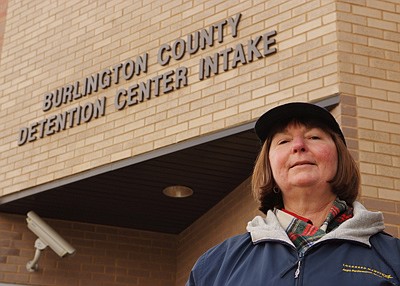
Redder, who coordinates volunteer efforts in Burlington, focuses her efforts on the Burlington County Detention Center. She and other volunteers lead a Quest group every Monday that evolved out of Renew 2000 in her parish. “I petitioned our pastor to do renew at the jail and we’ve never stopped,” she said. “We’ve been doing it for almost 11 years and they love it.
“The warden said it makes a big difference in behavior in the wings. On Saturday nights, there is a Catholic Communion service attended by members of the faith and non-Catholics.
“We average about 65 people a week” said Redder. “They love that it’s on the weekend because they feel that they are really worshipping.”
Another thing “that’s really important to Father Bob is distributing rosaries and (prayer) books to Catholics and non-Catholics alike in the facility,” she said.
Reading materials on spiritual themes are especially popular said Redder who encourages people to make their Catholic periodicals and newspapers available to prison ministers.
“For the majority of people in there, this is a really traumatic experience where they are co-mingled in the population and have no idea of how to fend for themselves,” she said. “It is an experience that can happen to anybody.
“Someone in there may feel like they are drowning but when we come in and reach out to them, pray with them, help them reclaim their confidence and comfort them, well, we become their lifeline.”
Related Stories
Monday, December 15, 2025



E-Editions
Events
Walking with Jesus through the corridors of New Jersey State Prison in Trenton isn’t exactly how a 77-year-old lay eccesial minister from St. Mary Parish, Colts Neck, named John Carlucci envisioned spending his retirement.
He chalks that turn of events up to intervention from above. “It’s like everything else in life. You don’t make the big decisions,” Carlucci said. “A higher power does.”
Carlucci is one of a network of 120 men and women volunteering in prison ministry under the aegis of diocesan Jail and Prison ministries coordinated by Father Robert Schulze.
The members of the volunteer corps devote their time and spiritual energy to sharing the gospel message with inmates of 12 correctional facilities scattered throughout Monmouth, Mercer, Burlington and Ocean counties.
For Carlucci, that means meeting up every Friday morning without fail with his “buddies” – volunteers from a pool of 16 men and women from St. Mary Parish and five from area parishes – who travel weekly to New Jersey’s only maximum security prison in the capital city.
While the overwhelming number of motorists drive past the stark brown structure on the intersection of Route 129 and Cass Street, Carlucci and company turn in and gain entry with the express aim of “providing a presence to our prison brothers and sisters,” including those in solitary confinement who, he says, spend most of every day shut up in “5’-x-8’ cells which may serve as home for 20, 30 or 50 years or for a lifetime.”
“Souls lost in time,” is how he refers to them.
Like everyone else interviewed for this story, he is deeply conscious of the fact that “our volunteer ministers are frequently their only lifeline to the outside world. We speak to them about any subject that comes up, always careful to remind them that they truly are not alone because of God’s indwelling presence…” From 9 a.m. to noon, the group, all extraordinary ministers of Holy Communion, administer the Blessed Sacrament upon request to those in solitary confinement and give common sense, feet-on-theground spiritual counseling.
Each visit will conclude with liturgy sharing in the “chapel” – a room designed to hold about 40 occupants. “Twenty-five inmates usually attend,” he said.
“We finish about 1:30 p.m. when we leave the prison and our brothers in Christ.”
The Making of a Mission
The consistent, careful and prayerful mission of Carlucci and company is a reflection, Father Schulze said, of how the diocese, at the behest of Bishop John M. Smith, carries out Catholic social teaching as it applies to the criminal justice system.
“If you went around the country, you’d find that we are one of the few dioceses with a full-time (coordinator) of prison ministries,” said Father Schulze, who has been in charge of the diocesan office for 13 years.
He brought to the office a wide bank of knowledge on prison ministry accumulated in 30 years of experience including two decades with the federal prison system. He served at institutions in various locations around the country including Ann Arbor, Mich., Otisville, N.Y.; and the Central Office of the Bureau of Federal Prisons and Fort Dix, his last assignment before retiring from the federal system in 1997.
“When Bishop Smith arrived in the diocese as coadjutor in 1996, he said he wanted to set up a prison ministry,” Father Schulze said.
“In his years as Bishop of Pensacola- Tallahassee, Fla. he came to know prison ministry and he came here with a vision to let men and women who are incarcerated know that they are as much a part of the Church community as everyone else.”
The office Father Schulze established in 1997 after his return to the Trenton Diocese reflects that sentiment. It is designed to serve as a resource for parishes and faithful by providing information and ministry opportunities for clergy and laity in corrections institutions in the diocese, which include county jails in Mercer, Monmouth, Ocean and Burlington counties, juvenile facilities and the state prison in Trenton.
The emphasis is on promoting “restorative justice” geared toward healing victims and offenders rather than the current penal law which pits them against each other.
Restorative justice, Father Schulze said, seeks to empower the offender in owning responsibility for the criminal action. This form of justice is regarded as integrated and whole and is based on mercy and love rather than perpetuating the current model of justice as punishment.
The office directs pastoral and sacramental ministry to incarcerated men and women; educates parishioners on the nature of incarceration as well as the needs of prisoners and their families; recruits and trains clergy and lay volunteer ministers such as those from St. Mary Parish, Colts Neck; advocates for the rights of the incarcerated and lobbies with civic and community leaders for a more just and humane correctional punishment.
A Prison Ministry Forum held in St. Anthony of Padua Parish, Hightstown, featuring keynote speakers on topics ranging from re-entry into society to the death penalty to juvenile justice, is an annual mainstay regarded by the volunteers as a key educational and networking opportunity.
Answering the Call
Reaching out for volunteers, like the Colts Neck group, is another key component of the ministry.
Two more who answered the call with dynamic results are John DiStefano and Teresa Redder. Between them, DiStefano and Redder have devoted nearly 40 years to prison ministry.
DiStefano, a reader and extraordinary minister of Holy Communion in St. Aloysius Parish, Jackson, is diocesan Cursillo director. He has been involved in prison ministry for 26 years. Redder, a member of Sacred Heart Parish, Mount Holly, will mark her 12th anniversary of service in May.
Though interviewed separately for this story, Redder and DiStefano sounded the same notes throughout, expressing gratitude for Bishop Smith’s commitment to those in prison. “He is someone who walks the talk,” said DiStefano who recalled how the bishop encouraged him to persevere in prison ministry.
“He told me that (prison ministry) has a very special place in his heart and thanked me for being involved in the ministry all those years,” said DiStefano who served as director of the state’s prison ministries for eight years. DiStefano speaks of his years of service as a “very special time” and recounts that his wife, Rosemarie, and six children became involved as well, playing guitar and singing with him at Sunday Masses for the inmates.
Redder, a senior program manger for Lockeed Martin, and DiStefano talked about statistics that show how important prison ministry is in the lives of the inmate population. DiStefano pointed to national statistics that showed the recidivism rate is 26 percent of all inmates who have been involved in prison ministry and 82 percent for those in the general population who didn’t get involved.
Redder, who coordinates volunteer efforts in Burlington, focuses her efforts on the Burlington County Detention Center. She and other volunteers lead a Quest group every Monday that evolved out of Renew 2000 in her parish. “I petitioned our pastor to do renew at the jail and we’ve never stopped,” she said. “We’ve been doing it for almost 11 years and they love it.
“The warden said it makes a big difference in behavior in the wings. On Saturday nights, there is a Catholic Communion service attended by members of the faith and non-Catholics.
“We average about 65 people a week” said Redder. “They love that it’s on the weekend because they feel that they are really worshipping.”
Another thing “that’s really important to Father Bob is distributing rosaries and (prayer) books to Catholics and non-Catholics alike in the facility,” she said.
Reading materials on spiritual themes are especially popular said Redder who encourages people to make their Catholic periodicals and newspapers available to prison ministers.
“For the majority of people in there, this is a really traumatic experience where they are co-mingled in the population and have no idea of how to fend for themselves,” she said. “It is an experience that can happen to anybody.
“Someone in there may feel like they are drowning but when we come in and reach out to them, pray with them, help them reclaim their confidence and comfort them, well, we become their lifeline.”