


O Sacrament Most Holy': Cathedral community celebrates new placement of tabernacle
July 29, 2019 at 12:37 p.m.
By Mary Stadnyk| Associate Editor
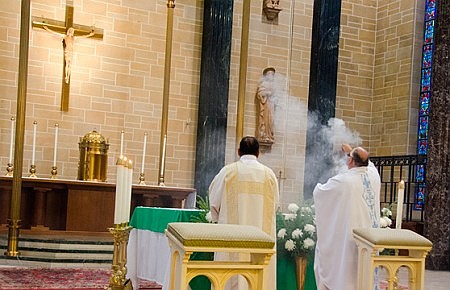
History was made in St. Mary of the Assumption Cathedral, Trenton, Aug. 14, as the Blessed Sacrament was reverently and ceremoniously transferred from a place of temporary repose to the newly installed tabernacle in the center of the spacious sanctuary. Several hundred members of the cathedral parish community gathered to witness the inaugural use of the relocated tabernacle and to celebrate the central place that the Eucharist has in the life of the faithful.
Click Here to See Photo Gallery
Click Here to See Video
Click Here to See Video Gallery
A Eucharistic procession that followed the Vigil Mass for the Feast of the Assumption began at the altar dedicated to the Blessed Mother, located on the left side of the cathedral. The Blessed Sacrament had been reserved there in a temporary tabernacle while the original tabernacle had to be disassembled in order to be moved from where it had been on the cathedral’s right side altar to a place of prominence in the center of the sanctuary below the large crucifix.
Donned in a radiant gold cope, Msgr. Joseph Roldan, cathedral rector, carefully placed a consecrated host in an ornate, gold monstrance which he reverently carried in procession that slowly traveled around the church perimeter. As Msgr. Roldan was joined by other priest concelebrants, deacons and altar servers, one of the cathedral’s choirs, Sembrando Esperanza (Planting of Hope) led in the singing of solemn Eucharistic hymns, while parishioners knelt reverently in their pews and intently watched the Blessed Sacrament pass by.
Once the procession reached the main sanctuary, other litanies were chanted and prayers were recited before Msgr. Roldan, never taking his eyes off the most sacred species, removed the Blessed Sacrament from the monstrance and placed it in the newly located tabernacle. After the Salve Regina, which concluded the Eucharistic procession, the demeanor in the cathedral went from quiet reverence to jubilance as the congregation joined in the singing of a closing hymn of joy. Parishioners were invited to remain in the cathedral afterward to spend quiet, reflective time in prayerful adoration before the Blessed Sacrament.
The relocation of the tabernacle is part of a modest, long-term restoration project that is currently underway in the cathedral. The relocation aimed to help strengthen the prayerful and liturgical experiences of the faithful who visit the cathedral and place greater prominence on the Holy Eucharist, said Msgr. Roldan.
While the first phase of the restoration will be more visual in nature, a number of much-needed improvements to the cathedral’s infrastructure are scheduled to be made in the next few years. Work will be done on the mechanical, electrical and plumbing systems and the roof. Upgrades to the restrooms and dining hall, which are beneath the cathedral, are expected to take place in the current year and there is also a plan to install an elevator to the lower level farther out in the future.
Msgr. Roldan explained that moving the tabernacle to the center of the sanctuary is in keeping with Sacrosanctum Caritatis (Sacrament of Charity), the Vatican document written by Pope Benedict XVI, which “calls for the tabernacle to be placed in the center of the sanctuary where it can be seen by all.” (To read more about the placement of the tabernacle, click on www.TrentonMonitor.com.) He also noted that when the current cathedral was built in 1959, the tabernacle sat on a high altar in the center of the sanctuary. However, in the late 1960s, following the Second Vatican Council, the sanctuary underwent renovations and the tabernacle was placed at the side altar which used to be an altar dedicated to St. Joseph. With the current restoration, the side altar is once again dedicated to St. Joseph and the tabernacle “now sits in its rightful place of honor,” said Msgr. Roldan.
The tabernacle, Msgr. Roldan said, has been part of the cathedral patrimony since 1959. Made of hand wrought and cast bronze, its doors are decorated with appropriate symbols including wheat and grapes, which, from early Christian times, were a mystical representation of the Sacrament of Holy Eucharist. Toward the top of the tabernacle is the inscription, “Sanctus,” the Latin word meaning “holy.”
The inner steel safe of the tabernacle is lined with gold plated bronze, while the veils are made of silk damask.
Before the tabernacle was moved, preliminary work had to be done on the sanctuary floor and new platforms had to be created. Other changes included a new altar table built where the tabernacle now sits and extending the altar of sacrifice from a 4’x4’ square structure to an 8’x4’ rectangular structure.
The bishop’s cathedra (chair), which had also been in the middle of the sanctuary, directly behind the altar of sacrifice since the 1960s, has been moved to the front left side of the sanctuary.
“This now brings the bishop closer to the people,” said Msgr. Roldan, noting that the cathedra is now placed directly below the stained glass window depicting the Rite of Ordination.
There is also more room in the sanctuary to accommodate the priests during major diocesan celebrations such as the Chrism Masses and ordination Masses of priests and deacons.
Placing the tabernacle in the center of the sanctuary places greater prominence on the Holy Eucharist, Msgr. Roldan said reflectively. “And with the changes that we are making to the cathedral, we are restoring the cathedral to its original beauty.”
Related Stories
Monday, December 15, 2025


E-Editions
Events
By Mary Stadnyk| Associate Editor
History was made in St. Mary of the Assumption Cathedral, Trenton, Aug. 14, as the Blessed Sacrament was reverently and ceremoniously transferred from a place of temporary repose to the newly installed tabernacle in the center of the spacious sanctuary. Several hundred members of the cathedral parish community gathered to witness the inaugural use of the relocated tabernacle and to celebrate the central place that the Eucharist has in the life of the faithful.
Click Here to See Photo Gallery
Click Here to See Video
Click Here to See Video Gallery
A Eucharistic procession that followed the Vigil Mass for the Feast of the Assumption began at the altar dedicated to the Blessed Mother, located on the left side of the cathedral. The Blessed Sacrament had been reserved there in a temporary tabernacle while the original tabernacle had to be disassembled in order to be moved from where it had been on the cathedral’s right side altar to a place of prominence in the center of the sanctuary below the large crucifix.
Donned in a radiant gold cope, Msgr. Joseph Roldan, cathedral rector, carefully placed a consecrated host in an ornate, gold monstrance which he reverently carried in procession that slowly traveled around the church perimeter. As Msgr. Roldan was joined by other priest concelebrants, deacons and altar servers, one of the cathedral’s choirs, Sembrando Esperanza (Planting of Hope) led in the singing of solemn Eucharistic hymns, while parishioners knelt reverently in their pews and intently watched the Blessed Sacrament pass by.
Once the procession reached the main sanctuary, other litanies were chanted and prayers were recited before Msgr. Roldan, never taking his eyes off the most sacred species, removed the Blessed Sacrament from the monstrance and placed it in the newly located tabernacle. After the Salve Regina, which concluded the Eucharistic procession, the demeanor in the cathedral went from quiet reverence to jubilance as the congregation joined in the singing of a closing hymn of joy. Parishioners were invited to remain in the cathedral afterward to spend quiet, reflective time in prayerful adoration before the Blessed Sacrament.
The relocation of the tabernacle is part of a modest, long-term restoration project that is currently underway in the cathedral. The relocation aimed to help strengthen the prayerful and liturgical experiences of the faithful who visit the cathedral and place greater prominence on the Holy Eucharist, said Msgr. Roldan.
While the first phase of the restoration will be more visual in nature, a number of much-needed improvements to the cathedral’s infrastructure are scheduled to be made in the next few years. Work will be done on the mechanical, electrical and plumbing systems and the roof. Upgrades to the restrooms and dining hall, which are beneath the cathedral, are expected to take place in the current year and there is also a plan to install an elevator to the lower level farther out in the future.
Msgr. Roldan explained that moving the tabernacle to the center of the sanctuary is in keeping with Sacrosanctum Caritatis (Sacrament of Charity), the Vatican document written by Pope Benedict XVI, which “calls for the tabernacle to be placed in the center of the sanctuary where it can be seen by all.” (To read more about the placement of the tabernacle, click on www.TrentonMonitor.com.) He also noted that when the current cathedral was built in 1959, the tabernacle sat on a high altar in the center of the sanctuary. However, in the late 1960s, following the Second Vatican Council, the sanctuary underwent renovations and the tabernacle was placed at the side altar which used to be an altar dedicated to St. Joseph. With the current restoration, the side altar is once again dedicated to St. Joseph and the tabernacle “now sits in its rightful place of honor,” said Msgr. Roldan.
The tabernacle, Msgr. Roldan said, has been part of the cathedral patrimony since 1959. Made of hand wrought and cast bronze, its doors are decorated with appropriate symbols including wheat and grapes, which, from early Christian times, were a mystical representation of the Sacrament of Holy Eucharist. Toward the top of the tabernacle is the inscription, “Sanctus,” the Latin word meaning “holy.”
The inner steel safe of the tabernacle is lined with gold plated bronze, while the veils are made of silk damask.
Before the tabernacle was moved, preliminary work had to be done on the sanctuary floor and new platforms had to be created. Other changes included a new altar table built where the tabernacle now sits and extending the altar of sacrifice from a 4’x4’ square structure to an 8’x4’ rectangular structure.
The bishop’s cathedra (chair), which had also been in the middle of the sanctuary, directly behind the altar of sacrifice since the 1960s, has been moved to the front left side of the sanctuary.
“This now brings the bishop closer to the people,” said Msgr. Roldan, noting that the cathedra is now placed directly below the stained glass window depicting the Rite of Ordination.
There is also more room in the sanctuary to accommodate the priests during major diocesan celebrations such as the Chrism Masses and ordination Masses of priests and deacons.
Placing the tabernacle in the center of the sanctuary places greater prominence on the Holy Eucharist, Msgr. Roldan said reflectively. “And with the changes that we are making to the cathedral, we are restoring the cathedral to its original beauty.”