


Mitch Albom's new book recounts uplifting spiritual journey
July 29, 2019 at 12:37 p.m.
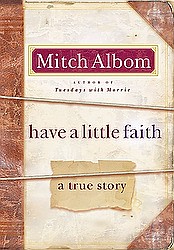
"Have a Little Faith: A True Story" by Mitch Albom
Hyperion (New York, 2009). 249 pp., $23.99.
The young Mitch Albom, raised and bar-mitzvahed in a conservative synagogue in New Jersey, ran from his rabbi - he feared that the "man of God" would condemn him for his sins. Albom kept running through college and the early stages of his successful sportswriting career anchored in Detroit until the 82-year-old rabbi collared him one day with the request to give his eulogy.
Uncertain how to say no to a man of God, Albom agreed. That set him on a course of getting to know his subject, Albert Lewis. The relationship they developed over eight years, a sort of spiritual apprenticeship, forms the basis of "Have a Little Faith: A True Story."
Albom has written two best-selling novels since "Tuesdays With Morrie," the 1997 best-selling memoir of all time which chronicled the author's weekly visits with Morrie Schwartz, an elderly professor dying of amyotrophic lateral sclerosis, or ALS. Those Tuesdays inspired Albom to reorder his priorities.
In "Have a Little Faith," Albom's first memoir and sequel to "Tuesdays," he tries to square the rabbi's ancient faith with his Blackberry world. He gently grills Rabbi Lewis on suffering, free will, death, i.e., the questions that religion has confronted since the creation. The better he gets to know Rabbi Lewis, the more attracted Albom is to his worldview and, along with it, his faith.
Albom weaves in a parallel narrative, that of his relationship with the Rev. Henry Covington, pastor of a struggling inner-city church in Detroit. Albom meets Rev. Covington on a mission to find recipients for aid from the homeless charity the author founded. He admits his initial suspicion about Rev. Covington, a recovering addict and ex-con whose life turned on a prayer said while clutching a rifle behind trash cans in an alleyway and waiting for the killers who never came. The stories parishioners tell him of the pastor's humility, generosity and charity make Albom a believer in the sincerity of Rev. Covington's conversion -- and the inherent goodness latent in all people.
On repeated visits to the tattered shell of Rev. Covington's church, Albom has an epiphany about a Christian black man he initially thought was different from him in just about every way imaginable: "I am neither better nor smarter, only maybe luckier. And I should be ashamed of scoffing, ashamed of thinking I know it all, because you can know the whole world and still feel lost in it. So many people are in pain. And those who mock faith don't appear to be any happier. So maybe instead of looking down on things, we should be looking up. Because underneath our egos and our attitudes, we all share this: a deep yearning for comfort, and the dream of a peaceful heart."
While Rev. Covington helps Albom find the humility in his humanity, Rabbi Lewis leads him to contemplate the divine with his joyful approach to life and serene acceptance of death. By the end of the book, the reader feels Albom's affection for both of them to the depth that the author does. The change in Albom's feelings toward the two men is analogous to the change in his thoughts about religion.
Accompanying the author in his interactions with these two men of different faiths yet common good works, the reader can't help but put the book down feeling uplifted.
Rosengren is an award-winning journalist and the author of six books, including the short story collection "Life Is Just a Party: Portrait of a Teenage Partier" and, most recently, "Hammerin' Hank, George Almighty and the Say Hey Kid: The Year That Changed Baseball Forever."
[[In-content Ad]]Related Stories
Monday, December 15, 2025



E-Editions
Events
"Have a Little Faith: A True Story" by Mitch Albom
Hyperion (New York, 2009). 249 pp., $23.99.
The young Mitch Albom, raised and bar-mitzvahed in a conservative synagogue in New Jersey, ran from his rabbi - he feared that the "man of God" would condemn him for his sins. Albom kept running through college and the early stages of his successful sportswriting career anchored in Detroit until the 82-year-old rabbi collared him one day with the request to give his eulogy.
Uncertain how to say no to a man of God, Albom agreed. That set him on a course of getting to know his subject, Albert Lewis. The relationship they developed over eight years, a sort of spiritual apprenticeship, forms the basis of "Have a Little Faith: A True Story."
Albom has written two best-selling novels since "Tuesdays With Morrie," the 1997 best-selling memoir of all time which chronicled the author's weekly visits with Morrie Schwartz, an elderly professor dying of amyotrophic lateral sclerosis, or ALS. Those Tuesdays inspired Albom to reorder his priorities.
In "Have a Little Faith," Albom's first memoir and sequel to "Tuesdays," he tries to square the rabbi's ancient faith with his Blackberry world. He gently grills Rabbi Lewis on suffering, free will, death, i.e., the questions that religion has confronted since the creation. The better he gets to know Rabbi Lewis, the more attracted Albom is to his worldview and, along with it, his faith.
Albom weaves in a parallel narrative, that of his relationship with the Rev. Henry Covington, pastor of a struggling inner-city church in Detroit. Albom meets Rev. Covington on a mission to find recipients for aid from the homeless charity the author founded. He admits his initial suspicion about Rev. Covington, a recovering addict and ex-con whose life turned on a prayer said while clutching a rifle behind trash cans in an alleyway and waiting for the killers who never came. The stories parishioners tell him of the pastor's humility, generosity and charity make Albom a believer in the sincerity of Rev. Covington's conversion -- and the inherent goodness latent in all people.
On repeated visits to the tattered shell of Rev. Covington's church, Albom has an epiphany about a Christian black man he initially thought was different from him in just about every way imaginable: "I am neither better nor smarter, only maybe luckier. And I should be ashamed of scoffing, ashamed of thinking I know it all, because you can know the whole world and still feel lost in it. So many people are in pain. And those who mock faith don't appear to be any happier. So maybe instead of looking down on things, we should be looking up. Because underneath our egos and our attitudes, we all share this: a deep yearning for comfort, and the dream of a peaceful heart."
While Rev. Covington helps Albom find the humility in his humanity, Rabbi Lewis leads him to contemplate the divine with his joyful approach to life and serene acceptance of death. By the end of the book, the reader feels Albom's affection for both of them to the depth that the author does. The change in Albom's feelings toward the two men is analogous to the change in his thoughts about religion.
Accompanying the author in his interactions with these two men of different faiths yet common good works, the reader can't help but put the book down feeling uplifted.
Rosengren is an award-winning journalist and the author of six books, including the short story collection "Life Is Just a Party: Portrait of a Teenage Partier" and, most recently, "Hammerin' Hank, George Almighty and the Say Hey Kid: The Year That Changed Baseball Forever."
[[In-content Ad]]