


Follow the star to Newark and Pennsylvania
July 29, 2019 at 12:37 p.m.
By Lois Rogers | Features Editor
Throughout December and well into January, faithful can follow in the footsteps of the three wise men by traveling to unforgettable nativity exhibits depicting the birth of Jesus.
In this instance, the journey leads pilgrims not to Bethlehem but to Paradise – that’s Paradise, Pa. – in Amish country where the national Christmas Center is located as well as a castle in another Pennsylvania town, Bryn Athyn, and St. Lucy’s Church, a hub of Catholic devotion in the heart of Newark for well over 100 years.
At all three locations those in search of artistic representations of the Incarnation will find them as surely as the Magi found the babe in the manger more than 2,000 years ago.
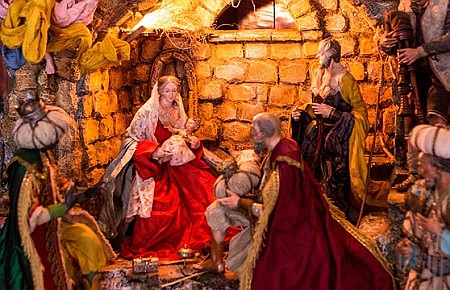
The National Christmas Center and Glencairn Museum both display a breathtaking world view of the birth of Christ that spans the centuries and the globe while St. Lucy’s Church invites visitors to experience the parish’s 100-year-old vision of the traditional Neapolitan presepio or village manger scene that stands 15 feet high and 30 feet wide.
Star of Wonder
Jim Morrison, curator of the National Christmas Center, which he founded in 1998, says though the road trip for most people living in the Trenton Diocese is only about an hour and a half long, those making the journey should be prepared to “arrive in another world.”
“People are amazed, sometimes speechless when they see the exhibit,” Morrison said. Though the National Christmas Center is composed of 15 main galleries that span over 20,000-square-feet and display everything from a recreated Woolworth & Company store at Christmas to Santa’s workshop and a Dutch depiction of Sinter Klaus, it’s the collection of 150 nativities on display from all over the world that most visitors of all ages site as their favorite part of the tour.
“I ask the children when they come out what they like the best,” Morrison said. “Eighty to 85 percent say it’s the baby Jesus. That just blows me away!”
Morrison said creating the center as a way to “preserve the real meaning of Christmas,” has been his aim for years. “I bought the building and then added exhibit after exhibit.” The birth of Jesus, he says is the heart of the center.
“If it wasn’t for the birth, there wouldn’t have been a Resurrection. It touches people so much to see the nativities.”
The collection he has amassed spans the globe. He believes almost every country in the world is represented.
“There are many from nativities from Africa, Russia, Laos and Haiti. There are wonderful figures from Austria and a metal nativity from New York State that was found in a scrap yard.”
German and Italian nativities appear as does the traditional Moravian depiction of a creche known as a Christmas putz – from the German word putzen which means to decorate a home or church. Traditionally, he said, the putz tells the story of the birth of Jesus according to Luke. “The Annunciation and the Visitation are included,” he said. “There are hosts of angels and it ends with the flight into Egypt.”
For more information on the National Christmas Center, call 717-442-7950 or go to http://www.nationalchristmascenter.com/
A World View
In Glencairn Museum, a Romanesque-style castle which houses a world renowned collection of religious art, visitors can follow the star at the “World Nativities” exhibit which, like the National Christmas Center’s presentation, features dozens of crèches revealing how Christians around the world adapted the Nativity scene to reflect their own national, regional and local cultures.
In this fourth annual, family friendly exhibition, visitors can linger over nativity scenes featuring indigenous materials and regionally distinctive clothing and representations of animals and structures from the museum’s extensive collection of nativity art dating from medieval times to the early 20th century said Joralyn Echols, Glencairn’s outreach and public relations coordinator.
Among the new and notable works on view in the museum, Echols said, are three painted terracotta nativities from Estremoz, Portugal – one each from the 19th, 20th, and 21st centuries representing a continuous cultural tradition.
Other crèches have come from European countries traditionally associated with them including Germany, Italy, Poland and Latin America but many among the hundreds on view were crafted in nations not typically associated with the devotional form such as Tanzania and Camaroon, Echols said.
For more information on the Glencarin Musem, call 267-502-2993 or go to www.glencairnmuseum.org
Objects of Devotion
More than 100 years have passed since Louis Penza, an immigrant from Atripalda, Italy began the tradition of constructing a presepio or manger scene in St. Lucy Church located in the heart of the Newark’s Old First Ward.
The tradition continues still, attracting thousands of visitors annually to the church, once the hub of Italian life in north Newark and still a gathering place for Newark’s Italian diaspora.
Omar Navarro, parish director of religious education, expects about 5,000 faithful will come to the presepio which officially goes on view Dec. 13, the feast day of St. Lucy, the parish’s name saint and is usually extended past Epiphany until early in February, Navarro said.
Though intended for devotion from Advent through Epiphany, the consensus is that it is “so beautiful and so many people want to come and see it, it would be a shame to have it up for only a few weeks,” Navarro said.
The display began with just a handful of figures and soon expanded to more than 100 made from terra cotta and cloth that were hand crafted in Naples. Some of those original figures still exist today, Navarro said, and can be spotted among scores of later additions to the scene.
The three dimensional scene depicting an Italian mountainside village covers one wall of the chapel of St. Gerard in the neo-Renaissance church which is on the state and national registers of historic sites and worth a visit any time of year.
Behind the manger, and rising near to the ceiling, the vista is of an old world mountain community complete with cottages, shops, tree-lined cliffs, a waterfall and villagers bearing gifts along roads leading downhill to the crib of the newborn Christ child.
Navarro said the presepio is always wonderful to look at but even better after 6 p.m. when the lights in the mountain village come on.
For more information on St. Lucy’s Church and the presepio call 973-482-6663 or go to saintlucy.net
[[In-content Ad]]Related Stories
Monday, December 15, 2025



E-Editions
Events
By Lois Rogers | Features Editor
Throughout December and well into January, faithful can follow in the footsteps of the three wise men by traveling to unforgettable nativity exhibits depicting the birth of Jesus.
In this instance, the journey leads pilgrims not to Bethlehem but to Paradise – that’s Paradise, Pa. – in Amish country where the national Christmas Center is located as well as a castle in another Pennsylvania town, Bryn Athyn, and St. Lucy’s Church, a hub of Catholic devotion in the heart of Newark for well over 100 years.
At all three locations those in search of artistic representations of the Incarnation will find them as surely as the Magi found the babe in the manger more than 2,000 years ago.
The National Christmas Center and Glencairn Museum both display a breathtaking world view of the birth of Christ that spans the centuries and the globe while St. Lucy’s Church invites visitors to experience the parish’s 100-year-old vision of the traditional Neapolitan presepio or village manger scene that stands 15 feet high and 30 feet wide.
Star of Wonder
Jim Morrison, curator of the National Christmas Center, which he founded in 1998, says though the road trip for most people living in the Trenton Diocese is only about an hour and a half long, those making the journey should be prepared to “arrive in another world.”
“People are amazed, sometimes speechless when they see the exhibit,” Morrison said. Though the National Christmas Center is composed of 15 main galleries that span over 20,000-square-feet and display everything from a recreated Woolworth & Company store at Christmas to Santa’s workshop and a Dutch depiction of Sinter Klaus, it’s the collection of 150 nativities on display from all over the world that most visitors of all ages site as their favorite part of the tour.
“I ask the children when they come out what they like the best,” Morrison said. “Eighty to 85 percent say it’s the baby Jesus. That just blows me away!”
Morrison said creating the center as a way to “preserve the real meaning of Christmas,” has been his aim for years. “I bought the building and then added exhibit after exhibit.” The birth of Jesus, he says is the heart of the center.
“If it wasn’t for the birth, there wouldn’t have been a Resurrection. It touches people so much to see the nativities.”
The collection he has amassed spans the globe. He believes almost every country in the world is represented.
“There are many from nativities from Africa, Russia, Laos and Haiti. There are wonderful figures from Austria and a metal nativity from New York State that was found in a scrap yard.”
German and Italian nativities appear as does the traditional Moravian depiction of a creche known as a Christmas putz – from the German word putzen which means to decorate a home or church. Traditionally, he said, the putz tells the story of the birth of Jesus according to Luke. “The Annunciation and the Visitation are included,” he said. “There are hosts of angels and it ends with the flight into Egypt.”
For more information on the National Christmas Center, call 717-442-7950 or go to http://www.nationalchristmascenter.com/
A World View
In Glencairn Museum, a Romanesque-style castle which houses a world renowned collection of religious art, visitors can follow the star at the “World Nativities” exhibit which, like the National Christmas Center’s presentation, features dozens of crèches revealing how Christians around the world adapted the Nativity scene to reflect their own national, regional and local cultures.
In this fourth annual, family friendly exhibition, visitors can linger over nativity scenes featuring indigenous materials and regionally distinctive clothing and representations of animals and structures from the museum’s extensive collection of nativity art dating from medieval times to the early 20th century said Joralyn Echols, Glencairn’s outreach and public relations coordinator.
Among the new and notable works on view in the museum, Echols said, are three painted terracotta nativities from Estremoz, Portugal – one each from the 19th, 20th, and 21st centuries representing a continuous cultural tradition.
Other crèches have come from European countries traditionally associated with them including Germany, Italy, Poland and Latin America but many among the hundreds on view were crafted in nations not typically associated with the devotional form such as Tanzania and Camaroon, Echols said.
For more information on the Glencarin Musem, call 267-502-2993 or go to www.glencairnmuseum.org
Objects of Devotion
More than 100 years have passed since Louis Penza, an immigrant from Atripalda, Italy began the tradition of constructing a presepio or manger scene in St. Lucy Church located in the heart of the Newark’s Old First Ward.
The tradition continues still, attracting thousands of visitors annually to the church, once the hub of Italian life in north Newark and still a gathering place for Newark’s Italian diaspora.
Omar Navarro, parish director of religious education, expects about 5,000 faithful will come to the presepio which officially goes on view Dec. 13, the feast day of St. Lucy, the parish’s name saint and is usually extended past Epiphany until early in February, Navarro said.
Though intended for devotion from Advent through Epiphany, the consensus is that it is “so beautiful and so many people want to come and see it, it would be a shame to have it up for only a few weeks,” Navarro said.
The display began with just a handful of figures and soon expanded to more than 100 made from terra cotta and cloth that were hand crafted in Naples. Some of those original figures still exist today, Navarro said, and can be spotted among scores of later additions to the scene.
The three dimensional scene depicting an Italian mountainside village covers one wall of the chapel of St. Gerard in the neo-Renaissance church which is on the state and national registers of historic sites and worth a visit any time of year.
Behind the manger, and rising near to the ceiling, the vista is of an old world mountain community complete with cottages, shops, tree-lined cliffs, a waterfall and villagers bearing gifts along roads leading downhill to the crib of the newborn Christ child.
Navarro said the presepio is always wonderful to look at but even better after 6 p.m. when the lights in the mountain village come on.
For more information on St. Lucy’s Church and the presepio call 973-482-6663 or go to saintlucy.net
[[In-content Ad]]