


FAITH ALIVE: Viewing leadership in action
July 29, 2019 at 12:37 p.m.
By David Gibson| Catholic News Service
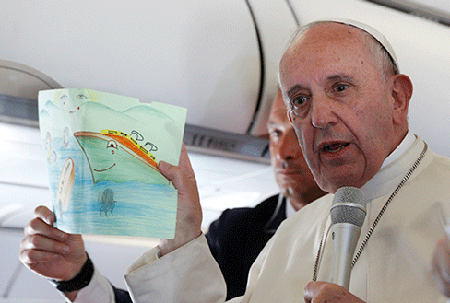
"Look at this one!"
During an in-flight press conference while returning to Rome after a one-day, April 2016 visit to the Moria refugee camp on the Greek isle of Lesbos in the Aegean Sea, Pope Francis held up a picture for all to see, drawn by a child of the camp.
"The sun is watching and weeping" in the drawing. Yet, "if the sun is able to weep, so can we," the Pope commented. "A tear would do us good."
The visit to Moria "brought tears," he said. For the camp's refugees, the future appeared grim. They came on unsafe boats from the Turkish coast. Not all attempting the passage arrived; many children and others drowned.
"They died at sea, victims of unsafe and inhumane means of transport, prey to unscrupulous thugs," Pope Francis lamented during a prayer service with Orthodox leaders on Lesbos.
"I want to tell you that you are not alone," he had told refugees that day; most came from Syria, Iraq and Afghanistan. "Many of you felt forced to flee situations of conflict and persecution for the sake, above all, of your children," he acknowledged.
Pope Francis, like most leaders, communicates through words. Yet, when his story is told in the distant future, it also will be a story about actions that lend credibility to words – a story about closeness to people.
Often his words and actions reflect the Second Vatican Council's 1965 Decree on the Pastoral Office of Bishops. It described "good shepherds" as leaders "who know their sheep and whose sheep know them" (No. 16).
Pope Francis announced en route to Lesbos, "We are going to, and we will see, so many who are suffering, who do not know where to go, who had to flee. We will also go to a cemetery: the sea."
His message on the island was that "the greatest gift we can offer one another is love: a merciful look, a readiness to listen and understand, a word of encouragement, a prayer."
Pope Francis, joined by Orthodox Ecumenical Patriarch Bartholomew of Constantinople and Greek Orthodox Archbishop Ieronymos II of Athens, ate lunch with eight refugees that day, wanting to listen to their stories.
This Pope, after all, in his pontificate's first year, called listening an "art" that "makes possible that closeness without which genuine spiritual encounter cannot occur." Listening "helps us to find the right gesture and word that show we are more than simply bystanders" ("The Joy of the Gospel," No. 171).
After lunch, he and the Orthodox Church leaders went to Lesbos' main port. Tossing floral wreaths into the sea, they commemorated the many whose journey ended in drowning.
"You know the pain of having left behind everything dear to you and – what is perhaps most difficult – not knowing what the future will bring," the Pope said in the Moria camp.
He and the Orthodox Church leaders hoped the world might respond to the refugees' plight "in a way worthy of our common humanity."
The Pope and Orthodox Church leaders viewed their Lesbos visit as a way to serve refugees and defend their human rights. "Service overcomes that dense pall of indifference that clouds hearts and minds," the Pope observed on the island.
Astonishingly, at day's end 12 Syrian refugees – three Syrian Muslim couples and their children – boarded Pope Francis' flight to Rome. Everything finally was in order for bringing them to Rome, the Vatican revealed at the last minute.
They would be welcomed and provided for by the Vatican and the Sant'Egidio lay Catholic community, which ranks care for suffering people among its foremost purposes.
Did this welcoming, compassionate gesture represent more than a drop in the bucket of an immense, pressing call to serve others? Pope Francis addressed the question during his flight home.
The same question was asked of St. Teresa of Kolkata, he recalled. Wasn't what she was doing useless, since "the sea is so great”? Pope Francis said she responded:
"It is a drop of water in the sea! But after this drop of water the sea will not be the same!"
Gibson served on Catholic News Service's editorial staff for 37 years.
[[In-content Ad]]Related Stories
Monday, December 15, 2025

E-Editions
Events
By David Gibson| Catholic News Service
"Look at this one!"
During an in-flight press conference while returning to Rome after a one-day, April 2016 visit to the Moria refugee camp on the Greek isle of Lesbos in the Aegean Sea, Pope Francis held up a picture for all to see, drawn by a child of the camp.
"The sun is watching and weeping" in the drawing. Yet, "if the sun is able to weep, so can we," the Pope commented. "A tear would do us good."
The visit to Moria "brought tears," he said. For the camp's refugees, the future appeared grim. They came on unsafe boats from the Turkish coast. Not all attempting the passage arrived; many children and others drowned.
"They died at sea, victims of unsafe and inhumane means of transport, prey to unscrupulous thugs," Pope Francis lamented during a prayer service with Orthodox leaders on Lesbos.
"I want to tell you that you are not alone," he had told refugees that day; most came from Syria, Iraq and Afghanistan. "Many of you felt forced to flee situations of conflict and persecution for the sake, above all, of your children," he acknowledged.
Pope Francis, like most leaders, communicates through words. Yet, when his story is told in the distant future, it also will be a story about actions that lend credibility to words – a story about closeness to people.
Often his words and actions reflect the Second Vatican Council's 1965 Decree on the Pastoral Office of Bishops. It described "good shepherds" as leaders "who know their sheep and whose sheep know them" (No. 16).
Pope Francis announced en route to Lesbos, "We are going to, and we will see, so many who are suffering, who do not know where to go, who had to flee. We will also go to a cemetery: the sea."
His message on the island was that "the greatest gift we can offer one another is love: a merciful look, a readiness to listen and understand, a word of encouragement, a prayer."
Pope Francis, joined by Orthodox Ecumenical Patriarch Bartholomew of Constantinople and Greek Orthodox Archbishop Ieronymos II of Athens, ate lunch with eight refugees that day, wanting to listen to their stories.
This Pope, after all, in his pontificate's first year, called listening an "art" that "makes possible that closeness without which genuine spiritual encounter cannot occur." Listening "helps us to find the right gesture and word that show we are more than simply bystanders" ("The Joy of the Gospel," No. 171).
After lunch, he and the Orthodox Church leaders went to Lesbos' main port. Tossing floral wreaths into the sea, they commemorated the many whose journey ended in drowning.
"You know the pain of having left behind everything dear to you and – what is perhaps most difficult – not knowing what the future will bring," the Pope said in the Moria camp.
He and the Orthodox Church leaders hoped the world might respond to the refugees' plight "in a way worthy of our common humanity."
The Pope and Orthodox Church leaders viewed their Lesbos visit as a way to serve refugees and defend their human rights. "Service overcomes that dense pall of indifference that clouds hearts and minds," the Pope observed on the island.
Astonishingly, at day's end 12 Syrian refugees – three Syrian Muslim couples and their children – boarded Pope Francis' flight to Rome. Everything finally was in order for bringing them to Rome, the Vatican revealed at the last minute.
They would be welcomed and provided for by the Vatican and the Sant'Egidio lay Catholic community, which ranks care for suffering people among its foremost purposes.
Did this welcoming, compassionate gesture represent more than a drop in the bucket of an immense, pressing call to serve others? Pope Francis addressed the question during his flight home.
The same question was asked of St. Teresa of Kolkata, he recalled. Wasn't what she was doing useless, since "the sea is so great”? Pope Francis said she responded:
"It is a drop of water in the sea! But after this drop of water the sea will not be the same!"
Gibson served on Catholic News Service's editorial staff for 37 years.
[[In-content Ad]]