


FAITH ALIVE: Thirsting for water in the Year of Mercy
July 29, 2019 at 12:37 p.m.
By David Gibson | Catholic News Service
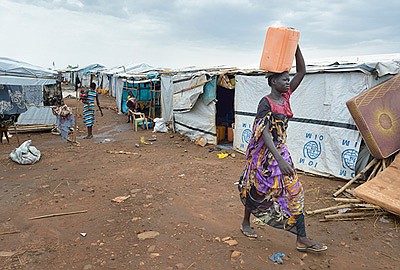
Countless sad stories can be told about the great numbers of people in large parts of the contemporary world who thirst anxiously for safe water to drink.
In other parts of the world where a decent supply of drinking water is taken almost for granted, it can be hard to fathom these stories. Is there still a need for the corporal work of mercy that calls for giving drink to the thirsty? Really?
The truth about the thirst for water in the 21st century strikes a sensitive nerve in the Christian community, where tradition honors water as a powerful sign of goodness and life.
It always is remembered among Christians that Jesus asked the woman at the well in Samaria to give him a drink and proceeded to tell her that whoever "drinks the water I shall give will never thirst" again (Jn. 4:7; 14).
Water is a life-giving force. The water of baptism stands as a dynamic sign for Christians that Christ is a giver of life. Through baptism, his people are joined to his body in life-giving ways meant to influence the entire course both of their physical and spiritual existence in this world.
But the water of baptism is more than a sign of new life for baptized individuals. It confers a mandate on them to become life-givers themselves.
The simple fact is that no one lives, grows or thrives without water. So the profound thirst today for healthful water to drink is a confounding reality.
It delivers the message that even in these times of stunning advancements in technology, communications, education and medicine, the corporal works of mercy cannot be set aside.
No, the thirst for water is not obsolete or even rare today, Pope Francis attests in "Laudato Si'," his 2015 encyclical on the environment. Giving care to the planet and to the poor requires that close attention be paid to the state of the world's drinking water, he suggests (in Nos. 27-31).
A response of some kind to the contemporary thirst for water is, moreover, not out of reach for those like me who, in our daily comings and goings, tend never to be approached by someone requesting a glass or bottle of water.
I admit that grandchildren of mine often declare their great thirst in dramatic terms. What they really want is a soda or, more rarely, a bottle of juice. Their thirst is not the kind born of wrenching poverty.
But the encyclical turns our attention to the thirst of people living in profound poverty. "Our world has a grave social debt toward the poor who lack access to drinking water, because they are denied the right to a life consistent with their inalienable dignity," the pope writes.
It is a debt, he adds, that "can be paid partly by an increase in funding to provide clean water and sanitary services among the poor."
The pope notes that "water poverty especially affects Africa where large sectors of the population have no access to safe drinking water or experience droughts which impede agricultural production."
"Unsafe water" leads on a continual basis to "deaths and the spread of water-related diseases," he points out. "Dysentery and cholera, linked to inadequate hygiene and water supplies, are a significant cause of suffering and of infant mortality."
He calls attention to the pollution of underground water reserves caused "by certain mining, farming and industrial activities, especially in countries lacking adequate regulation or controls."
The encyclical regards "access to safe, drinkable water" as a "basic and universal human right." Pope Francis affirms that water is "essential to human survival," which means it also "is a condition for the exercise of other human rights."
But life's sad reality for people who lack access to safe water means that many also lack the chance to enjoy the benefits of other human rights -- pursuing an education, for example, or looking with hope to the future. Too often the present, desperate moment consumes them.
So thirst is a form of slavery that confines and diminishes human persons. The cry of thirsty people is a cry for life. It starts as a cry for survival.
When people lack water or can gain access only to tainted water, they grow weak. Sickness overtakes them, and many will die.
The church's current Year of Mercy is, then, an opportunity to become aware of all that blocks human access to water and of all the ways individuals, communities, international organizations and governments might respond to the facts on human thirst.
Water in the Christian vision is a sign of new life. The hope of the Year of Mercy, then, is that in relieving people of their thirst for water, they will be freed to thirst for a new, more rewarding way of life.
In Judeo-Christian history, one goal of a jubilee year is to proclaim liberty to captives. Bearing that in mind, I conclude with a probing question: What does giving drink to the thirsty imply in this Year of Mercy?
Gibson served on Catholic News Service's editorial staff for 37 years.
Putting the works of mercy to work -- on the freeway
By Mike Nelson | Catholic News Service
I was stopped at a red light, waiting to enter a freeway in downtown Los Angeles. A homeless man stood nearby, his hands holding a cardboard sign: "Please help, and God bless you."
I looked at the passenger seat and saw that my lunch -- peanut butter sandwich, cookie and apple -- sat nesting in its brown paper bag. "Why not?" I thought. I rolled down the window and handed it to the man as I drove slowly past. "For you," I said. He nodded in thanks as I drove up the ramp and entered the freeway.
Nice gesture, right? Except that there was nothing to drink in my bag, and a peanut butter sandwich in the middle of a 90-degree day needs some liquid to go with it, right? I sighed and prayed that someone else would hand the man a bottle of water.
Giving drink to the thirsty is one of the corporal works of mercy that our church teaches us to practice. It is rooted in Jesus' words to his disciples in Matthew 25:35: "I was thirsty and you gave me drink."
I recall well that teaching from my Lutheran Sunday school. I was maybe 7 or 8 years old, and our lesson addressed specific ways that we can be kind to one another (the core of Jesus' teaching). One of the suggestions: "Offer the mailman a cool drink on a hot day."
Several years later, there came a hot summer's day when my parents hired a couple of guys to do some outside repair work on our home. In hindsight, I am sure they came prepared with a thermos full of water. But all I knew then was that these guys were working very hard, and it was hot.
So I filled two glasses with ice water and brought them outside. "Would you like some water?" I asked. They looked up from their work, smiled and said, "Sure, son. Thanks." They took a drink and went back to work.
I hold onto that memory in part because I've not, in all honesty, done as many "works of mercy" as I should. As least, not in the literal sense. But it occurs to me that we can take "giving drink to the thirsty" to mean something more.
I think of the Samaritan woman at the well (in Jn 4: 7) in which Jesus tells the woman, "Give me a drink." The incident takes place at noon, in all probability, on a brutally hot day, when the "less desirables" of the community (like Samaritan women who have had five husbands) -- are most likely to approach the well, lest they be ridiculed by the more "respectable" members of the community. But in this case, not only is a man speaking to a woman, and a Jew to a Samaritan no less, but he is asking her for a drink of water.
The woman's immediate puzzlement turns to amazement when Jesus suggests he can offer her "living water." Of course she wants to know what that is, and how she can get it. But as their conversation continues, her amazement turns to astonishment at Jesus' knowledge of her life. Before long she is convinced that she has, indeed, seen and spoken with the Messiah. She has, in fact, received "living water."
None of us (as far as I know) is prophetic enough to be telling strangers all about their lives. But we are certainly able to lead people to the "living water" that we all need to survive as disciples of the Lord, our God of mercy. How? By the examples we set in living our daily lives. Including, when presented with the opportunity, handing a hungry person a peanut butter sandwich, and keeping an extra bottle of "earthly" water with us at all times -- just in case.
Nelson is former editor of The Tidings, newspaper of the Archdiocese of Los Angeles.
The spiritual meaning of the gift of water By Daniel S. Mulhall | Catholic News Service
Water is necessary for life. We couldn't live without it physical or spiritually.
The importance of water is highlighted throughout the Bible. Genesis 1:9 tells us that from water, God created everything: "Then God said: Let the water under the sky be gathered into a single basin, so that the dry land may appear."
Isaiah 12:3-6 notes that those who believe in God are given the water they need forever, and that there will be great a celebration because of that gift. Isaiah 49:10 affirms this understanding, saying that the faithful of God will neither hunger nor thirst.
Of particular interest is 1 Kings 19:1-21 when the prophet Elijah, fleeing for his life, is given food and drink by an angel of the Lord so that he might complete his mission. And in 2 Kings 2:19-22, the prophet
Elisha "heals" a town's water supply so that the people there would never go thirsty again.
Throughout Jesus' teaching he emphasized the importance of giving people a drink. In Matthew 10:42 and Mark 9:41 Jesus says, anyone who is his disciple and who gives a cup of water to someone to drink will be rewarded.
But Jesus takes it to the next level and makes it clear that he himself is the living water. In the famous story of the woman at the well, in John 4, particularly in verses 13-14, Jesus says, "Everyone who drinks this water will be thirsty again; but whoever drinks the water I shall give will never thirst; the water I shall give will become in him a spring of water welling up to eternal life."
Later, in John 7:38, he says that those who drink of this water will become "rivers of living water."
So when the king in Jesus' parable in Matthew 25:35 says that the righteous are those who give drink to the thirsty he was making a statement bigger than the importance of quenching someone's thirst. He was saying that the righteous are those who give someone life, for giving someone water is giving them the gift of life.
In addition, for a disciple, sharing water with someone is also sharing Jesus with them. Thus, giving drink to the thirsty is not just a corporal work of mercy, it is also an act of evangelization and an act of salvation.
The Catholic imagination is filled with sacramental signs that point to God's saving actions in the world. Water is one of those wonderful signs. Remember this the next time you offer a drink to someone who is thirsty, whether a child, a person who suffers, a person on the street, or the one who collects your trash.
Offering them a drink is a way that you can bring to them a touch of God's saving love.
Mulhall is a catechist. He lives in Laurel, Maryland.
FOOD FOR THOUGHT
In an August 2015 radio interview about the corporal works of mercy, Msgr. John Kennedy, an official at the Vatican's Congregation for the Doctrine of the Faith, spoke of the significance of water in Scripture, particularly how it applies to giving water to the thirsty -– even in modern times.
"One thing we all understand is what it's like to be thirsty," he said.
When Jesus spoke of giving water to the thirsty, some 2000 years ago, he "recognized that in giving a person water who was thirsty was something more important. I would say critical really," said Msgr. Kennedy.
Though many parts of the world have access to clean water, there are still many that do not, particularly areas where poverty is rampant, said Msgr. Kennedy. And sadly, it's still a necessity these days and one that is "not out of date," he added.
"We know that water is essential for life," he said. "What we're saying in this commandment, to give water to people, is actually a commandment to say 'help people how to live, let's actually help each other out and give each other what we need to survive.'"
[[In-content Ad]]Related Stories
Sunday, December 14, 2025




E-Editions

Events
By David Gibson | Catholic News Service
Countless sad stories can be told about the great numbers of people in large parts of the contemporary world who thirst anxiously for safe water to drink.
In other parts of the world where a decent supply of drinking water is taken almost for granted, it can be hard to fathom these stories. Is there still a need for the corporal work of mercy that calls for giving drink to the thirsty? Really?
The truth about the thirst for water in the 21st century strikes a sensitive nerve in the Christian community, where tradition honors water as a powerful sign of goodness and life.
It always is remembered among Christians that Jesus asked the woman at the well in Samaria to give him a drink and proceeded to tell her that whoever "drinks the water I shall give will never thirst" again (Jn. 4:7; 14).
Water is a life-giving force. The water of baptism stands as a dynamic sign for Christians that Christ is a giver of life. Through baptism, his people are joined to his body in life-giving ways meant to influence the entire course both of their physical and spiritual existence in this world.
But the water of baptism is more than a sign of new life for baptized individuals. It confers a mandate on them to become life-givers themselves.
The simple fact is that no one lives, grows or thrives without water. So the profound thirst today for healthful water to drink is a confounding reality.
It delivers the message that even in these times of stunning advancements in technology, communications, education and medicine, the corporal works of mercy cannot be set aside.
No, the thirst for water is not obsolete or even rare today, Pope Francis attests in "Laudato Si'," his 2015 encyclical on the environment. Giving care to the planet and to the poor requires that close attention be paid to the state of the world's drinking water, he suggests (in Nos. 27-31).
A response of some kind to the contemporary thirst for water is, moreover, not out of reach for those like me who, in our daily comings and goings, tend never to be approached by someone requesting a glass or bottle of water.
I admit that grandchildren of mine often declare their great thirst in dramatic terms. What they really want is a soda or, more rarely, a bottle of juice. Their thirst is not the kind born of wrenching poverty.
But the encyclical turns our attention to the thirst of people living in profound poverty. "Our world has a grave social debt toward the poor who lack access to drinking water, because they are denied the right to a life consistent with their inalienable dignity," the pope writes.
It is a debt, he adds, that "can be paid partly by an increase in funding to provide clean water and sanitary services among the poor."
The pope notes that "water poverty especially affects Africa where large sectors of the population have no access to safe drinking water or experience droughts which impede agricultural production."
"Unsafe water" leads on a continual basis to "deaths and the spread of water-related diseases," he points out. "Dysentery and cholera, linked to inadequate hygiene and water supplies, are a significant cause of suffering and of infant mortality."
He calls attention to the pollution of underground water reserves caused "by certain mining, farming and industrial activities, especially in countries lacking adequate regulation or controls."
The encyclical regards "access to safe, drinkable water" as a "basic and universal human right." Pope Francis affirms that water is "essential to human survival," which means it also "is a condition for the exercise of other human rights."
But life's sad reality for people who lack access to safe water means that many also lack the chance to enjoy the benefits of other human rights -- pursuing an education, for example, or looking with hope to the future. Too often the present, desperate moment consumes them.
So thirst is a form of slavery that confines and diminishes human persons. The cry of thirsty people is a cry for life. It starts as a cry for survival.
When people lack water or can gain access only to tainted water, they grow weak. Sickness overtakes them, and many will die.
The church's current Year of Mercy is, then, an opportunity to become aware of all that blocks human access to water and of all the ways individuals, communities, international organizations and governments might respond to the facts on human thirst.
Water in the Christian vision is a sign of new life. The hope of the Year of Mercy, then, is that in relieving people of their thirst for water, they will be freed to thirst for a new, more rewarding way of life.
In Judeo-Christian history, one goal of a jubilee year is to proclaim liberty to captives. Bearing that in mind, I conclude with a probing question: What does giving drink to the thirsty imply in this Year of Mercy?
Gibson served on Catholic News Service's editorial staff for 37 years.
Putting the works of mercy to work -- on the freeway
By Mike Nelson | Catholic News Service
I was stopped at a red light, waiting to enter a freeway in downtown Los Angeles. A homeless man stood nearby, his hands holding a cardboard sign: "Please help, and God bless you."
I looked at the passenger seat and saw that my lunch -- peanut butter sandwich, cookie and apple -- sat nesting in its brown paper bag. "Why not?" I thought. I rolled down the window and handed it to the man as I drove slowly past. "For you," I said. He nodded in thanks as I drove up the ramp and entered the freeway.
Nice gesture, right? Except that there was nothing to drink in my bag, and a peanut butter sandwich in the middle of a 90-degree day needs some liquid to go with it, right? I sighed and prayed that someone else would hand the man a bottle of water.
Giving drink to the thirsty is one of the corporal works of mercy that our church teaches us to practice. It is rooted in Jesus' words to his disciples in Matthew 25:35: "I was thirsty and you gave me drink."
I recall well that teaching from my Lutheran Sunday school. I was maybe 7 or 8 years old, and our lesson addressed specific ways that we can be kind to one another (the core of Jesus' teaching). One of the suggestions: "Offer the mailman a cool drink on a hot day."
Several years later, there came a hot summer's day when my parents hired a couple of guys to do some outside repair work on our home. In hindsight, I am sure they came prepared with a thermos full of water. But all I knew then was that these guys were working very hard, and it was hot.
So I filled two glasses with ice water and brought them outside. "Would you like some water?" I asked. They looked up from their work, smiled and said, "Sure, son. Thanks." They took a drink and went back to work.
I hold onto that memory in part because I've not, in all honesty, done as many "works of mercy" as I should. As least, not in the literal sense. But it occurs to me that we can take "giving drink to the thirsty" to mean something more.
I think of the Samaritan woman at the well (in Jn 4: 7) in which Jesus tells the woman, "Give me a drink." The incident takes place at noon, in all probability, on a brutally hot day, when the "less desirables" of the community (like Samaritan women who have had five husbands) -- are most likely to approach the well, lest they be ridiculed by the more "respectable" members of the community. But in this case, not only is a man speaking to a woman, and a Jew to a Samaritan no less, but he is asking her for a drink of water.
The woman's immediate puzzlement turns to amazement when Jesus suggests he can offer her "living water." Of course she wants to know what that is, and how she can get it. But as their conversation continues, her amazement turns to astonishment at Jesus' knowledge of her life. Before long she is convinced that she has, indeed, seen and spoken with the Messiah. She has, in fact, received "living water."
None of us (as far as I know) is prophetic enough to be telling strangers all about their lives. But we are certainly able to lead people to the "living water" that we all need to survive as disciples of the Lord, our God of mercy. How? By the examples we set in living our daily lives. Including, when presented with the opportunity, handing a hungry person a peanut butter sandwich, and keeping an extra bottle of "earthly" water with us at all times -- just in case.
Nelson is former editor of The Tidings, newspaper of the Archdiocese of Los Angeles.
The spiritual meaning of the gift of water By Daniel S. Mulhall | Catholic News Service
Water is necessary for life. We couldn't live without it physical or spiritually.
The importance of water is highlighted throughout the Bible. Genesis 1:9 tells us that from water, God created everything: "Then God said: Let the water under the sky be gathered into a single basin, so that the dry land may appear."
Isaiah 12:3-6 notes that those who believe in God are given the water they need forever, and that there will be great a celebration because of that gift. Isaiah 49:10 affirms this understanding, saying that the faithful of God will neither hunger nor thirst.
Of particular interest is 1 Kings 19:1-21 when the prophet Elijah, fleeing for his life, is given food and drink by an angel of the Lord so that he might complete his mission. And in 2 Kings 2:19-22, the prophet
Elisha "heals" a town's water supply so that the people there would never go thirsty again.
Throughout Jesus' teaching he emphasized the importance of giving people a drink. In Matthew 10:42 and Mark 9:41 Jesus says, anyone who is his disciple and who gives a cup of water to someone to drink will be rewarded.
But Jesus takes it to the next level and makes it clear that he himself is the living water. In the famous story of the woman at the well, in John 4, particularly in verses 13-14, Jesus says, "Everyone who drinks this water will be thirsty again; but whoever drinks the water I shall give will never thirst; the water I shall give will become in him a spring of water welling up to eternal life."
Later, in John 7:38, he says that those who drink of this water will become "rivers of living water."
So when the king in Jesus' parable in Matthew 25:35 says that the righteous are those who give drink to the thirsty he was making a statement bigger than the importance of quenching someone's thirst. He was saying that the righteous are those who give someone life, for giving someone water is giving them the gift of life.
In addition, for a disciple, sharing water with someone is also sharing Jesus with them. Thus, giving drink to the thirsty is not just a corporal work of mercy, it is also an act of evangelization and an act of salvation.
The Catholic imagination is filled with sacramental signs that point to God's saving actions in the world. Water is one of those wonderful signs. Remember this the next time you offer a drink to someone who is thirsty, whether a child, a person who suffers, a person on the street, or the one who collects your trash.
Offering them a drink is a way that you can bring to them a touch of God's saving love.
Mulhall is a catechist. He lives in Laurel, Maryland.
FOOD FOR THOUGHT
In an August 2015 radio interview about the corporal works of mercy, Msgr. John Kennedy, an official at the Vatican's Congregation for the Doctrine of the Faith, spoke of the significance of water in Scripture, particularly how it applies to giving water to the thirsty -– even in modern times.
"One thing we all understand is what it's like to be thirsty," he said.
When Jesus spoke of giving water to the thirsty, some 2000 years ago, he "recognized that in giving a person water who was thirsty was something more important. I would say critical really," said Msgr. Kennedy.
Though many parts of the world have access to clean water, there are still many that do not, particularly areas where poverty is rampant, said Msgr. Kennedy. And sadly, it's still a necessity these days and one that is "not out of date," he added.
"We know that water is essential for life," he said. "What we're saying in this commandment, to give water to people, is actually a commandment to say 'help people how to live, let's actually help each other out and give each other what we need to survive.'"
[[In-content Ad]]