


FAITH ALIVE: Sacrament Series: Anointing of the sick
July 29, 2019 at 12:37 p.m.
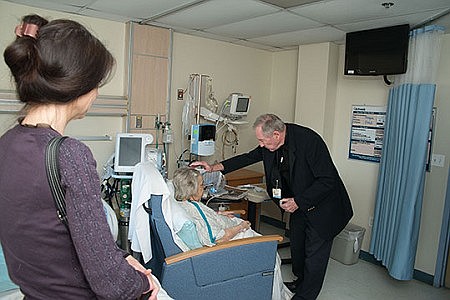
By Catholic News Service
IN A NUTSHELL
The sacrament of anointing of the sick -- sometimes called the sacrament of the sick -- continues the healing work of Jesus.
The sacrament is appropriate for anyone whose health is seriously imperiled by sickness or advanced age.
Through the anointing of the sick, we are reminded that Jesus understands our suffering and that the church, communally, shares with us in our pain.
Sacrament of the sick: Amazing grace
By David Gibson | Catholic News Service
Sickness can be nothing less than dumbfounding. Perhaps without warning it strikes a friend or relative, someone who last month appeared entirely healthy. Its arrival stuns us.
Initially we may feel helplessly at a loss, neither knowing what to do, what to say to this person or how to say it. The sacrament of the anointing of the sick is for people like this -- all of them, though in different ways.
First, it is a healing force for good in the life of someone who is seriously ill. Anointing a sick person with the oil of healing and peace petitions God to strengthen, comfort, encourage and even heal the person.
Second, when the sacrament assembles a small community of friends, relatives and others around a sick person, it serves them all by giving voice to their natural desire to ease suffering. The sacrament enables them to stand alongside their suffering friend and to join in coping with the confusions, pain or shaken hopes a serious illness can bring.
Personally, I never knew anyone who found this sacrament's celebration anything less than wonderful. Even the parent of a teen whose life hung in the balance due to a dire, life-threatening injury, described how uplifting, comforting and inviting the sacrament was.
Mercifully and thankfully, that child survived and thrived.
The very existence today of this sacrament shows that the sick remain a central concern of the church community and are not meant to be ignored or pushed aside. When sickness prevents someone from coming to the Sunday Eucharist, the church's ministers to the sick come to them.
The reason for this is clear in Scripture. Jesus went out of his way to comfort, speak with and heal the sick and people suffering from physical conditions that caused others of that time to ignore them or ostracize them.
The Gospels show that Jesus did not relegate profoundly ill people or others living with serious disabilities to a life apart.
Thus, he noticed the blind man who "used to sit and beg" at the Pool of Siloam in what today is Jerusalem. Speaking to the man, Jesus told him to "go wash" in the pool, which the man did. He "came back able to see."
Later, Jesus went again to look for the man and speak with him. It seems the man was ridiculed and pushed aside -- barred from the pool area due to his statements about Jesus (Jn 9:1-39).
The importance Jesus accorded to sick people was noted by St. Peter in a speech in the city of Caesarea, according to the Acts of the Apostles (10:38). Peter explained that Jesus "went about doing good and healing" oppressed people.
A Scripture reading from the Gospel of Luke that might well be heard during a celebration of the sacrament of the sick tells of Jesus curing many people "of their diseases" and sufferings (7:18-23). In this reading John the Baptist sends two of his disciples to ask Jesus, "Are you the one who is to come, or should we look for another?" Jesus responds:
"Go and tell John what you have seen and heard: The blind regain their sight, the lame walk, lepers are cleansed, the deaf hear, the dead are raised, the poor have the good news proclaimed to them."
In early Christian times the epistle of James accented the importance of an anointing for the sick (5:13-15). It asked, "Is anyone among you sick?" If so, it continues, "he should summon the presbyters of the church, and they should pray over him and anoint (him) with oil in the name of the Lord."
The sacrament of the sick continues the healing work of Jesus. This sacrament puts into practice the Christian community's great concern for human well-being, including both spiritual and bodily health.
Often the sacrament of the anointing of the sick is misunderstood, thought of as a sacrament for the dying only. True, the sacrament may be celebrated together with holy Communion for the dying that is known as viaticum or food for the journey.
The sacrament of the sick, however, is not reserved to those nearing death. Actually, it expresses hope for healing and recovery. So people with serious illnesses of many kinds receive the sacrament, including those who are injured, face serious surgery or suffer emotional illnesses, for example.
The sacrament of the sick expresses Christ's healing care and kindness toward people who are sick and suffering. But what kinds of healing are meant?
Recovery from an illness or physical condition is one kind. But a healing of the spirit within that gives rise to renewed hope and trust in God, as well as to the quieting of anxiety and fear, also is meant. And could the sacrament's celebration lead to the mending of relationships?
Care and kindness, after all, are dynamic. Many dying people themselves have become models of care and kindness toward others.
Christ's care and kindness tend to spread, to expand in amazing ways.
Gibson served on Catholic News Service's editorial staff for 37 years.
A misunderstood sacrament: Anointing of the sick
By Father Kenneth Doyle | Catholic News Service
Among the seven sacraments of the church, I can say with some confidence (after 51 years as a priest) that the one most frequently misunderstood is the anointing of the sick.
Two weeks ago, I happened to be at a funeral home for a wake service when one of the funeral directors came out of an office and asked to speak with me. He had just been with the son of a man who had died the previous day, arranging the funeral service. He wondered if I would go into their morgue and give the "last rites" to the man, as a comfort to the son.
I explained that the sacraments were not administered to those who had already died, but that I would be glad to say a prayer of blessing.
He brought me into the morgue, where I did just that -- made the sign of the cross on the deceased man's forehead and asked the Lord to bring him gently into the peace of heaven and to give to his family both strength and consolation.
My guess was that the son may have thought earlier about calling a priest but had put it off so as not to "frighten" his ailing father. My guess, too, was that the son had grown up thinking of this particular sacrament as "the last rites" or "extreme unction" and had postponed it until it was too late.
In the updating of the church's pastoral practice after the Second Vatican Council, the sacrament began to be called instead the anointing of the sick. Vatican II was clear that it was not to be reserved only for those at the point of death.
The church's current Code of Canon Law provides that it is to be administered "to a member of the faithful who … begins to be in danger due to sickness or old age" (No. 1004). The ritual itself designates as proper recipients "a sick person … before surgery whenever a serious illness is the reason for the surgery," as well as "elderly people … if they become notably weakened even though no serious illness is present."
So the sacrament is appropriate for anyone whose health is seriously imperiled by sickness or advanced age. While it is never to be trivialized (hay fever, the flu or a torn rotator cuff would hardly justify it), neither should families wait until death is right on the doorstep.
The first purpose of the sacrament is a spiritual one -- as well as forgiving sins, it offers the peace and the courage to deal with the difficulties that accompany illness -- but it also asks for the restoration of health, if that be God's will.
St. James, in fact, directed in his epistle: "Is anyone among you sick? He should summon the presbyters of the church, and they should pray over him and anoint (him) with oil in the name of the Lord, and the prayer of faith will save the sick person" (5:14-15).
Many times, I have found the sacrament to be of real comfort not only to the recipient but to the relatives as well. Often, I have gathered entire families at the home or around the hospital bed of a person with a serious illness; having said an Our Father and a Hail Mary together, I will anoint the person, using the striking prayers provided in the church's pastoral ritual for the sick:
"Through this holy anointing, may the Lord in his love and mercy help you with the grace of the Holy Spirit. May the Lord who frees you from sin save you and raise you up."
Sometimes, as I pronounce the final blessing, I invite the family to extend their own hand in blessing, all of them interceding together with the Lord for the one beloved.
Tears may flow freely -- but so, I believe, does God's grace.
Father Doyle is a priest of the Diocese of Albany. He is a columnist for Catholic News Service.
Anointing of the sick: Christ and the church shares in our suffering
By Effie Caldarola | Catholic News Service
When we read Scripture, we marvel at the compassion that Jesus showed to the sick and suffering. Often, we read that Jesus was "moved with pity" for the distress of others, and scholars tell us this phrase connotes not just an emotional reaction to their plight, but an empathy so strong that he experiences a physical response.
One can hardly turn a page of the four Gospels without observing Jesus reaching out to the blind, those tormented by demons, those fearing for their children, or to individuals like the man lowered through the roof by his friends or the woman who dared to touch the hem of his garment in hope of healing.
Although the Gospel writers tell us of many incidents of physical healing accomplished by Jesus, it leaves largely to our imagination the multitude of people who received the grace to carry on valiantly in their suffering or struggles as a result of their encounter with him.
In the church, the sacrament that embodies this beautiful love of Christ for the sick is called the anointing of the sick. This anointing has its roots in the earliest days of the church and the example of Jesus, and along with the sacrament of reconciliation is one of the sacraments of healing.
In the days before the Second Vatican Council, the sacrament of anointing was used more sparingly and was sometimes called "the last rites."
This has led to the misconception even today that one only receives the beauty and power of this sacrament on one's deathbed. People often feel life's end is near if a priest arrives to convey this sacrament to them or their loved one.
Today, the sacrament is encouraged for those facing surgery, suffering a long-term or chronic illness, or experiencing the travails of old age. In many ways, it's a joyful sacrament. Like those who met Jesus on the road, or saw him passing by, we too can call out with hope and confidence that we will receive his healing touch. We experience the exhilaration of encountering Christ.
Like all the sacraments, the sacrament of anointing is a conduit of grace, that mysterious outpouring of the life of the Spirit.
The Catechism of the Catholic Church says the sacrament is "one especially intended to strengthen those who are being tried by illness" (No. 1511). Strength, courage and comfort are given us through this sacrament, just as Jesus graced people with these gifts on the roads of Palestine.
Jesus himself, through his constant attention to the poor and needy, was no stranger to suffering. His life's mission led him to his own Passion and painful death. And none of us will be free of suffering in this life.
Through the anointing of the sick, we are reminded that Jesus understands our suffering and that the church, communally, shares with us in our pain.
This sacrament encourages us to unite our suffering to Jesus in his suffering and to our struggling world, and to be offered Christ's healing strength in return.
Caldarola is a freelance writer and a columnist for Catholic News Service.
FOOD FOR THOUGHT
Continuing an audience series on the sacraments Feb. 26, 2014, Pope Francis looked to the parable of the good Samaritan in Luke's Gospel to explore the "mystery" that shines through the anointing of the sick.
In the parable, the good Samaritan pours oil and wine on the victim's wounds and then takes him to an inn to care for him and entrusts him to the innkeeper's care.
Oil in the story "makes us think of that which is blessed by the bishop each year at the Holy Thursday Chrism Mass, precisely in view of the anointing of the sick," Pope Francis told the crowd gathered at St. Peter's Square.
The wine "is a sign of Christ's love and grace, which flow from the gift of his life for us and are expressed in all their richness in the sacramental life of the church," the pope added.
Finally, the innkeeper represents the church, the Christian community, Pope Francis explained. "It is us," he said, "to whom each day the Lord entrusts those who are afflicted in body and spirit, so that we might lavish all of his mercy and salvation upon them without measure."
Don't hesitate to call a priest to administer the sacrament to the ill or elderly, Pope Francis urged.
"It is Jesus himself who comes to relieve the sick person, to give him strength, to give him hope, to help him; and also to forgive his sins," he said.
[[In-content Ad]]Related Stories
Sunday, December 14, 2025

E-Editions
Events
By Catholic News Service
IN A NUTSHELL
The sacrament of anointing of the sick -- sometimes called the sacrament of the sick -- continues the healing work of Jesus.
The sacrament is appropriate for anyone whose health is seriously imperiled by sickness or advanced age.
Through the anointing of the sick, we are reminded that Jesus understands our suffering and that the church, communally, shares with us in our pain.
Sacrament of the sick: Amazing grace
By David Gibson | Catholic News Service
Sickness can be nothing less than dumbfounding. Perhaps without warning it strikes a friend or relative, someone who last month appeared entirely healthy. Its arrival stuns us.
Initially we may feel helplessly at a loss, neither knowing what to do, what to say to this person or how to say it. The sacrament of the anointing of the sick is for people like this -- all of them, though in different ways.
First, it is a healing force for good in the life of someone who is seriously ill. Anointing a sick person with the oil of healing and peace petitions God to strengthen, comfort, encourage and even heal the person.
Second, when the sacrament assembles a small community of friends, relatives and others around a sick person, it serves them all by giving voice to their natural desire to ease suffering. The sacrament enables them to stand alongside their suffering friend and to join in coping with the confusions, pain or shaken hopes a serious illness can bring.
Personally, I never knew anyone who found this sacrament's celebration anything less than wonderful. Even the parent of a teen whose life hung in the balance due to a dire, life-threatening injury, described how uplifting, comforting and inviting the sacrament was.
Mercifully and thankfully, that child survived and thrived.
The very existence today of this sacrament shows that the sick remain a central concern of the church community and are not meant to be ignored or pushed aside. When sickness prevents someone from coming to the Sunday Eucharist, the church's ministers to the sick come to them.
The reason for this is clear in Scripture. Jesus went out of his way to comfort, speak with and heal the sick and people suffering from physical conditions that caused others of that time to ignore them or ostracize them.
The Gospels show that Jesus did not relegate profoundly ill people or others living with serious disabilities to a life apart.
Thus, he noticed the blind man who "used to sit and beg" at the Pool of Siloam in what today is Jerusalem. Speaking to the man, Jesus told him to "go wash" in the pool, which the man did. He "came back able to see."
Later, Jesus went again to look for the man and speak with him. It seems the man was ridiculed and pushed aside -- barred from the pool area due to his statements about Jesus (Jn 9:1-39).
The importance Jesus accorded to sick people was noted by St. Peter in a speech in the city of Caesarea, according to the Acts of the Apostles (10:38). Peter explained that Jesus "went about doing good and healing" oppressed people.
A Scripture reading from the Gospel of Luke that might well be heard during a celebration of the sacrament of the sick tells of Jesus curing many people "of their diseases" and sufferings (7:18-23). In this reading John the Baptist sends two of his disciples to ask Jesus, "Are you the one who is to come, or should we look for another?" Jesus responds:
"Go and tell John what you have seen and heard: The blind regain their sight, the lame walk, lepers are cleansed, the deaf hear, the dead are raised, the poor have the good news proclaimed to them."
In early Christian times the epistle of James accented the importance of an anointing for the sick (5:13-15). It asked, "Is anyone among you sick?" If so, it continues, "he should summon the presbyters of the church, and they should pray over him and anoint (him) with oil in the name of the Lord."
The sacrament of the sick continues the healing work of Jesus. This sacrament puts into practice the Christian community's great concern for human well-being, including both spiritual and bodily health.
Often the sacrament of the anointing of the sick is misunderstood, thought of as a sacrament for the dying only. True, the sacrament may be celebrated together with holy Communion for the dying that is known as viaticum or food for the journey.
The sacrament of the sick, however, is not reserved to those nearing death. Actually, it expresses hope for healing and recovery. So people with serious illnesses of many kinds receive the sacrament, including those who are injured, face serious surgery or suffer emotional illnesses, for example.
The sacrament of the sick expresses Christ's healing care and kindness toward people who are sick and suffering. But what kinds of healing are meant?
Recovery from an illness or physical condition is one kind. But a healing of the spirit within that gives rise to renewed hope and trust in God, as well as to the quieting of anxiety and fear, also is meant. And could the sacrament's celebration lead to the mending of relationships?
Care and kindness, after all, are dynamic. Many dying people themselves have become models of care and kindness toward others.
Christ's care and kindness tend to spread, to expand in amazing ways.
Gibson served on Catholic News Service's editorial staff for 37 years.
A misunderstood sacrament: Anointing of the sick
By Father Kenneth Doyle | Catholic News Service
Among the seven sacraments of the church, I can say with some confidence (after 51 years as a priest) that the one most frequently misunderstood is the anointing of the sick.
Two weeks ago, I happened to be at a funeral home for a wake service when one of the funeral directors came out of an office and asked to speak with me. He had just been with the son of a man who had died the previous day, arranging the funeral service. He wondered if I would go into their morgue and give the "last rites" to the man, as a comfort to the son.
I explained that the sacraments were not administered to those who had already died, but that I would be glad to say a prayer of blessing.
He brought me into the morgue, where I did just that -- made the sign of the cross on the deceased man's forehead and asked the Lord to bring him gently into the peace of heaven and to give to his family both strength and consolation.
My guess was that the son may have thought earlier about calling a priest but had put it off so as not to "frighten" his ailing father. My guess, too, was that the son had grown up thinking of this particular sacrament as "the last rites" or "extreme unction" and had postponed it until it was too late.
In the updating of the church's pastoral practice after the Second Vatican Council, the sacrament began to be called instead the anointing of the sick. Vatican II was clear that it was not to be reserved only for those at the point of death.
The church's current Code of Canon Law provides that it is to be administered "to a member of the faithful who … begins to be in danger due to sickness or old age" (No. 1004). The ritual itself designates as proper recipients "a sick person … before surgery whenever a serious illness is the reason for the surgery," as well as "elderly people … if they become notably weakened even though no serious illness is present."
So the sacrament is appropriate for anyone whose health is seriously imperiled by sickness or advanced age. While it is never to be trivialized (hay fever, the flu or a torn rotator cuff would hardly justify it), neither should families wait until death is right on the doorstep.
The first purpose of the sacrament is a spiritual one -- as well as forgiving sins, it offers the peace and the courage to deal with the difficulties that accompany illness -- but it also asks for the restoration of health, if that be God's will.
St. James, in fact, directed in his epistle: "Is anyone among you sick? He should summon the presbyters of the church, and they should pray over him and anoint (him) with oil in the name of the Lord, and the prayer of faith will save the sick person" (5:14-15).
Many times, I have found the sacrament to be of real comfort not only to the recipient but to the relatives as well. Often, I have gathered entire families at the home or around the hospital bed of a person with a serious illness; having said an Our Father and a Hail Mary together, I will anoint the person, using the striking prayers provided in the church's pastoral ritual for the sick:
"Through this holy anointing, may the Lord in his love and mercy help you with the grace of the Holy Spirit. May the Lord who frees you from sin save you and raise you up."
Sometimes, as I pronounce the final blessing, I invite the family to extend their own hand in blessing, all of them interceding together with the Lord for the one beloved.
Tears may flow freely -- but so, I believe, does God's grace.
Father Doyle is a priest of the Diocese of Albany. He is a columnist for Catholic News Service.
Anointing of the sick: Christ and the church shares in our suffering
By Effie Caldarola | Catholic News Service
When we read Scripture, we marvel at the compassion that Jesus showed to the sick and suffering. Often, we read that Jesus was "moved with pity" for the distress of others, and scholars tell us this phrase connotes not just an emotional reaction to their plight, but an empathy so strong that he experiences a physical response.
One can hardly turn a page of the four Gospels without observing Jesus reaching out to the blind, those tormented by demons, those fearing for their children, or to individuals like the man lowered through the roof by his friends or the woman who dared to touch the hem of his garment in hope of healing.
Although the Gospel writers tell us of many incidents of physical healing accomplished by Jesus, it leaves largely to our imagination the multitude of people who received the grace to carry on valiantly in their suffering or struggles as a result of their encounter with him.
In the church, the sacrament that embodies this beautiful love of Christ for the sick is called the anointing of the sick. This anointing has its roots in the earliest days of the church and the example of Jesus, and along with the sacrament of reconciliation is one of the sacraments of healing.
In the days before the Second Vatican Council, the sacrament of anointing was used more sparingly and was sometimes called "the last rites."
This has led to the misconception even today that one only receives the beauty and power of this sacrament on one's deathbed. People often feel life's end is near if a priest arrives to convey this sacrament to them or their loved one.
Today, the sacrament is encouraged for those facing surgery, suffering a long-term or chronic illness, or experiencing the travails of old age. In many ways, it's a joyful sacrament. Like those who met Jesus on the road, or saw him passing by, we too can call out with hope and confidence that we will receive his healing touch. We experience the exhilaration of encountering Christ.
Like all the sacraments, the sacrament of anointing is a conduit of grace, that mysterious outpouring of the life of the Spirit.
The Catechism of the Catholic Church says the sacrament is "one especially intended to strengthen those who are being tried by illness" (No. 1511). Strength, courage and comfort are given us through this sacrament, just as Jesus graced people with these gifts on the roads of Palestine.
Jesus himself, through his constant attention to the poor and needy, was no stranger to suffering. His life's mission led him to his own Passion and painful death. And none of us will be free of suffering in this life.
Through the anointing of the sick, we are reminded that Jesus understands our suffering and that the church, communally, shares with us in our pain.
This sacrament encourages us to unite our suffering to Jesus in his suffering and to our struggling world, and to be offered Christ's healing strength in return.
Caldarola is a freelance writer and a columnist for Catholic News Service.
FOOD FOR THOUGHT
Continuing an audience series on the sacraments Feb. 26, 2014, Pope Francis looked to the parable of the good Samaritan in Luke's Gospel to explore the "mystery" that shines through the anointing of the sick.
In the parable, the good Samaritan pours oil and wine on the victim's wounds and then takes him to an inn to care for him and entrusts him to the innkeeper's care.
Oil in the story "makes us think of that which is blessed by the bishop each year at the Holy Thursday Chrism Mass, precisely in view of the anointing of the sick," Pope Francis told the crowd gathered at St. Peter's Square.
The wine "is a sign of Christ's love and grace, which flow from the gift of his life for us and are expressed in all their richness in the sacramental life of the church," the pope added.
Finally, the innkeeper represents the church, the Christian community, Pope Francis explained. "It is us," he said, "to whom each day the Lord entrusts those who are afflicted in body and spirit, so that we might lavish all of his mercy and salvation upon them without measure."
Don't hesitate to call a priest to administer the sacrament to the ill or elderly, Pope Francis urged.
"It is Jesus himself who comes to relieve the sick person, to give him strength, to give him hope, to help him; and also to forgive his sins," he said.
[[In-content Ad]]