


FAITH ALIVE: Personal confession: The legacy of Irish monks
July 29, 2019 at 12:37 p.m.
By Susan Gately | Catholic News Service
The sight of Skellig Michael rising majestically from the Atlantic Ocean to the sky is stunning. And when you climb the ancient stairway hewn in solid rock to its summit, you are transported to another age and world.
Irish monks lived on this wind-buffeted and inhospitable island for nearly 600 years. They lived in finely built beehive huts, which a thousand years later still keep out the wind and rain. Free from the threat of "red" martyrdom, they chose what became known as "green" martyrdom, exiling themselves from home, family, the world. They embraced an austere, robust life of prayer, fasting and community.
From possibly as early as the sixth century, monks lived on Skellig Michael. There is no fresh water on the stone island, which is home to thousands of gannets and puffins. The monks prayed, fished, grew vegetables, collected rainwater and birds' eggs, and lived, we suspect, a life of Gospel simplicity.
It is an extraordinary place and not surprisingly designated a UNESCO World Heritage site.
The monks remained on Skellig Michael until about the late 12th century, when storms and cold weather, and changes in the structure of the Irish Catholic Church resulted in their leaving the island for good.
Many know of the monks on Skellig Michael, but perhaps we are not so aware of the amazing gift they made to the universal church: the gift of individual confession.
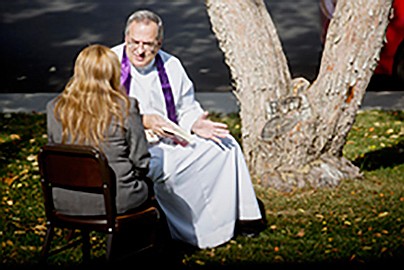
In the early church, confession -- what we now call the sacrament of reconciliation -- was a once in a lifetime event, administered by the bishop and normally in public. You stood up and proclaimed yourself a sinner. Typically a person would receive the sacrament toward the end of his or her life.
What became known as "Celtic penance" came from the monasteries following the example of the monks.
"We didn't have the great cities that characterized mainland Europe, but we did have monasteries, centers of civilization which were places for the people," said Msgr. Hugh Connolly, of Maynooth, Ireland. "And so you had these concentric circles, the monks at the center, beyond that you had the people who lived in the vicinity and it was natural for them to take up the practice of the monastery."
Each monk had an "anam cara," or soul friend, to whom he would bear his soul. Seeing the way the monks lived, the people who lived close by wanted to share in this practice.
"Usually a senior monk was entrusted with a junior monk," said Msgr. Connolly, "and he would conduct a review of life with the monk, and with people who asked for this, and he would reveal the areas of life where they needed to improve in the light of the Gospel."
What was new about the practice was that it could be repeated. The "anam cara" accompanied the penitent, conscious of his sinfulness.
"It wasn't helping from on high. It was the idea that all were engaged as human beings in the human condition," said Msgr. Connolly.
The notion of restorative justice or satisfaction, so strong in traditional Irish law, became enmeshed in the practice of Celtic penance. If a man killed the breadwinner in a home, for example, he might be asked to provide for the family.
"There was a very strong sense that those going to confession should do something to undo some of the harm they had done," said Msgr. Connolly, an expert in early Irish monastic penitence.
Another principle operating in Celtic penance was the principle of "contraries," in which every vice is countered with a virtue, with hopes of changing sinful behavior. If a person confessed to greed, the confessor would advise him or her to do something generous.
"They might say 'we expect you now to go and give to the poor because you are an avaricious person and so we've got to get over this sense of hoarding and holding on and learn how to give and be someone who is generous.'"
Over time, senior monks drew up charts of sins and penances that younger monks learned by heart. The penances called for fasting and abstinence, but had humanizing elements, too.
Over time the discipline and practices of the Irish monasteries migrated across modern Western Europe.
"It really spread by people voting with their feet as the Irish monastic movement spread through the wanderings of these Irish monks who came from Ireland into a Europe which had grown cold in terms of its faith," said Msgr. Connolly.
"They became the sparks of light. But also the practices which they brought with them became little flames of light as well. And the older canonical model of penance, literally gave way over time to the private penance."
Msgr. Connolly says that in penance, we might take a page from the monks' practices.
"If we are sorry, shouldn't we try to express it in a way that actually undoes some of the harm and the hurt we caused?" he asks.
Gately is a freelance writer from Dublin, Ireland.
A confession about confession
By Kelly Bothum | Catholic News Service
Bless me, reader, for I have sinned: I am not the best role model when it comes to confession.
Of course, I know how important it is. I know that there is great peace in the forgiveness offered by God, that it strengthens our relationship with him and it reminds us of our duty to live our lives in a more Christ-like way.
Like exercise, confession -- or the sacrament of reconciliation, as we now call it -- always makes me feel better after I go -- separated from my sinful habits and inspired to adhere more closely to my spiritual path.
But convincing my children of its myriad benefits is one of the wonderful challenges of parenting, akin to making sure they've got enough spiritual veggies on their plate of faith.
Me: "Try it, you'll like it!"
Them: "Uh, huh," as they hide their peas under the mound of mashed potatoes.
Like plenty of adults I know, my children have no problem coming up with reasons why they don't need to make a list of their less-than-stellar moments and, worse, tell someone about it.
"I haven't done anything wrong," spits out my younger daughter at my suggestion of a Saturday afternoon family trip to the confessional. (This, of course, comes right after a morning fight with her younger brother.)
I deftly point out that while we aren't a family of murderers, it would behoove all of us to take a moment and think of the times we were less than kind to each other, when we perhaps spoke too hastily or took pleasure in another person's misfortune.
We can confess those sinful moments and receive God's forgiveness, I say. I try to explain it in different ways: It's like wiping down the dry erase board -- chalkboards are so 20th century -- and making a fresh start.
I say to the kids: "Try it, you'll like it!"
Kid No. 2 says: "We've got (insert random sports activity, birthday party, semiannual family ritual) coming up."
Sure, in a family of five, there is always something going on in our lives. I joke that we don't have excuses, we have exceptions -- reasons why we are somehow above the rules. Except, that's not the case.
Sometimes, the day-to-day struggles are precisely why we need to make the time for a trip to the confessional. Those moments spent in the pew clicking off our list of sins -- the gossip, the profanity, the desiring of what belongs to someone else -- may be the reality check we need to bring us back on course.
We can take a look into our spiritual mirror, and if we don't like what we see, we have the chance to change it, all while accepting God's gift of forgiveness.
Me: "Try it, you'll like it!"
"You've been saying we need to go, and then we don't," my older one says to me.
Zing -- the shot to the heart. She's right. Oh, I talk a good game about confession, but in the end, I make all the same excuses they do. I can't tell you how many times I've walked into church on a Sunday morning and chastised myself for missing the Saturday confession window. And then I slide into the pew, the thought discarded like a wadded-up tissue.
So what am I teaching my kids?
During Lent, I took the time to teach them that confession is something we do -- as a family. It doesn't matter if our sins are big or small, if we are busy or lazy. I realized the one I'm convincing is myself, that it's time for me to look into the mirror and decide if this is the reflection of God I want the world to see. Only then can I hope my children will follow my example.
"Try it, you'll like it!"
Bothum, a mother of three, is a freelance writer.
Confession as an affirmation of faith
By Daniel S. Mulhall | Catholic News Service
The word "confess" means to make a public avowal. Some may paint the word "confession" with negative meanings, as in confessing one's sins or failures, or admitting to a crime. And, yes, in Mass Catholics confess "to almighty God" that they have greatly sinned.
But there is another confession made during Mass, a confession of belief: "I believe in God, the father almighty." In fact, the Mass is a "confession" of our belief in God and in God's saving mercy.
These two concepts of "confession" are found throughout the Bible in the Old and New Testaments. In many ways, the Bible is the story of how a people confessed faith and how they confessed their failures to live up to that faith.
The pattern is set in the first stories of the Bible found in Genesis. Adam and Eve eat the forbidden fruit and Cain kills Abel. In both cases God gives an opportunity to confess what they have done so they can experience God's mercy, but, instead, they attempt to hide their deeds from God and so are made outcasts.
When we sin, we do so because we turn away from God. We are not faithful to God. That is when we do bad things. In the Bible, confession is always an affirmation of faith and not just a proclamation of sinfulness.
This theme is echoed in Leviticus 26 where God tells Moses that the people of Israel will be forgiven all of their iniquity and that of their ancestors if they will but make an honest confession of their failures and make amends for them. As Leviticus is a book that lays out Jewish belief in relationship to the law, what is being asked here is a return to and a confession of true belief.
In Psalms 32:5, we hear the need for and importance of confession: "Then I declared my sin to you; my guilt I did not hide. I said, 'I confess my transgression to the Lord,' and you took away the guilt of my sin."
The importance of confessing belief and confessing sin also are central tenets of the New Testament. Jesus illustrated this idea of confession of sin and belief in most of his parables but one in particular stands out: the parable of the prodigal son found in Luke 15.
After abandoning his father, the son returns and confesses, "Father, I have sinned against heaven and against you. I no longer deserve to be called your son" (Lk 15:21). In the parable, the father's mercy is beyond all understanding and the sinner's confession is celebrated by all except the older brother.
Like the father in the parable, our heavenly Father wants for nothing but our return to him in faith.
Mulhall is a freelance writer and a catechist for adults. He lives in Laurel, Maryland.
Food for Thought
In seeking and receiving God's forgiveness for our sins, we also will find the path that will lead us to forgive others, Pope Francis has said throughout his pontificate. And the place where we can find that forgiveness and that driving force to change is the sacrament of reconciliation, or confession, as some call it.
To drive home the importance of receiving the sacrament, the pope publicly went to the confessional before the cameras in 2014. Don't think of it as a "torture chamber," he said, but as a place to find grace.
In 2015, the Vatican issued the "Safeguard Your Heart" booklet that lists some questions to consider before heading to confession. They include:
Do I only turn to God when I'm in need?
Am I embarrassed to show that I am a Christian?
Do I want to be served?
In considering our answers, we can consider how we can approach a path toward becoming the Christian that God wishes us to become.
Confession is meant to be a sincere moment of conversion, an occasion to demonstrate trust in God's willingness to forgive his children and to help them back on the path of following Jesus, Pope Francis said.
[[In-content Ad]]Related Stories
Sunday, December 14, 2025


E-Editions
Events
By Susan Gately | Catholic News Service
The sight of Skellig Michael rising majestically from the Atlantic Ocean to the sky is stunning. And when you climb the ancient stairway hewn in solid rock to its summit, you are transported to another age and world.
Irish monks lived on this wind-buffeted and inhospitable island for nearly 600 years. They lived in finely built beehive huts, which a thousand years later still keep out the wind and rain. Free from the threat of "red" martyrdom, they chose what became known as "green" martyrdom, exiling themselves from home, family, the world. They embraced an austere, robust life of prayer, fasting and community.
From possibly as early as the sixth century, monks lived on Skellig Michael. There is no fresh water on the stone island, which is home to thousands of gannets and puffins. The monks prayed, fished, grew vegetables, collected rainwater and birds' eggs, and lived, we suspect, a life of Gospel simplicity.
It is an extraordinary place and not surprisingly designated a UNESCO World Heritage site.
The monks remained on Skellig Michael until about the late 12th century, when storms and cold weather, and changes in the structure of the Irish Catholic Church resulted in their leaving the island for good.
Many know of the monks on Skellig Michael, but perhaps we are not so aware of the amazing gift they made to the universal church: the gift of individual confession.
In the early church, confession -- what we now call the sacrament of reconciliation -- was a once in a lifetime event, administered by the bishop and normally in public. You stood up and proclaimed yourself a sinner. Typically a person would receive the sacrament toward the end of his or her life.
What became known as "Celtic penance" came from the monasteries following the example of the monks.
"We didn't have the great cities that characterized mainland Europe, but we did have monasteries, centers of civilization which were places for the people," said Msgr. Hugh Connolly, of Maynooth, Ireland. "And so you had these concentric circles, the monks at the center, beyond that you had the people who lived in the vicinity and it was natural for them to take up the practice of the monastery."
Each monk had an "anam cara," or soul friend, to whom he would bear his soul. Seeing the way the monks lived, the people who lived close by wanted to share in this practice.
"Usually a senior monk was entrusted with a junior monk," said Msgr. Connolly, "and he would conduct a review of life with the monk, and with people who asked for this, and he would reveal the areas of life where they needed to improve in the light of the Gospel."
What was new about the practice was that it could be repeated. The "anam cara" accompanied the penitent, conscious of his sinfulness.
"It wasn't helping from on high. It was the idea that all were engaged as human beings in the human condition," said Msgr. Connolly.
The notion of restorative justice or satisfaction, so strong in traditional Irish law, became enmeshed in the practice of Celtic penance. If a man killed the breadwinner in a home, for example, he might be asked to provide for the family.
"There was a very strong sense that those going to confession should do something to undo some of the harm they had done," said Msgr. Connolly, an expert in early Irish monastic penitence.
Another principle operating in Celtic penance was the principle of "contraries," in which every vice is countered with a virtue, with hopes of changing sinful behavior. If a person confessed to greed, the confessor would advise him or her to do something generous.
"They might say 'we expect you now to go and give to the poor because you are an avaricious person and so we've got to get over this sense of hoarding and holding on and learn how to give and be someone who is generous.'"
Over time, senior monks drew up charts of sins and penances that younger monks learned by heart. The penances called for fasting and abstinence, but had humanizing elements, too.
Over time the discipline and practices of the Irish monasteries migrated across modern Western Europe.
"It really spread by people voting with their feet as the Irish monastic movement spread through the wanderings of these Irish monks who came from Ireland into a Europe which had grown cold in terms of its faith," said Msgr. Connolly.
"They became the sparks of light. But also the practices which they brought with them became little flames of light as well. And the older canonical model of penance, literally gave way over time to the private penance."
Msgr. Connolly says that in penance, we might take a page from the monks' practices.
"If we are sorry, shouldn't we try to express it in a way that actually undoes some of the harm and the hurt we caused?" he asks.
Gately is a freelance writer from Dublin, Ireland.
A confession about confession
By Kelly Bothum | Catholic News Service
Bless me, reader, for I have sinned: I am not the best role model when it comes to confession.
Of course, I know how important it is. I know that there is great peace in the forgiveness offered by God, that it strengthens our relationship with him and it reminds us of our duty to live our lives in a more Christ-like way.
Like exercise, confession -- or the sacrament of reconciliation, as we now call it -- always makes me feel better after I go -- separated from my sinful habits and inspired to adhere more closely to my spiritual path.
But convincing my children of its myriad benefits is one of the wonderful challenges of parenting, akin to making sure they've got enough spiritual veggies on their plate of faith.
Me: "Try it, you'll like it!"
Them: "Uh, huh," as they hide their peas under the mound of mashed potatoes.
Like plenty of adults I know, my children have no problem coming up with reasons why they don't need to make a list of their less-than-stellar moments and, worse, tell someone about it.
"I haven't done anything wrong," spits out my younger daughter at my suggestion of a Saturday afternoon family trip to the confessional. (This, of course, comes right after a morning fight with her younger brother.)
I deftly point out that while we aren't a family of murderers, it would behoove all of us to take a moment and think of the times we were less than kind to each other, when we perhaps spoke too hastily or took pleasure in another person's misfortune.
We can confess those sinful moments and receive God's forgiveness, I say. I try to explain it in different ways: It's like wiping down the dry erase board -- chalkboards are so 20th century -- and making a fresh start.
I say to the kids: "Try it, you'll like it!"
Kid No. 2 says: "We've got (insert random sports activity, birthday party, semiannual family ritual) coming up."
Sure, in a family of five, there is always something going on in our lives. I joke that we don't have excuses, we have exceptions -- reasons why we are somehow above the rules. Except, that's not the case.
Sometimes, the day-to-day struggles are precisely why we need to make the time for a trip to the confessional. Those moments spent in the pew clicking off our list of sins -- the gossip, the profanity, the desiring of what belongs to someone else -- may be the reality check we need to bring us back on course.
We can take a look into our spiritual mirror, and if we don't like what we see, we have the chance to change it, all while accepting God's gift of forgiveness.
Me: "Try it, you'll like it!"
"You've been saying we need to go, and then we don't," my older one says to me.
Zing -- the shot to the heart. She's right. Oh, I talk a good game about confession, but in the end, I make all the same excuses they do. I can't tell you how many times I've walked into church on a Sunday morning and chastised myself for missing the Saturday confession window. And then I slide into the pew, the thought discarded like a wadded-up tissue.
So what am I teaching my kids?
During Lent, I took the time to teach them that confession is something we do -- as a family. It doesn't matter if our sins are big or small, if we are busy or lazy. I realized the one I'm convincing is myself, that it's time for me to look into the mirror and decide if this is the reflection of God I want the world to see. Only then can I hope my children will follow my example.
"Try it, you'll like it!"
Bothum, a mother of three, is a freelance writer.
Confession as an affirmation of faith
By Daniel S. Mulhall | Catholic News Service
The word "confess" means to make a public avowal. Some may paint the word "confession" with negative meanings, as in confessing one's sins or failures, or admitting to a crime. And, yes, in Mass Catholics confess "to almighty God" that they have greatly sinned.
But there is another confession made during Mass, a confession of belief: "I believe in God, the father almighty." In fact, the Mass is a "confession" of our belief in God and in God's saving mercy.
These two concepts of "confession" are found throughout the Bible in the Old and New Testaments. In many ways, the Bible is the story of how a people confessed faith and how they confessed their failures to live up to that faith.
The pattern is set in the first stories of the Bible found in Genesis. Adam and Eve eat the forbidden fruit and Cain kills Abel. In both cases God gives an opportunity to confess what they have done so they can experience God's mercy, but, instead, they attempt to hide their deeds from God and so are made outcasts.
When we sin, we do so because we turn away from God. We are not faithful to God. That is when we do bad things. In the Bible, confession is always an affirmation of faith and not just a proclamation of sinfulness.
This theme is echoed in Leviticus 26 where God tells Moses that the people of Israel will be forgiven all of their iniquity and that of their ancestors if they will but make an honest confession of their failures and make amends for them. As Leviticus is a book that lays out Jewish belief in relationship to the law, what is being asked here is a return to and a confession of true belief.
In Psalms 32:5, we hear the need for and importance of confession: "Then I declared my sin to you; my guilt I did not hide. I said, 'I confess my transgression to the Lord,' and you took away the guilt of my sin."
The importance of confessing belief and confessing sin also are central tenets of the New Testament. Jesus illustrated this idea of confession of sin and belief in most of his parables but one in particular stands out: the parable of the prodigal son found in Luke 15.
After abandoning his father, the son returns and confesses, "Father, I have sinned against heaven and against you. I no longer deserve to be called your son" (Lk 15:21). In the parable, the father's mercy is beyond all understanding and the sinner's confession is celebrated by all except the older brother.
Like the father in the parable, our heavenly Father wants for nothing but our return to him in faith.
Mulhall is a freelance writer and a catechist for adults. He lives in Laurel, Maryland.
Food for Thought
In seeking and receiving God's forgiveness for our sins, we also will find the path that will lead us to forgive others, Pope Francis has said throughout his pontificate. And the place where we can find that forgiveness and that driving force to change is the sacrament of reconciliation, or confession, as some call it.
To drive home the importance of receiving the sacrament, the pope publicly went to the confessional before the cameras in 2014. Don't think of it as a "torture chamber," he said, but as a place to find grace.
In 2015, the Vatican issued the "Safeguard Your Heart" booklet that lists some questions to consider before heading to confession. They include:
Do I only turn to God when I'm in need?
Am I embarrassed to show that I am a Christian?
Do I want to be served?
In considering our answers, we can consider how we can approach a path toward becoming the Christian that God wishes us to become.
Confession is meant to be a sincere moment of conversion, an occasion to demonstrate trust in God's willingness to forgive his children and to help them back on the path of following Jesus, Pope Francis said.
[[In-content Ad]]