


FAITH ALIVE: 'Lectio divina' and the beauty of faith: Discovering art as an aid to worship
July 29, 2019 at 12:37 p.m.
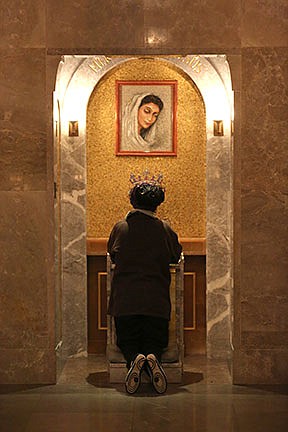
By Jem Sullivan | Catholic News Service
Think of the last time you read words on a page or screen. Perhaps it was the headline news, a newspaper column, blog post or online article, your email or Facebook page. Images and sounds were mostly likely part of that experience.
We live in a visual culture. Images and sounds flood daily life from our waking moments to the day's end. What is the place of sacred images in worship, faith formation and the spiritual life? How might we discover or re-discover the beauty of faith expressed in art?
Here is one practical approach that adapts the ancient monastic practice of "lectio divina" to appreciating works of art as an aid to worship and prayer.
"Lectio divina" literally means "divine reading," or "holy reading." Strictly speaking, "lectio divina" is a Christian spiritual practice that focuses on the reading of sacred Scripture.
It traces back to the early monastic tradition when monks and nuns used stages or steps of "lectio divina" to read, reflect and live God's word within the monastic rhythm of prayer and work. Four traditional steps -- "lectio," "meditatio," "oratio" and "contemplatio" -- of "lectio divina" are being rediscovered today as a fruitful path of prayer.
"Lectio divina" is a prayerful, reflective reading of the word of God as divine revelation, as the very "speech of God," as stated in the Catechism of the Catholic Church (No. 81). Practicing "lectio divina" rests on the conviction that "the word of God is living and effective" (Heb 4:12).
The first step, "lectio," invites us to a slow reading of God's word. This takes some getting used to as it is the opposite of the "speed reading" we are accustomed to today.
When applied to appreciating a work of art, "lectio" invites us to quiet the mind, eye and ear in silence, allowing us to look at works of art in a reflective spirit. With the painting before you, begin by asking simple questions:
What do I see? Which Gospel stories or figures are depicted? Who is the main subject? The secondary scenes and subjects? Who is in the background, the foreground? And what is being conveyed through the artists' use of light, color, line and movement?
The second step -- "meditatio" or prayerful meditation on God's word -- is a silent pondering of God's word. The Christian tradition has always looked to Mary, the mother of God, as she "kept all these things, reflecting on them in her heart" (Lk 2:19).
As the catechism notes, "to meditate on what we read helps us to make it our own by confronting it with ourselves. Here, another book is opened: the book of life. We pass from thoughts to reality." (No. 2706).
In "meditation," one moves from the "what" and the "who" to the "why" of the artistic masterpiece. Pondering with the "eyes of faith" now we look to the mysteries of faith presented in visual form. If the image is a Gospel scene, begin with the Scripture passage it evokes.
Moving between the sacred text and its visual representation in a silent pondering of word and image draws mind, heart and will into the beauty of faith. Identify key artistic symbols and reflect on their meaning in the light of God's word.
"Oratio," or prayer, is the third step of "lectio divina." Now the divine word meditated on turns into prayer. The mind's pondering becomes the heart's spontaneous offering rising to God in praise, thanksgiving, intercession or petition.
When applied to appreciating art, "oratio" turns the mind and eye from visible beauty to the invisible God, the divine artist and source of all that is true, good and beautiful in the world. From the heart's depths arises a hymn of praise and thanksgiving for the gift and beauty of faith in visual form.
A fourth step of "lectio divina" is contemplation, a fixing of one's inner gaze on Jesus Christ. This quiet and trusting rest in the presence of God is a silent abiding under the gaze of God's merciful love.
Simply being in God's holy presence rather than doing is the goal. Receptivity to God's grace and openness to the transforming power of God's word replaces anxious, self-sustained effort.
Appreciating artistic beauty leads to an experience of contemplation as "a gaze of faith, fixed on Jesus. ... This focus on Jesus is a renunciation of self. His gaze purifies our heart; the light of the countenance of Jesus illumines the eyes of the heart and teaches us to see everything in the light of his truth and his compassion for all. ...
"Words in this kind of prayer are not speeches; they are like kindling that feeds the fire of love" (Catechism of the Catholic Church, No. 2715-2717).
With "lectio divina," one moves from seeing to contemplation to praise of God.
It is in seeing with the eyes of faith that sacred art evokes and glorifies "the transcendent mystery of God -- the surpassing invisible beauty of truth and love made visible in Christ. … (For) genuine sacred art draws man to adoration, to prayer and to love of God" (Catechism, No. 2502).
Sullivan, professor and writer, is the author of "The Beauty of Faith: Using Art to Spread the Good News."
A painter's musings and memories
By Father David O'Rourke, OP | Catholic News Service
It is common for pastors to look at their work through wide-angle lenses. There are many people, many needs, and all sorts of religious and human realities that really need your attention. With over 50 years' experience under my belt, I know just how varied people's daily realities can be.
But I am also a painter; I work with watercolors. An amateur painter of course, but practiced enough now that I can slip into the peace I find that I need.
Painting requires a very different lens from the pastor' wide-angle view of life on the move. And I didn't come to that realization gradually. I was actually forced to face the limits of that view, which came as a surprise.
An unanticipated and demanding ministry required opening my life to living in quiet and stillness. Not just facing it as a reality out there somewhere, but living in it myself. And it was in that quiet that my painting went from a hobby to a real part of life.
Beginning in 1999, I began working in the former Soviet Union, in the Lithuanian capital of Vilnius. The Soviet tanks had been gone for only five years.
Every walk on any street brought me face to face with the Soviet's 50-year reign of terror. How it had reduced many historic buildings and churches to empty wrecks with grass growing on the window sills, the windows broken by state vandalism, the people scattered.
And as I got to know people, there were the endless stories of surprise arrests, deportations to Siberia, thousands spending years in slave labor camps. Everyone lost someone.
For some reason, I started sketching and painting some of the once beautiful and historic churches. Ruins do not move. They are as fixed as their histories are painful. So I had to slow down, even stop, to get some sense of their realities. That meant setting that American, wide-angle lens aside.
To appreciate what I was sketching, even in some limited way, I had to look through a narrow and focused lens. I am still surprised with what came into view.
From the details of ruined buildings to the realities of ruined lives. And then, surprisingly, the view that really moved and took hold of me were the faces of the old.
I would sit in our church waiting for our noon Mass and watch as they came in. Sometimes hours in advance, mostly women, bundled against the cold, and I would look at their faces. Pained, enduring. They would attend to their prayers alone and in silence.
They did not greet each other. You didn't greet people publicly in the Soviet Union. The police were watching. As I watched I knew that God was present in that peasant solitude. Their faith was as rock-solid as the five-foot-thick walls of our church.
I came to see that those closed and vandalized churches that I first saw as ruins were actually serving as religious anchors in their lives, they were still living symbols of God's enduring presence.
In the past, all through the short but splendid summer in this northern land, village life celebrated Catholic family events, weddings, patron saints, first Communions. And all involved joyous processions through the streets, with banners blowing in the breezes.
Then they were gone. But these reminders were alive. That, I suspect, is why I painted them. I came to see them through their eyes.
I went there an outsider. Somehow my painting put me in touch with the religious sense that was worked into the very life of the land. I always knew that my own faith was not very different from the earthy piety of these Catholic people.
Now as I sketch before beginning to paint I look through the lens of religious memory. Somehow if there is something worth painting it has to be made of that same dirt and bones of daily life where faith has its roots.
Dominican Father O'Rourke is a senior fellow at Santa Fe Institute in Berkeley, California.
The art of the church architect
By David Gibson | Catholic News Service
A simple, white-granite altar, together with the crucifix and striking white baldachin suspended above it, catches and holds the eye as soon as one enters the remarkable church constructed in the early 1960s at St. John's Abbey and University in central Minnesota.
In planning this church, its Hungarian-born architect, the widely known Marcel Breuer, and members of the abbey's Benedictine community, known for expertise and leadership in all things liturgical, confronted a key question.
Could a way be found, through the church's very design, to foster unity among everyone present during celebrations of the Mass and to encourage their full participation in the liturgy?
The church opened in the fall of 1961, not long before the promulgation late in 1963 of the Second Vatican Council's Constitution on the Sacred Liturgy. It asked that "great care" be taken when churches are built "that they be suitable for the celebration of liturgical services and for the active participation of the faithful."
Those present for celebrations of the Mass "should not be there as strangers or silent spectators," the council declared. "Full and active participation by all the people" is the aim.
When you think of artists serving the church, architects might not be the first to come to mind. But they came to mind for St. John Paul II in his 1999 "Letter to Artists."
An artist's work has the potential to reflect God's creative work, he suggested. It was particularly the beauty created by artists that captured the pope's attention.
"It can be said that beauty is the vocation bestowed on (the artist) by the Creator in the gift of 'artistic talent,'" a talent that ought to "bear fruit," he wrote. Among the artists mentioned were poets, painters, sculptors, architects, musicians, actors and others.
I confess that I am partial to the church at St. John's and to its uniquely simple beauty. My 1963 class at the university the monks run was the second to graduate in the new church.
Years later when I participated in Sunday Mass there, I felt that the underlying purpose of the Liturgy of the Eucharist still to come was made plain when several monks came forward after the homily "to set" the Lord's table at the main altar.
Of course, the church's interior architectural design drew all eyes to this action at the altar. No columns obstruct one's view of the altar, or the monastic choir, or the congregation. The floor plan, with its trapezoid-like shape, lends itself to pulling the assembled community together and making it one.
Thus, it aids worship by nurturing a sense that those participating in the liturgy are bonded both to God and to each other.
Contemporary architects frequently "have constructed churches which are both places of prayer and true works of art," St. John Paul noted in his "Letter to Artists."
The church, he told them, needs artists, needs them to "make perceptible, and as far as possible attractive, the world of the spirit, of the invisible, of God."
Gibson served on Catholic News Service's editorial staff for 37 years.
FOOD FOR THOUGHT
"There is something about art that touches the soul" writes Alaine DeSantis in a March 25 article for the Catholic Stand. "Whether it be a breathtaking painting, a powerful poem or a song that speaks to the heart, art -- in all forms -- has the unique ability to transform, uplift and inspire."
Without art, Catholic churches would lose part of their vibrancy, DeSantis says. Art is a means to visualize faith in paintings, sculpture, statues. Music, too, lifts worshippers' voices and spirit in song and prayer.
DeSantis also points to church architecture as a form of art: The design of churches and cathedrals draw attention heavenward.
"Art connects to us at a very human level," bringing intense emotions, she writes. It holds power, as "it connects us with the true beauty of God himself."
When we place ourselves before art, "we are uplifted into a new awareness of who we are" and ultimately, "encounter God."
[[In-content Ad]]Related Stories
Sunday, December 14, 2025


E-Editions
Events
By Jem Sullivan | Catholic News Service
Think of the last time you read words on a page or screen. Perhaps it was the headline news, a newspaper column, blog post or online article, your email or Facebook page. Images and sounds were mostly likely part of that experience.
We live in a visual culture. Images and sounds flood daily life from our waking moments to the day's end. What is the place of sacred images in worship, faith formation and the spiritual life? How might we discover or re-discover the beauty of faith expressed in art?
Here is one practical approach that adapts the ancient monastic practice of "lectio divina" to appreciating works of art as an aid to worship and prayer.
"Lectio divina" literally means "divine reading," or "holy reading." Strictly speaking, "lectio divina" is a Christian spiritual practice that focuses on the reading of sacred Scripture.
It traces back to the early monastic tradition when monks and nuns used stages or steps of "lectio divina" to read, reflect and live God's word within the monastic rhythm of prayer and work. Four traditional steps -- "lectio," "meditatio," "oratio" and "contemplatio" -- of "lectio divina" are being rediscovered today as a fruitful path of prayer.
"Lectio divina" is a prayerful, reflective reading of the word of God as divine revelation, as the very "speech of God," as stated in the Catechism of the Catholic Church (No. 81). Practicing "lectio divina" rests on the conviction that "the word of God is living and effective" (Heb 4:12).
The first step, "lectio," invites us to a slow reading of God's word. This takes some getting used to as it is the opposite of the "speed reading" we are accustomed to today.
When applied to appreciating a work of art, "lectio" invites us to quiet the mind, eye and ear in silence, allowing us to look at works of art in a reflective spirit. With the painting before you, begin by asking simple questions:
What do I see? Which Gospel stories or figures are depicted? Who is the main subject? The secondary scenes and subjects? Who is in the background, the foreground? And what is being conveyed through the artists' use of light, color, line and movement?
The second step -- "meditatio" or prayerful meditation on God's word -- is a silent pondering of God's word. The Christian tradition has always looked to Mary, the mother of God, as she "kept all these things, reflecting on them in her heart" (Lk 2:19).
As the catechism notes, "to meditate on what we read helps us to make it our own by confronting it with ourselves. Here, another book is opened: the book of life. We pass from thoughts to reality." (No. 2706).
In "meditation," one moves from the "what" and the "who" to the "why" of the artistic masterpiece. Pondering with the "eyes of faith" now we look to the mysteries of faith presented in visual form. If the image is a Gospel scene, begin with the Scripture passage it evokes.
Moving between the sacred text and its visual representation in a silent pondering of word and image draws mind, heart and will into the beauty of faith. Identify key artistic symbols and reflect on their meaning in the light of God's word.
"Oratio," or prayer, is the third step of "lectio divina." Now the divine word meditated on turns into prayer. The mind's pondering becomes the heart's spontaneous offering rising to God in praise, thanksgiving, intercession or petition.
When applied to appreciating art, "oratio" turns the mind and eye from visible beauty to the invisible God, the divine artist and source of all that is true, good and beautiful in the world. From the heart's depths arises a hymn of praise and thanksgiving for the gift and beauty of faith in visual form.
A fourth step of "lectio divina" is contemplation, a fixing of one's inner gaze on Jesus Christ. This quiet and trusting rest in the presence of God is a silent abiding under the gaze of God's merciful love.
Simply being in God's holy presence rather than doing is the goal. Receptivity to God's grace and openness to the transforming power of God's word replaces anxious, self-sustained effort.
Appreciating artistic beauty leads to an experience of contemplation as "a gaze of faith, fixed on Jesus. ... This focus on Jesus is a renunciation of self. His gaze purifies our heart; the light of the countenance of Jesus illumines the eyes of the heart and teaches us to see everything in the light of his truth and his compassion for all. ...
"Words in this kind of prayer are not speeches; they are like kindling that feeds the fire of love" (Catechism of the Catholic Church, No. 2715-2717).
With "lectio divina," one moves from seeing to contemplation to praise of God.
It is in seeing with the eyes of faith that sacred art evokes and glorifies "the transcendent mystery of God -- the surpassing invisible beauty of truth and love made visible in Christ. … (For) genuine sacred art draws man to adoration, to prayer and to love of God" (Catechism, No. 2502).
Sullivan, professor and writer, is the author of "The Beauty of Faith: Using Art to Spread the Good News."
A painter's musings and memories
By Father David O'Rourke, OP | Catholic News Service
It is common for pastors to look at their work through wide-angle lenses. There are many people, many needs, and all sorts of religious and human realities that really need your attention. With over 50 years' experience under my belt, I know just how varied people's daily realities can be.
But I am also a painter; I work with watercolors. An amateur painter of course, but practiced enough now that I can slip into the peace I find that I need.
Painting requires a very different lens from the pastor' wide-angle view of life on the move. And I didn't come to that realization gradually. I was actually forced to face the limits of that view, which came as a surprise.
An unanticipated and demanding ministry required opening my life to living in quiet and stillness. Not just facing it as a reality out there somewhere, but living in it myself. And it was in that quiet that my painting went from a hobby to a real part of life.
Beginning in 1999, I began working in the former Soviet Union, in the Lithuanian capital of Vilnius. The Soviet tanks had been gone for only five years.
Every walk on any street brought me face to face with the Soviet's 50-year reign of terror. How it had reduced many historic buildings and churches to empty wrecks with grass growing on the window sills, the windows broken by state vandalism, the people scattered.
And as I got to know people, there were the endless stories of surprise arrests, deportations to Siberia, thousands spending years in slave labor camps. Everyone lost someone.
For some reason, I started sketching and painting some of the once beautiful and historic churches. Ruins do not move. They are as fixed as their histories are painful. So I had to slow down, even stop, to get some sense of their realities. That meant setting that American, wide-angle lens aside.
To appreciate what I was sketching, even in some limited way, I had to look through a narrow and focused lens. I am still surprised with what came into view.
From the details of ruined buildings to the realities of ruined lives. And then, surprisingly, the view that really moved and took hold of me were the faces of the old.
I would sit in our church waiting for our noon Mass and watch as they came in. Sometimes hours in advance, mostly women, bundled against the cold, and I would look at their faces. Pained, enduring. They would attend to their prayers alone and in silence.
They did not greet each other. You didn't greet people publicly in the Soviet Union. The police were watching. As I watched I knew that God was present in that peasant solitude. Their faith was as rock-solid as the five-foot-thick walls of our church.
I came to see that those closed and vandalized churches that I first saw as ruins were actually serving as religious anchors in their lives, they were still living symbols of God's enduring presence.
In the past, all through the short but splendid summer in this northern land, village life celebrated Catholic family events, weddings, patron saints, first Communions. And all involved joyous processions through the streets, with banners blowing in the breezes.
Then they were gone. But these reminders were alive. That, I suspect, is why I painted them. I came to see them through their eyes.
I went there an outsider. Somehow my painting put me in touch with the religious sense that was worked into the very life of the land. I always knew that my own faith was not very different from the earthy piety of these Catholic people.
Now as I sketch before beginning to paint I look through the lens of religious memory. Somehow if there is something worth painting it has to be made of that same dirt and bones of daily life where faith has its roots.
Dominican Father O'Rourke is a senior fellow at Santa Fe Institute in Berkeley, California.
The art of the church architect
By David Gibson | Catholic News Service
A simple, white-granite altar, together with the crucifix and striking white baldachin suspended above it, catches and holds the eye as soon as one enters the remarkable church constructed in the early 1960s at St. John's Abbey and University in central Minnesota.
In planning this church, its Hungarian-born architect, the widely known Marcel Breuer, and members of the abbey's Benedictine community, known for expertise and leadership in all things liturgical, confronted a key question.
Could a way be found, through the church's very design, to foster unity among everyone present during celebrations of the Mass and to encourage their full participation in the liturgy?
The church opened in the fall of 1961, not long before the promulgation late in 1963 of the Second Vatican Council's Constitution on the Sacred Liturgy. It asked that "great care" be taken when churches are built "that they be suitable for the celebration of liturgical services and for the active participation of the faithful."
Those present for celebrations of the Mass "should not be there as strangers or silent spectators," the council declared. "Full and active participation by all the people" is the aim.
When you think of artists serving the church, architects might not be the first to come to mind. But they came to mind for St. John Paul II in his 1999 "Letter to Artists."
An artist's work has the potential to reflect God's creative work, he suggested. It was particularly the beauty created by artists that captured the pope's attention.
"It can be said that beauty is the vocation bestowed on (the artist) by the Creator in the gift of 'artistic talent,'" a talent that ought to "bear fruit," he wrote. Among the artists mentioned were poets, painters, sculptors, architects, musicians, actors and others.
I confess that I am partial to the church at St. John's and to its uniquely simple beauty. My 1963 class at the university the monks run was the second to graduate in the new church.
Years later when I participated in Sunday Mass there, I felt that the underlying purpose of the Liturgy of the Eucharist still to come was made plain when several monks came forward after the homily "to set" the Lord's table at the main altar.
Of course, the church's interior architectural design drew all eyes to this action at the altar. No columns obstruct one's view of the altar, or the monastic choir, or the congregation. The floor plan, with its trapezoid-like shape, lends itself to pulling the assembled community together and making it one.
Thus, it aids worship by nurturing a sense that those participating in the liturgy are bonded both to God and to each other.
Contemporary architects frequently "have constructed churches which are both places of prayer and true works of art," St. John Paul noted in his "Letter to Artists."
The church, he told them, needs artists, needs them to "make perceptible, and as far as possible attractive, the world of the spirit, of the invisible, of God."
Gibson served on Catholic News Service's editorial staff for 37 years.
FOOD FOR THOUGHT
"There is something about art that touches the soul" writes Alaine DeSantis in a March 25 article for the Catholic Stand. "Whether it be a breathtaking painting, a powerful poem or a song that speaks to the heart, art -- in all forms -- has the unique ability to transform, uplift and inspire."
Without art, Catholic churches would lose part of their vibrancy, DeSantis says. Art is a means to visualize faith in paintings, sculpture, statues. Music, too, lifts worshippers' voices and spirit in song and prayer.
DeSantis also points to church architecture as a form of art: The design of churches and cathedrals draw attention heavenward.
"Art connects to us at a very human level," bringing intense emotions, she writes. It holds power, as "it connects us with the true beauty of God himself."
When we place ourselves before art, "we are uplifted into a new awareness of who we are" and ultimately, "encounter God."
[[In-content Ad]]