


Digital pioneers encourage Catholics to witness online as well as in person
July 29, 2019 at 12:37 p.m.
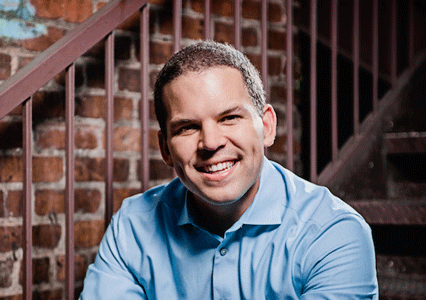
Shining our light as children of Christ doesn’t end at the portal to the digital world. To strengthen this mission, the Diocesan Office of Communications will host the Digital Church Conference, which features Catholic social media and website experts presenting on how to build the digital kingdom online. The conference will offer practical strategies on how to create an engaging online presence while framing that presence through the lens of the Catholic faith. Parish and school website directors, social media administrators, bloggers, teachers, catechists, clergy, and the laity are all invited for a day of learning and exploration about living the Gospel in their online lives.
In advance of the event, the Monitor spoke to three of the featured speakers, eCatholic’s Josh Simmons, Flocknote's Matt Warner, and Brandon Vogt of Word on Fire. They, along with Michael Marchand, will present at the conference, which will take on Dec. 5 from 9 a.m. to 4 p.m. at 4620 Nottingham Way, Hamilton Square. Registration is $35 for an individual or $250 for a group of 10, and lunch will be served. More information is available at www.URCalled.com
***
Josh Simmons is the founder and CEO of eCatholic, one of the largest providers of Catholic websites in the country. Before launching eCatholic, he also worked in the Church for several years as a youth minister, director of faith formation, and music minister. He also developed and has lead a popular “eMinistry” Seminar in Dioceses around the country. Josh has a bachelor’s degree in engineering from Texas A&M University and lives in College Station, Tex., with his wife Elizabeth and their five children.
The Monitor: eCatholic helps parishes, schools, and other Catholic organizations deliver dynamic content to their parishioners and members. What do you think is the biggest challenge Catholic communities face with their websites today?
Simmons: Communicating effectively. We can't just provide information, we have to make our websites beautiful, welcoming, and engaging – just like our faith. This means providing a clean and simple design, a great user experience on all devices, and relevant and concise content.
The Monitor: What inspired you to turn a sideline developing websites into a fulltime ministry of supporting parishes?
Simmons: The short answer – I saw a desperate and unfilled need in the Church and felt called to solve it. While I was a youth minister, I noticed that most of our Catholic websites were terrible or non-existent. I knew that if I could figure out a way to help parishes create beautiful, dynamic websites that were easy to update, I could help transform the communication of the Church. Thus was born the idea that became eCatholic.
The Monitor: What do you see the role of faith in the online world? How can people of faith incorporate their identity as a child of God into the digital presence?
Simmons: The role of faith in the online world is the same as the offline world – to evangelize and transform the culture. The exciting part is that the digital world provides us with an opportunity to reach more people, more quickly, than any other time in history! The key is to be authentic. Not obnoxious, just authentic. We must learn to listen and understand before we can effectively share and be understood. Be transparent and humble but bold and courageous.
The Monitor: Why is it important for Catholics, whether in parishes or as individuals, to engage and communicate in the digital sphere? How did you come to that conclusion?
Simmons: As Catholics, we are called to go to where the people are and be a light unto the world. So where are the people today? Online! Throughout history, the truth has remained the same, but the means in which we effectively and efficiently communicate it have changed. New media provides us an incredible opportunity to share our faith and live out the New Evangelization!
***
Brandon Vogt is a Catholic author, speaker, and new media expert who works as the content director for Bishop Robert Barron’s Word on Fire Catholic Ministries. He blogs at BrandonVogt.com and is the author of five books. In May 2011, Brandon was invited to the Vatican to dialogue with Church officials about new media. Brandon lives in Casselberry, Fla., with his wife, Kathleen, and their three children.
The Monitor: You’re one of the leaders in using digital media tools and resources to share the good news of the Gospel. Did you imagine a career in doing this work?
Vogt: Not in a million years. I converted to the Catholic church in 2000 and I thought I’d become an ordinary Catholic, go to Mass, maybe get involved in the parish…I was a young guy, and was in college right in the mist of the digital revolution. I started a blog and was on Twitter, using a lot of these tools, and once I became Catholic, I realized the Church was a little behind the times, and that inspired me to get more involved.
I was writing my first book (“The Church and New Media: Blogging Converts, Online Activists, and Bishops Who Tweet”), and I invited then-Father Robert Barron to write a chapter in the book…He did, and over the next couple years he and I worked on a number of projects together, including the “CATHOLICISM: The New Evangelization” film series and study guide…we collaborated a lot and eventually he was kind of like, “Why don’t you work for me full time?”… I prayed about it and I felt like this is where God is calling me.
The Monitor: How did your journey as a convert influence your career and the way you see the role of the faithful online?
Vogt: I came from a Protestant background, was very involved with the Methodist campus ministry [at Florida State University], and they were really on top of everything when it came to digital ministry, so coming to the Catholic church was kind of an eye-opener…I wanted to learn more, and was being pointed to cassette tapes and TV shows, God bless them…It inspired me to want to do something new [for] the digital space.
One of my favorite quotes is from Frederick Buechner - “The place God calls you to is the place where your deep gladness and the world’s deep hunger meet.” If I can match the things I’m good at with the world needs, that’s where I’m called to be.
The Monitor: In your blog, books, and work with Word on Fire, you’ve stressed the importance of reading widely and engaging with those who may not agree with everything the Church teaches. But the Internet is notorious for breeding conflict and disagreement. How can Christians keep from being sucked in?
Vogt: The Internet is a communications tool, so the question is whether to make it a hostile environment or a charitable environment. It’s not dependent on the tool itself but on who’s using it…it’s naturally anonymous, you don’t see anyone’s faces, so it makes it more tempting to dehumanize people, so you have to be on guard against that…One thing I try to stress [is]…real identities can help raise the level of discourse - a reminder that behind every person you interact with is a real human being, a real father or mother or son or daughter…we can lose touch of that online.
The Monitor: How can people of faith incorporate their identity as a child of God into the digital presence? What message would you want to give people seeking to be authentic witnesses?
Vogt: Many Catholics are afraid to share their faith at all on the internet, so do it! Don’t be afraid. The Internet is a great tool because it can be easier than a face-to-face conversation to naturally share your faith…You can share a link on Facebook and it’s a lot less threatening than having a conversation about a contentious topic…So that would be something I’d suggest - to find a good article or video to share with others, post [it] and say something like “here’s an interesting article, what do you guys think?” So you don’t have to put things in your words and can get this discussion going in a natural, charitable way.
***
Matt Warner is a self-described "Catholic husband, father, tweeter, blogger and social media nerd." In 2008, Matt left his engineering career to focus full time on New Media and the Catholic Faith. He is the founder of FlockNote.com, TweetCatholic.com, QuoteCatholic.com and his popular blog, Fallible Blogma. In his free time, he can be found changing diapers and building LEGO empires. Matt has a B.S. in Electrical Engineering from Texas A&M and an M.B.A. in Entrepreneurship, and lives in Texas with his family.
Warner: After college, I realized how many of my peers were drifting away from the Church. I wanted to help, but I didn’t know how. I quickly realized that to best help others, I first needed to dive deeper into the faith myself! So I did. And what I found blew me away. I found amazing, thoughtful answers to life’s most important questions. I found joyful communities of people doing inspiring things to serve others. I found the fullest experience of the true, the good and the beautiful. I found a loving God who wants to know each of us intimately and who wants to help everyone become the saint they were created to be…I was a computer engineer by day, so I started working nights experimenting with ideas that could help improve the situation. After tons of trial and error, some tough lessons-learned and lots of hard work, I eventually quit my job and created what is now Flocknote.
The Monitor: Flocknote achieved national attention for sending out daily emails allowing people to read the Gospels or the Catechism in a year – Where that idea grow out of? How does that exemplify what you’re hoping to do with the service?
Warner: It was simply a side project that caught on and hundreds of thousands of people joined in on. It is certainly one example of the power, practicality and convenience of email and text message communications. Most foundationally, we help parishes and ministries more efficiently and effectively connect with and communicate with their people. We do that by making the most powerful communication methods of today simple for church leadership to use. We're on a mission to build a more connected Church by helping church leaders listen to, understand and better communicate with their people.
The Monitor: What do you see the role of faith in the online world? How can people of faith incorporate their identity as a child of God into the digital presence?
Warner: It's a challenge, especially for those who aren't complete digital natives. And even for digital natives, it's easy for one's true identity to get lost in it all. But certainly as The Church we must find ways to carry on our mission in an increasingly digital world. And certainly many of the technologies available to use can help us do so more powerfully than we've ever been able to do before. That's pretty exciting!
The Monitor: What is the biggest challenge that parishes face in communicating with their parishioners? What do you wish more people knew about how staying in touch in the digital age is changing the way people get information?
Warner: The biggest challenge is that too many parishes have forgotten they are on a mission. They are stuck in maintenance mode. And no matter how fancy your communication tools are, nobody is inspired to join a community in maintenance mode. We have to wake up and start communicating the exciting, radical, life-changing work we're doing as the Church. That is what inspires and moves people -- not technology. That is what changes the world. Once parish leadership gets that, then the new technologies and communication tools are able to magnify their work in amazing ways. At Flocknote, we love helping remind parishes and ministries of that and helping them tell the world and their people about the extraordinary things they are doing.
Interviews conducted for The Monitor by Patrick T. Brown, associate editor. Responses have been lightly edited for length.
[[In-content Ad]]Related Stories
Sunday, December 14, 2025


E-Editions
Events
Shining our light as children of Christ doesn’t end at the portal to the digital world. To strengthen this mission, the Diocesan Office of Communications will host the Digital Church Conference, which features Catholic social media and website experts presenting on how to build the digital kingdom online. The conference will offer practical strategies on how to create an engaging online presence while framing that presence through the lens of the Catholic faith. Parish and school website directors, social media administrators, bloggers, teachers, catechists, clergy, and the laity are all invited for a day of learning and exploration about living the Gospel in their online lives.
In advance of the event, the Monitor spoke to three of the featured speakers, eCatholic’s Josh Simmons, Flocknote's Matt Warner, and Brandon Vogt of Word on Fire. They, along with Michael Marchand, will present at the conference, which will take on Dec. 5 from 9 a.m. to 4 p.m. at 4620 Nottingham Way, Hamilton Square. Registration is $35 for an individual or $250 for a group of 10, and lunch will be served. More information is available at www.URCalled.com
***
Josh Simmons is the founder and CEO of eCatholic, one of the largest providers of Catholic websites in the country. Before launching eCatholic, he also worked in the Church for several years as a youth minister, director of faith formation, and music minister. He also developed and has lead a popular “eMinistry” Seminar in Dioceses around the country. Josh has a bachelor’s degree in engineering from Texas A&M University and lives in College Station, Tex., with his wife Elizabeth and their five children.
The Monitor: eCatholic helps parishes, schools, and other Catholic organizations deliver dynamic content to their parishioners and members. What do you think is the biggest challenge Catholic communities face with their websites today?
Simmons: Communicating effectively. We can't just provide information, we have to make our websites beautiful, welcoming, and engaging – just like our faith. This means providing a clean and simple design, a great user experience on all devices, and relevant and concise content.
The Monitor: What inspired you to turn a sideline developing websites into a fulltime ministry of supporting parishes?
Simmons: The short answer – I saw a desperate and unfilled need in the Church and felt called to solve it. While I was a youth minister, I noticed that most of our Catholic websites were terrible or non-existent. I knew that if I could figure out a way to help parishes create beautiful, dynamic websites that were easy to update, I could help transform the communication of the Church. Thus was born the idea that became eCatholic.
The Monitor: What do you see the role of faith in the online world? How can people of faith incorporate their identity as a child of God into the digital presence?
Simmons: The role of faith in the online world is the same as the offline world – to evangelize and transform the culture. The exciting part is that the digital world provides us with an opportunity to reach more people, more quickly, than any other time in history! The key is to be authentic. Not obnoxious, just authentic. We must learn to listen and understand before we can effectively share and be understood. Be transparent and humble but bold and courageous.
The Monitor: Why is it important for Catholics, whether in parishes or as individuals, to engage and communicate in the digital sphere? How did you come to that conclusion?
Simmons: As Catholics, we are called to go to where the people are and be a light unto the world. So where are the people today? Online! Throughout history, the truth has remained the same, but the means in which we effectively and efficiently communicate it have changed. New media provides us an incredible opportunity to share our faith and live out the New Evangelization!
***
Brandon Vogt is a Catholic author, speaker, and new media expert who works as the content director for Bishop Robert Barron’s Word on Fire Catholic Ministries. He blogs at BrandonVogt.com and is the author of five books. In May 2011, Brandon was invited to the Vatican to dialogue with Church officials about new media. Brandon lives in Casselberry, Fla., with his wife, Kathleen, and their three children.
The Monitor: You’re one of the leaders in using digital media tools and resources to share the good news of the Gospel. Did you imagine a career in doing this work?
Vogt: Not in a million years. I converted to the Catholic church in 2000 and I thought I’d become an ordinary Catholic, go to Mass, maybe get involved in the parish…I was a young guy, and was in college right in the mist of the digital revolution. I started a blog and was on Twitter, using a lot of these tools, and once I became Catholic, I realized the Church was a little behind the times, and that inspired me to get more involved.
I was writing my first book (“The Church and New Media: Blogging Converts, Online Activists, and Bishops Who Tweet”), and I invited then-Father Robert Barron to write a chapter in the book…He did, and over the next couple years he and I worked on a number of projects together, including the “CATHOLICISM: The New Evangelization” film series and study guide…we collaborated a lot and eventually he was kind of like, “Why don’t you work for me full time?”… I prayed about it and I felt like this is where God is calling me.
The Monitor: How did your journey as a convert influence your career and the way you see the role of the faithful online?
Vogt: I came from a Protestant background, was very involved with the Methodist campus ministry [at Florida State University], and they were really on top of everything when it came to digital ministry, so coming to the Catholic church was kind of an eye-opener…I wanted to learn more, and was being pointed to cassette tapes and TV shows, God bless them…It inspired me to want to do something new [for] the digital space.
One of my favorite quotes is from Frederick Buechner - “The place God calls you to is the place where your deep gladness and the world’s deep hunger meet.” If I can match the things I’m good at with the world needs, that’s where I’m called to be.
The Monitor: In your blog, books, and work with Word on Fire, you’ve stressed the importance of reading widely and engaging with those who may not agree with everything the Church teaches. But the Internet is notorious for breeding conflict and disagreement. How can Christians keep from being sucked in?
Vogt: The Internet is a communications tool, so the question is whether to make it a hostile environment or a charitable environment. It’s not dependent on the tool itself but on who’s using it…it’s naturally anonymous, you don’t see anyone’s faces, so it makes it more tempting to dehumanize people, so you have to be on guard against that…One thing I try to stress [is]…real identities can help raise the level of discourse - a reminder that behind every person you interact with is a real human being, a real father or mother or son or daughter…we can lose touch of that online.
The Monitor: How can people of faith incorporate their identity as a child of God into the digital presence? What message would you want to give people seeking to be authentic witnesses?
Vogt: Many Catholics are afraid to share their faith at all on the internet, so do it! Don’t be afraid. The Internet is a great tool because it can be easier than a face-to-face conversation to naturally share your faith…You can share a link on Facebook and it’s a lot less threatening than having a conversation about a contentious topic…So that would be something I’d suggest - to find a good article or video to share with others, post [it] and say something like “here’s an interesting article, what do you guys think?” So you don’t have to put things in your words and can get this discussion going in a natural, charitable way.
***
Matt Warner is a self-described "Catholic husband, father, tweeter, blogger and social media nerd." In 2008, Matt left his engineering career to focus full time on New Media and the Catholic Faith. He is the founder of FlockNote.com, TweetCatholic.com, QuoteCatholic.com and his popular blog, Fallible Blogma. In his free time, he can be found changing diapers and building LEGO empires. Matt has a B.S. in Electrical Engineering from Texas A&M and an M.B.A. in Entrepreneurship, and lives in Texas with his family.
Warner: After college, I realized how many of my peers were drifting away from the Church. I wanted to help, but I didn’t know how. I quickly realized that to best help others, I first needed to dive deeper into the faith myself! So I did. And what I found blew me away. I found amazing, thoughtful answers to life’s most important questions. I found joyful communities of people doing inspiring things to serve others. I found the fullest experience of the true, the good and the beautiful. I found a loving God who wants to know each of us intimately and who wants to help everyone become the saint they were created to be…I was a computer engineer by day, so I started working nights experimenting with ideas that could help improve the situation. After tons of trial and error, some tough lessons-learned and lots of hard work, I eventually quit my job and created what is now Flocknote.
The Monitor: Flocknote achieved national attention for sending out daily emails allowing people to read the Gospels or the Catechism in a year – Where that idea grow out of? How does that exemplify what you’re hoping to do with the service?
Warner: It was simply a side project that caught on and hundreds of thousands of people joined in on. It is certainly one example of the power, practicality and convenience of email and text message communications. Most foundationally, we help parishes and ministries more efficiently and effectively connect with and communicate with their people. We do that by making the most powerful communication methods of today simple for church leadership to use. We're on a mission to build a more connected Church by helping church leaders listen to, understand and better communicate with their people.
The Monitor: What do you see the role of faith in the online world? How can people of faith incorporate their identity as a child of God into the digital presence?
Warner: It's a challenge, especially for those who aren't complete digital natives. And even for digital natives, it's easy for one's true identity to get lost in it all. But certainly as The Church we must find ways to carry on our mission in an increasingly digital world. And certainly many of the technologies available to use can help us do so more powerfully than we've ever been able to do before. That's pretty exciting!
The Monitor: What is the biggest challenge that parishes face in communicating with their parishioners? What do you wish more people knew about how staying in touch in the digital age is changing the way people get information?
Warner: The biggest challenge is that too many parishes have forgotten they are on a mission. They are stuck in maintenance mode. And no matter how fancy your communication tools are, nobody is inspired to join a community in maintenance mode. We have to wake up and start communicating the exciting, radical, life-changing work we're doing as the Church. That is what inspires and moves people -- not technology. That is what changes the world. Once parish leadership gets that, then the new technologies and communication tools are able to magnify their work in amazing ways. At Flocknote, we love helping remind parishes and ministries of that and helping them tell the world and their people about the extraordinary things they are doing.
Interviews conducted for The Monitor by Patrick T. Brown, associate editor. Responses have been lightly edited for length.
[[In-content Ad]]