


Department of Catholic Cemeteries ministers to diocesan faithful
July 29, 2019 at 12:37 p.m.
By Christina Leslie | Staff Writer
Burial of the dead is one of the Church’s seven corporal works of mercy. Preparing a final resting place for deceased Catholics in consecrated, or blessed, ground allows the faithful to complete the cycle of faith begun at Baptism and serves as the last testimony of those who believe in the hope of resurrection. Additionally, burial in a Catholic cemetery serves as a public witness to the sanctity of life.
Catholics in the Diocese of Trenton and their families are served by the diocesan Department of Catholic Cemeteries, which recognizes the importance of a respectful committal of the body and the works of mercy involved in the nurturing and preservation of the grounds which serve as a final resting place for generations of Catholics. The department, through its work in both parish properties and expanding diocesan cemeteries, as well as with both cemetery staff and bereaved families, is working to meet the needs of the Catholic community now and well into the future.
Mark Wilson, department director, outlined the steps the department takes to fulfill its mission to share its ministry of knowledgeable, prayerful support to the faithful in their time of need.
Resources, Assistance for All
The Department of Catholic Cemeteries operates the “flagship” cemetery of the Diocese of Trenton, St. Mary’s Cemetery. With an endowed perpetual care fund, the 35-acre expanse on Cedar Lane near Olden Avenue, Trenton, has provided a sacred, well-tended and peaceful setting since it first opened in 1850. St. Mary’s operates four area “satellite” cemeteries: St. Francis, St. Stephen, Holy Sepulchre and St. Nicholas.
For those families who desire an above-ground burial of their loved one’s mortal remains, the cemetery offers interment in one of five mausoleums. These free-standing buildings serve both as a monument and burial chambers for its deceased inhabitants; in addition to the tombs themselves, the mausoleums contain benches for visitors, a place for flowers, statuary and a chapel to offer a home for prayers for the dead. Masses for the deceased are also held in these Catholic mausoleums throughout the year.
In addition to St. Mary’s Cemetery, the Diocese of Trenton enfolds 26 cemeteries operated by parishes within its four counties. Whether they are operated by volunteers or professional staff, Wilson stressed he is available to assist the parishes in fulfilling their sacred duty to treat those who have gone before us in faith with the utmost respect.
“Part of my mission is to help parishes run their cemeteries, to be a resource for them to call upon,” he said. To that end, the department holds continuing educational seminars in each of the four counties for parish cemetery staff that are designed to strengthen and formalize the interment process. Wilson noted diocesan personnel are available to assist parish representatives to consult with the bereaved, arrange for dignified interment as part of the Christian burial ceremony, perform ground and building maintenance and keep careful records.
The same care is taken with cemetery operations whether they are expanding or have reached full capacity, or belong to parishes still in operation or have merged or closed, the director stressed. “We are in the eternity business,” Wilson said. “The Catholic Church doesn’t walk away from cemeteries; we will continue to run them.”
Change Ever Constant
Wilson noted the cemeteries of the Diocese are continually maintained and improved, serving to enrich the experience for visiting Catholics seeking modern yet faith-filled places of rest. Requests from an increasing number of individuals and families seeking interment in mausoleums prompted the completion of two such facilities in the Diocese.
St. Anne’s Mausoleum, Wall, which is managed by St. Catharine-St. Margaret Parish, Spring Lake, was opened for entombments in the fourth quarter of 2014, making fulfillment for this type of interment a reality for families of deceased first buried in the cemetery’s grave sites. Msgr. Thomas A. Luebking, former pastor of St. Catherine-St. Margaret Parish, was the first of over 60 decedents to be transferred from their temporary resting place in the parish cemetery to the above-ground mausoleum. Similar transfers were made with the completion of the Christ the King Mausoleum at St. Maximilian Kolbe, Toms River.
A New Resting Place for Burlington County
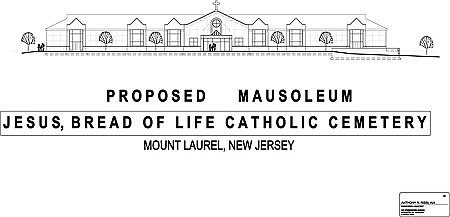
Construction is underway in Mount Laurel for the second diocesan cemetery. Jesus, Bread of Life Catholic Cemetery, the County, will offer the opportunity for Catholics in this county to be buried within our Diocese rather than crossing the border into Camden Diocese. It is slated to serve the faithful from seven local parishes: Holy Eucharist, Tabernacle; Our Lady of Good Counsel, Moorestown; St. Ann, Browns Mills; St. Isaac Jogues, Marlton; St. Joan of Arc, Marlton; St. John Neumann, Mount Laurel and St. Mary of the Lakes, Medford.
Purchased by the Diocese for $1.2 million in April 2012, the 13-acre site named Jesus, Bread of Life Catholic Cemetery “completes the full cycle of Catholicism,” noted Wilson. “On a daily basis you are prayed for as a Catholic. We have the advantage of being able to say Mass on site.”
Initially, five sections of flat-marker graves and two upright monument sections will open on the 13-acre site on Fostertown Road. Upright monuments will fill interior sections; ground burial options at the cemetery will include single and double depth full body interments and single depth burials for cremated remains.
Ground burial capacity in the first seven sections will exceed 3,400 casket spaces for double depth burials; when fully developed, there will be over 9,000 casket spaces.
The future mausoleum space will feature abbey crypts, which are located one level below the floor, as well as single, companion and oversized crypts in the interior. There will also be niches for cremated remains. The exterior offerings will include single and companion crypts as well as a stand-alone niche section. Total casket spaces will number more than 1,400, including abbey crypts, and over 800 niches.
Haks Engineers & Architects of Mount Laurel has designed the site plan for the Jesus Bread of Life Catholic Cemetery and Longford Landscapes is doing the site work. Ground burials will take place before the mausoleum, designed by Rissi & Associates, is built; selection of a mausoleum contractor has been made pending finalization of a contract.
Concrete foundations known as “ribbons” have been poured in the first two upright monument sections, named for Saints Ignatius and Therese, reported Wilson, who anticipates ground burials at the cemetery will begin in the second quarter of 2015.
Future Growth
The 2012 study which recommended the construction of Jesus, Bread of Life Catholic Cemetery also identified the need for four additional diocesan cemeteries to be located in Neptune, Brick, Hamilton and Jackson. In response to this, and to the estimate that St. Mary Cemetery will reach capacity within the next 10 years, the Diocese has planned construction on a diocesan cemetery in Hamilton Township, thus offering Catholics from area parishes additional options to honor their loved ones after death.
The Diocese is in hearings with Hamilton Township for permission to build a cemetery with three mausoleums on land purchased in the 1950s for the purpose of creating a church and cemetery or stand-alone cemetery. Zoning board meetings on the issue continue.
Planning Ahead: A Loving Gesture
Wilson, a ten-year veteran of the funeral home and interment industry, strongly advocates Catholics consider pre-planning their final arrangements, then informing their families and loved ones of their intentions.
“In order to save undue and unnecessary grief at the worst time of your family’s life, we always suggest that you to preplan your final arrangements. Promote the discussion with your family when everyone is gathered, such as at holiday times,” he said, advising the details be finalized in writing and given to trusted family members, not filed away in a safe deposit box. “By having the discussion, you avoid [your family] making the decisions for you,” he noted.
Money should not be a stumbling block to such conversations, Wilson continued. “Do the research while you can. You can talk to the people at the cemetery with no financial obligation,” he concluded, “but if you make the plans now, you can forgo inflationary increases. Start the discussion.”
[[In-content Ad]]
Related Stories
Sunday, December 14, 2025

E-Editions
Events
By Christina Leslie | Staff Writer
Burial of the dead is one of the Church’s seven corporal works of mercy. Preparing a final resting place for deceased Catholics in consecrated, or blessed, ground allows the faithful to complete the cycle of faith begun at Baptism and serves as the last testimony of those who believe in the hope of resurrection. Additionally, burial in a Catholic cemetery serves as a public witness to the sanctity of life.
Catholics in the Diocese of Trenton and their families are served by the diocesan Department of Catholic Cemeteries, which recognizes the importance of a respectful committal of the body and the works of mercy involved in the nurturing and preservation of the grounds which serve as a final resting place for generations of Catholics. The department, through its work in both parish properties and expanding diocesan cemeteries, as well as with both cemetery staff and bereaved families, is working to meet the needs of the Catholic community now and well into the future.
Mark Wilson, department director, outlined the steps the department takes to fulfill its mission to share its ministry of knowledgeable, prayerful support to the faithful in their time of need.
Resources, Assistance for All
The Department of Catholic Cemeteries operates the “flagship” cemetery of the Diocese of Trenton, St. Mary’s Cemetery. With an endowed perpetual care fund, the 35-acre expanse on Cedar Lane near Olden Avenue, Trenton, has provided a sacred, well-tended and peaceful setting since it first opened in 1850. St. Mary’s operates four area “satellite” cemeteries: St. Francis, St. Stephen, Holy Sepulchre and St. Nicholas.
For those families who desire an above-ground burial of their loved one’s mortal remains, the cemetery offers interment in one of five mausoleums. These free-standing buildings serve both as a monument and burial chambers for its deceased inhabitants; in addition to the tombs themselves, the mausoleums contain benches for visitors, a place for flowers, statuary and a chapel to offer a home for prayers for the dead. Masses for the deceased are also held in these Catholic mausoleums throughout the year.
In addition to St. Mary’s Cemetery, the Diocese of Trenton enfolds 26 cemeteries operated by parishes within its four counties. Whether they are operated by volunteers or professional staff, Wilson stressed he is available to assist the parishes in fulfilling their sacred duty to treat those who have gone before us in faith with the utmost respect.
“Part of my mission is to help parishes run their cemeteries, to be a resource for them to call upon,” he said. To that end, the department holds continuing educational seminars in each of the four counties for parish cemetery staff that are designed to strengthen and formalize the interment process. Wilson noted diocesan personnel are available to assist parish representatives to consult with the bereaved, arrange for dignified interment as part of the Christian burial ceremony, perform ground and building maintenance and keep careful records.
The same care is taken with cemetery operations whether they are expanding or have reached full capacity, or belong to parishes still in operation or have merged or closed, the director stressed. “We are in the eternity business,” Wilson said. “The Catholic Church doesn’t walk away from cemeteries; we will continue to run them.”
Change Ever Constant
Wilson noted the cemeteries of the Diocese are continually maintained and improved, serving to enrich the experience for visiting Catholics seeking modern yet faith-filled places of rest. Requests from an increasing number of individuals and families seeking interment in mausoleums prompted the completion of two such facilities in the Diocese.
St. Anne’s Mausoleum, Wall, which is managed by St. Catharine-St. Margaret Parish, Spring Lake, was opened for entombments in the fourth quarter of 2014, making fulfillment for this type of interment a reality for families of deceased first buried in the cemetery’s grave sites. Msgr. Thomas A. Luebking, former pastor of St. Catherine-St. Margaret Parish, was the first of over 60 decedents to be transferred from their temporary resting place in the parish cemetery to the above-ground mausoleum. Similar transfers were made with the completion of the Christ the King Mausoleum at St. Maximilian Kolbe, Toms River.
A New Resting Place for Burlington County
Construction is underway in Mount Laurel for the second diocesan cemetery. Jesus, Bread of Life Catholic Cemetery, the County, will offer the opportunity for Catholics in this county to be buried within our Diocese rather than crossing the border into Camden Diocese. It is slated to serve the faithful from seven local parishes: Holy Eucharist, Tabernacle; Our Lady of Good Counsel, Moorestown; St. Ann, Browns Mills; St. Isaac Jogues, Marlton; St. Joan of Arc, Marlton; St. John Neumann, Mount Laurel and St. Mary of the Lakes, Medford.
Purchased by the Diocese for $1.2 million in April 2012, the 13-acre site named Jesus, Bread of Life Catholic Cemetery “completes the full cycle of Catholicism,” noted Wilson. “On a daily basis you are prayed for as a Catholic. We have the advantage of being able to say Mass on site.”
Initially, five sections of flat-marker graves and two upright monument sections will open on the 13-acre site on Fostertown Road. Upright monuments will fill interior sections; ground burial options at the cemetery will include single and double depth full body interments and single depth burials for cremated remains.
Ground burial capacity in the first seven sections will exceed 3,400 casket spaces for double depth burials; when fully developed, there will be over 9,000 casket spaces.
The future mausoleum space will feature abbey crypts, which are located one level below the floor, as well as single, companion and oversized crypts in the interior. There will also be niches for cremated remains. The exterior offerings will include single and companion crypts as well as a stand-alone niche section. Total casket spaces will number more than 1,400, including abbey crypts, and over 800 niches.
Haks Engineers & Architects of Mount Laurel has designed the site plan for the Jesus Bread of Life Catholic Cemetery and Longford Landscapes is doing the site work. Ground burials will take place before the mausoleum, designed by Rissi & Associates, is built; selection of a mausoleum contractor has been made pending finalization of a contract.
Concrete foundations known as “ribbons” have been poured in the first two upright monument sections, named for Saints Ignatius and Therese, reported Wilson, who anticipates ground burials at the cemetery will begin in the second quarter of 2015.
Future Growth
The 2012 study which recommended the construction of Jesus, Bread of Life Catholic Cemetery also identified the need for four additional diocesan cemeteries to be located in Neptune, Brick, Hamilton and Jackson. In response to this, and to the estimate that St. Mary Cemetery will reach capacity within the next 10 years, the Diocese has planned construction on a diocesan cemetery in Hamilton Township, thus offering Catholics from area parishes additional options to honor their loved ones after death.
The Diocese is in hearings with Hamilton Township for permission to build a cemetery with three mausoleums on land purchased in the 1950s for the purpose of creating a church and cemetery or stand-alone cemetery. Zoning board meetings on the issue continue.
Planning Ahead: A Loving Gesture
Wilson, a ten-year veteran of the funeral home and interment industry, strongly advocates Catholics consider pre-planning their final arrangements, then informing their families and loved ones of their intentions.
“In order to save undue and unnecessary grief at the worst time of your family’s life, we always suggest that you to preplan your final arrangements. Promote the discussion with your family when everyone is gathered, such as at holiday times,” he said, advising the details be finalized in writing and given to trusted family members, not filed away in a safe deposit box. “By having the discussion, you avoid [your family] making the decisions for you,” he noted.
Money should not be a stumbling block to such conversations, Wilson continued. “Do the research while you can. You can talk to the people at the cemetery with no financial obligation,” he concluded, “but if you make the plans now, you can forgo inflationary increases. Start the discussion.”
[[In-content Ad]]