


A brief history of the Pueblo people and missions
July 29, 2019 at 12:37 p.m.
By Nancy Wiechec | Catholic News Service
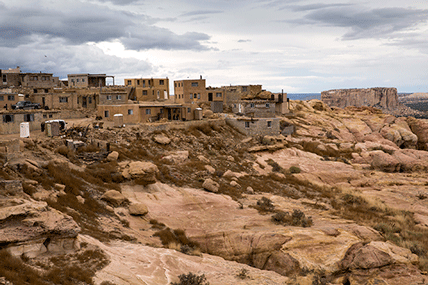
ALBUQUERQUE, N.M. -- Prehistoric ruins tell of Pueblo-type cultures existing in what is now Utah and Colorado southward into Mexico.
The ancestral Pueblo people, also known as the Anasazi, were distinguished by settled life in communal structures built of stone or adobe. They subsisted on agriculture and trading. By the mid-1500s, their populations had been reduced to areas in central and northwestern New Mexico and to the Hopi mesas in northeastern Arizona.
Franciscan Friar Marcos de Niza scouted the region for Spain in 1539.
The first Spanish settlement and mission were established in San Juan Pueblo (now known by its traditional name, Ohkay Owingeh Pueblo) under the patronage of St. Gabriel in 1598. The colonial government Santa Fe de Nuevo Mexico was eventually formed with a Franciscan priest assigned to each district. By 1616, Spanish Franciscans had overseen the construction of at least nine missions.
Spanish forces ultimately used intimidation and oppression to force Indians to leave behind their traditional spiritual practices and solely accept Christianity. Tensions led to violence. The Spanish raided and destroyed ceremonial kivas and imprisoned and executed some Pueblo spiritual leaders.
Pueblo Indians led by Po'pay staged a revolt and drove out the Spanish in 1680. The Indians killed more than 400 Spaniards, including 21 missionaries. The missions were burned to the ground. Pueblos retained independence for 12 years. In 1692 the Spanish repossessed the area and most pueblos adapted to colonial rule through syncretism. The people kept their traditional belief systems and many adopted Catholicism. There was relative calm for more than a century.
Mexico won independence from Spain in 1821. New Mexico became a territory of the United States in 1848 at the end of the Mexican-American War. There were fewer Spanish friars serving the Catholic churches and missions of New Mexico. In some remote areas, a priest would visit only a few times a year.
In the 19th and early 20th centuries, Pueblo culture was affected by efforts to assimilate Native Americans to American-European ideals and customs. With the Dawes Act of 1887, the government sought to allot land to each Indian resident, contrary to the Pueblos' communal way of life. Indian children were sent from their homes to boarding schools, immersing them in American culture. The 1883 Code of Indian Offenses sought to suppress ceremonial dances and the practices of medicine men.
Friars from the Franciscans' Cincinnati-based Province of St. John the Baptist began arriving in pueblo missions and New Mexico parishes in the late 1800s. By 1985, there were 100 Franciscans serving in New Mexico and Arizona.
Many of the federal policies that led to diminishing Indian populations and culture were eventually reversed and Indians were given more autonomy. The 1978 American Indian Religious Freedom Act sought to protect traditional religious and cultural practices.
Today, there are 21 surviving pueblos, 19 of them in New Mexico. Probably the best known communities are the Taos, Acoma and Zuni in New Mexico and the Hopi in Arizona. The Hopi as a whole never adopted Christianity.
Catholic missions still stand in each pueblo community in New Mexico. A few of the mission churches date to the late 1600s and early 1700s. Laguna Pueblo alone has six missions, one in each village of the pueblo. Two Franciscan priests are based in Laguna and Jemez pueblos. The other pueblos are mainly served by priests of the Santa Fe Archdiocese.
Although the pueblos value privacy, many of the communities are open to visitors, especially during feast-day celebrations. Each one marks its patron saint's feast with Catholic rites, a procession and Indian dance ceremonies.
There are an estimated 75,000 individuals of Pueblo descent.
[[In-content Ad]]
Related Stories
Monday, December 15, 2025
E-Editions
Events
By Nancy Wiechec | Catholic News Service
ALBUQUERQUE, N.M. -- Prehistoric ruins tell of Pueblo-type cultures existing in what is now Utah and Colorado southward into Mexico.
The ancestral Pueblo people, also known as the Anasazi, were distinguished by settled life in communal structures built of stone or adobe. They subsisted on agriculture and trading. By the mid-1500s, their populations had been reduced to areas in central and northwestern New Mexico and to the Hopi mesas in northeastern Arizona.
Franciscan Friar Marcos de Niza scouted the region for Spain in 1539.
The first Spanish settlement and mission were established in San Juan Pueblo (now known by its traditional name, Ohkay Owingeh Pueblo) under the patronage of St. Gabriel in 1598. The colonial government Santa Fe de Nuevo Mexico was eventually formed with a Franciscan priest assigned to each district. By 1616, Spanish Franciscans had overseen the construction of at least nine missions.
Spanish forces ultimately used intimidation and oppression to force Indians to leave behind their traditional spiritual practices and solely accept Christianity. Tensions led to violence. The Spanish raided and destroyed ceremonial kivas and imprisoned and executed some Pueblo spiritual leaders.
Pueblo Indians led by Po'pay staged a revolt and drove out the Spanish in 1680. The Indians killed more than 400 Spaniards, including 21 missionaries. The missions were burned to the ground. Pueblos retained independence for 12 years. In 1692 the Spanish repossessed the area and most pueblos adapted to colonial rule through syncretism. The people kept their traditional belief systems and many adopted Catholicism. There was relative calm for more than a century.
Mexico won independence from Spain in 1821. New Mexico became a territory of the United States in 1848 at the end of the Mexican-American War. There were fewer Spanish friars serving the Catholic churches and missions of New Mexico. In some remote areas, a priest would visit only a few times a year.
In the 19th and early 20th centuries, Pueblo culture was affected by efforts to assimilate Native Americans to American-European ideals and customs. With the Dawes Act of 1887, the government sought to allot land to each Indian resident, contrary to the Pueblos' communal way of life. Indian children were sent from their homes to boarding schools, immersing them in American culture. The 1883 Code of Indian Offenses sought to suppress ceremonial dances and the practices of medicine men.
Friars from the Franciscans' Cincinnati-based Province of St. John the Baptist began arriving in pueblo missions and New Mexico parishes in the late 1800s. By 1985, there were 100 Franciscans serving in New Mexico and Arizona.
Many of the federal policies that led to diminishing Indian populations and culture were eventually reversed and Indians were given more autonomy. The 1978 American Indian Religious Freedom Act sought to protect traditional religious and cultural practices.
Today, there are 21 surviving pueblos, 19 of them in New Mexico. Probably the best known communities are the Taos, Acoma and Zuni in New Mexico and the Hopi in Arizona. The Hopi as a whole never adopted Christianity.
Catholic missions still stand in each pueblo community in New Mexico. A few of the mission churches date to the late 1600s and early 1700s. Laguna Pueblo alone has six missions, one in each village of the pueblo. Two Franciscan priests are based in Laguna and Jemez pueblos. The other pueblos are mainly served by priests of the Santa Fe Archdiocese.
Although the pueblos value privacy, many of the communities are open to visitors, especially during feast-day celebrations. Each one marks its patron saint's feast with Catholic rites, a procession and Indian dance ceremonies.
There are an estimated 75,000 individuals of Pueblo descent.
[[In-content Ad]]