
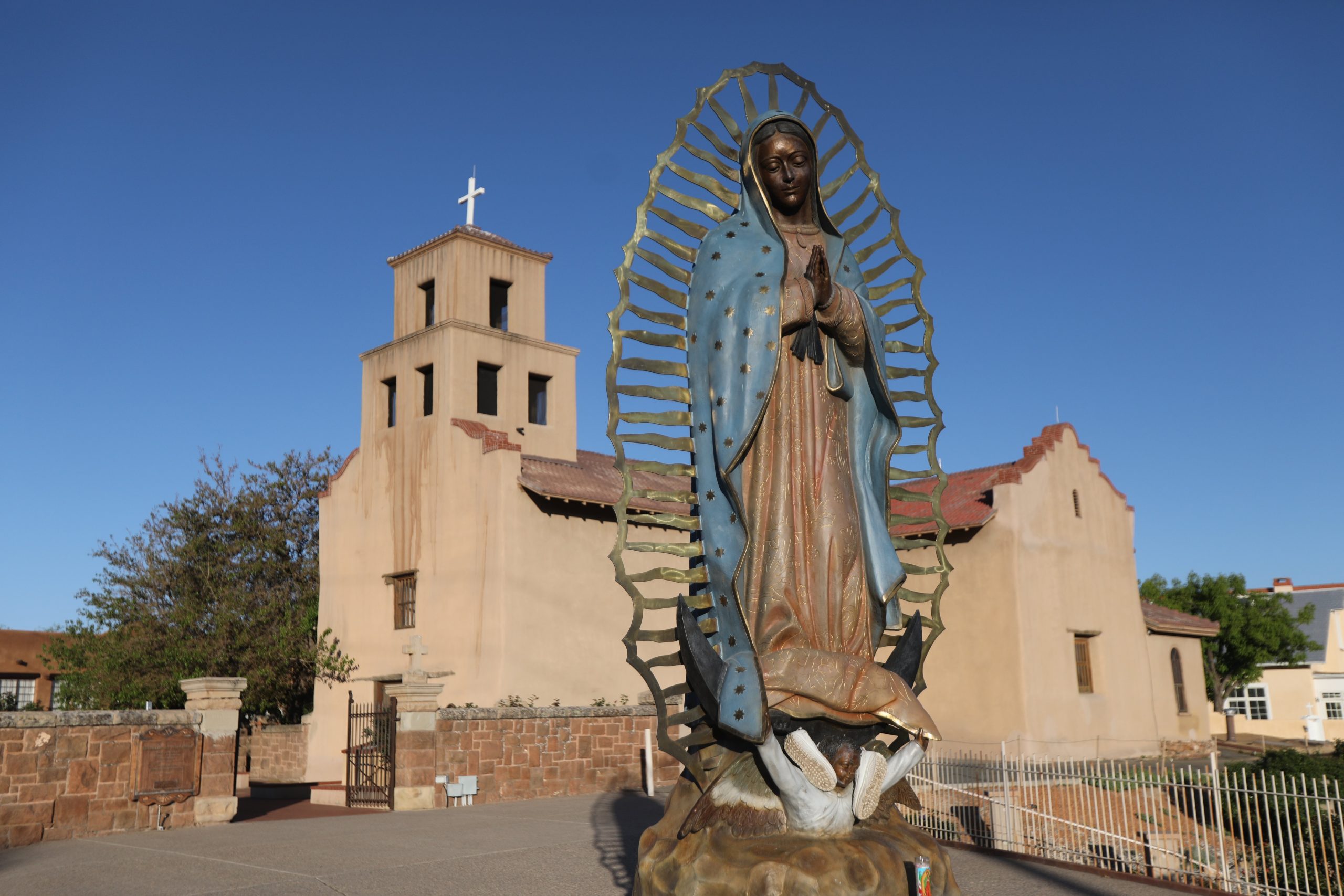
Top photo caption: A sculpture is pictured outside the Sanctuary of Our Lady of Guadalupe in Santa Fe, N.M., May 20, 2021. OSV News photo/Bob Roller, CNS file
By Father Anthony D. Andreassi, OSV News
Our journey through the origins of Catholicism in the 50 states now takes us to Colorado, Utah, New Mexico and Arizona.
Across this vast region, the Church’s history reaches back to the era of Spanish exploration and missionary activity, although the Catholic faith took root at different times and under very different circumstances in each of these four states.
– Colorado –
The first Catholics to enter what is now Colorado were likely Spanish explorers traveling north from New Mexico. Some historians believe the Spanish conquistador and explorer Francisco Vázquez de Coronado and a few Franciscan chaplains crossed what is now southeastern Colorado in 1541, likely marking the first Catholic presence in the region.
In 1850, the Holy See placed what is now Colorado under the jurisdiction of the newly established vicariate apostolic of New Mexico. In 1868, Pope Pius IX established the vicariate apostolic of Colorado and appointed Father Joseph Machebeuf its first bishop. The French-born bishop, who had come to the U.S. in 1839 to serve as a missionary, traveled extensively across his vast territory, ministering to scattered Catholic communities throughout the prairies and rugged Rocky Mountains. In 1887, the vicariate was elevated to become the Diocese of Denver, with Machebeuf as its first bishop.
By the time of his death in 1889, Colorado’s Catholic population had grown to about 40,000, served by more than 60 priests (mostly from France and Ireland) and more than 160 religious sisters.
The first of these to make a lasting presence were the Sisters of Loretto from Nerinx, Kentucky, who played an important role in establishing Catholic education in the region. Under Bishop Machebeuf’s leadership, the Church also established an impressive network of 49 churches, scores of chapels and mission stations, about two dozen schools, 11 Catholic hospitals, an orphanage and a college for men founded by Italian Jesuits (now Regis University).
Machebeuf’s remarkable missionary career and lifelong friendship with Archbishop Lamy of Santa Fe would later find a place in American literature, inspiring Willa Cather’s 1927 novel “Death Comes for the Archbishop,” in which the two missionaries appear as fictionalized characters.
Today, Colorado is home to approximately 1 million Catholics, served by three dioceses: the Archdiocese of Denver and the dioceses of Pueblo and Colorado Springs.
– Utah –
The first recorded Catholic presence in what is now Utah dates to 1776, when Spanish Franciscan friars, sent by the Spanish crown, passed through the area seeking an overland route from New Mexico to California. Traveling without military protections, they encountered Native peoples along the way and introduced them to Christianity. Their journey was among the earliest documented European expeditions into present-day Utah.
Through the 19th century, the Catholic presence in Utah remained small, consisting mainly of traders, trappers and soldiers. Some of these early Catholics explored the region around Great Salt Lake. Beginning in 1847, members of the Church of Jesus Christ of Latter-day Saints (Mormons) settled the area and soon became its dominant religious community. The relatively few Catholics were generally poorer and more transient, including soldiers stationed in Utah by the federal government during the Civil War.
In 1853, the Holy See assigned pastoral responsibility for Utah Territory to Archbishop Joseph Alemany of San Francisco. The first recorded Mass was offered in 1859 by a Franciscan chaplain at Camp Floyd near present-day Lehi.
In 1873, Archbishop Alemany entrusted Utah’s small Catholic community, which numbered about 800 in a population of nearly 90,000, to Father Lawrence Scanlon. Under his leadership, a more permanent Catholic presence began to take shape, with churches established in Salt Lake City, Ogden, Park City and Eureka. The Sisters of the Holy Cross also arrived, founding schools and hospitals. Appointed vicar apostolic in 1886, Scanlon oversaw construction of the Cathedral of the Madeleine, completed in 1909.
In 1891, Pope Leo XIII created the Diocese of Salt Lake City, embracing more than 150,000 square miles in Utah and eastern Nevada, then the largest geographical ecclesiastical jurisdiction in the United States.
Today, Utah is home to nearly 200,000 Catholics, served by the Diocese of Salt Lake City through 48 parishes, more than 20 missions and chapels, and 16 Catholic schools.
– New Mexico –
The first recorded Catholic presence in what is now New Mexico dates to 1539, when the Franciscan Marcos de Niza entered the region. Subsequent Spanish expeditions included Franciscan missionaries, some of whom remained behind. In 1598, the first permanent Spanish settlement was established at San Gabriel, near present-day San Juan Pueblo.
In 1610, the colonial capital was moved to Santa Fe, which became the state capital when New Mexico entered the Union in 1912 as the 47th state.
The Pueblo Revolt of 1680, fueled by longstanding grievances against Spanish rule, drove the colonists from New Mexico and resulted in the deaths of numerous Franciscan missionaries and the destruction of churches and missions. Spanish authority was restored in 1692–1693, and the Franciscans gradually began to rebuild their missions.
Following Mexican independence in 1821, the Church’s institutional support weakened, although New Mexico remained under the jurisdiction of the Diocese of Durango.
In 1850, Pope Pius IX established the Vicariate Apostolic of New Mexico, appointing the French priest Jean-Baptiste Lamy as its first bishop. Arriving the following year, Bishop Lamy worked to establish parishes, schools and charitable institutions. Santa Fe became a diocese in 1853 and an archdiocese in 1875, with Lamy as its first archbishop.
As the Church expanded across the Southwest, portions of Santa Fe’s vast territory were separated into new jurisdictions. Today, New Mexico is served by the Archdiocese of Santa Fe and the Dioceses of Gallup, established in 1939, and Las Cruces, established in 1982.
– Arizona –
The first recorded Catholic presence in what is now Arizona was in 1539, when the Franciscan friar Marcos de Niza traveled north from Mexico. According to traditional accounts, he planted a cross and claimed the territory for Spain, naming it the “New Kingdom of St. Francis.”
A lasting Catholic presence emerged much later, however, with the arrival of Jesuit missionary Eusebio Kino in 1687. Working among the Indigenous peoples of southern Arizona and northern Mexico, Kino established missions, introduced European agricultural practices, and laid the foundations for a continuing Catholic life in the region. One of his most enduring foundations was Mission San Xavier del Bac, established near present-day Tucson in 1692.
Following Mexican independence from Spain in 1821, the Catholic missions in what is now Arizona entered a period of decline, with many eventually abandoned. After the Mexican-American War, much of the region passed to the United States in 1848, although southern Arizona did not become American territory until the Gadsden Purchase of 1854.
Initially placed under the ecclesiastical jurisdiction of New Mexico, Arizona became a separate apostolic vicariate in 1868. In 1897, the Holy See established the Diocese of Tucson, which encompassed the entire Arizona Territory.
As Arizona’s population grew, so did its Catholic institutions. Churches were established in Phoenix, Tempe and Flagstaff during the 1880s, while religious communities played an important role in education and healthcare. Among them were the Sisters of Mercy, who arrived in Phoenix in 1892 and soon opened a school and a hospital for tuberculosis patients. The Church continued to expand during the 20th century, leading to the establishment of the Diocese of Phoenix in 1969.
Today, Arizona is home to more than 2.4 million Catholics, served principally by the dioceses of Phoenix and Tucson, along with the Diocese of Gallup, which extends into northeastern Arizona. Together, these dioceses maintain more than 200 parishes, dozens of missions, and numerous Catholic schools and charitable institutions throughout the state.
Father Anthony D. Andreassi, a priest of the Brooklyn Oratory of St. Philip Neri, holds a doctorate in history from Georgetown University. His research and writing have focused on the American Catholic community. After spending many years in Catholic secondary education, he is on the staff of the Oratory parishes of Assumption and St. Boniface in Brooklyn, New York.
Catholic journalism is needed now more than ever. Please consider supporting this work by signing up for a SUBSCRIPTION (click HERE) or making a DONATION to The Monitor (click HERE). Thank you for your contribution.