
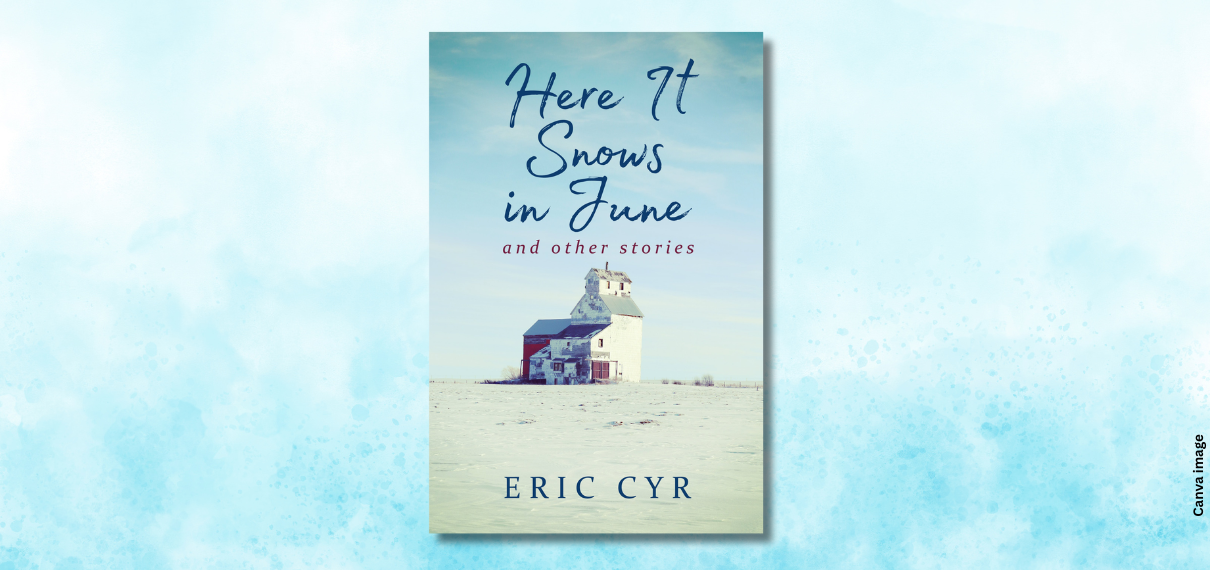
Top photo caption: This is the cover of “Here It Snows in June & Other Stories,” by Eric Cyr. OSV News photo/Wiseblood Books
By Madelyn Reichert, OSV News
“Here it Snows in June and Other Stories”
Eric Cyr, Wiseblood Books (2026).
156 pages, $16.00.
Autumn has come to Minnesota, the home state of this reviewer as well as the home state of Eric Cyr, the author of “Here it Snows in June and Other Stories.” As the landscape tips from summer into fall, with grass starting to brown and leaves to desiccate or rot, thoughts of death are only natural.
Perhaps that’s why Cyr’s collection feels like a natural read this time of year, as the stories in “Here it Snows in June” put life and death into gritty contrast, teasing out the thin ligament of faith connecting earthly life to eternal life, or lack thereof.
It would be disingenuous to pretend that the short stories in this collection didn’t make this reviewer uncomfortable; there’s a fascination with the macabre in Cyr’s stories that isn’t usually to this reader’s taste. But this was likely the author’s intention, bringing out through that discomfort just how thin the veil between life and death really is.
Whether on a winter’s morning hunt or a baseball diamond on a hot summer day, each of the stories finds a way to play in that liminal space. In “A Scout is Reverent,” a boy goes missing in the deep woods of Minnesota during a scouting camp with genuine uncertainty whether he will be found; and likewise in “Bell Lap,” a man suffering from dementia wonders about the purpose of continuing to live when death is near on the horizon.
Likewise, in “Primogeniture,” the metaphor of an unused pencil provides a striking conceptualization for a life half-lived, and in “Sacrifice Hit” the question of martyrdom as posed to a teenage boy more interested in baseball draws out how smaller deaths to self show up even when life is still in its prime. And in the titular story, a June snowfall highlights the way life can be unexpectedly fleeting — here one moment and gone the next.
Two stories in the collection are particularly effective at creating that liminal space between life and death, and the necessity of faith to bridge the gap. In “The Key,” Cyr forces a moment of liminality by having the character held at gunpoint for the contents of his pocket, which include the keys to the cathedral tabernacle. Life goes on for the protagonist afterward, but the threat of imminent death creates a bracket around the moment in which the character’s faith in what the tabernacle key represents, and the risk of having to die for it allows him to answer his ruminations on predestination and free will.
Contrarily, in “Cold is a State of Mind,” a man who makes an idol of his favorite sports team gets everything he ever wanted — only to find that it isn’t quite enough, after all. Cyr’s talents are particularly showcased in the moment of the viewpoint character’s passing; it’s never entirely clear when the scene transitions from the last moments of the character’s life into his final judgment, and working in that uncertainty allows Cyr to illustrate how closely our earthly lives are tied to the hereafter, and how what one worships in life will be what one worships in death.
At turns beautiful and unsettling, “Here it Snows in June and Other Stories” is the perfect short story collection for meditating on the change of seasons, both in life and in nature, and how essential it is to prepare for the hereafter, even when life seems busy and abundant.
Like the browning of leaves in September or the ephemerality of an unexpected summer snowfall, death is always nearer to life than we think.
Madelyn Reichert is publications administrative coordinator at The Catholic Spirit, the official publication of the Archdiocese of St. Paul and Minneapolis.
Catholic journalism is needed now more than ever. Please consider supporting this work by signing up for a SUBSCRIPTION (click HERE) or making a DONATION to The Monitor (click HERE). Thank you for your contribution.