
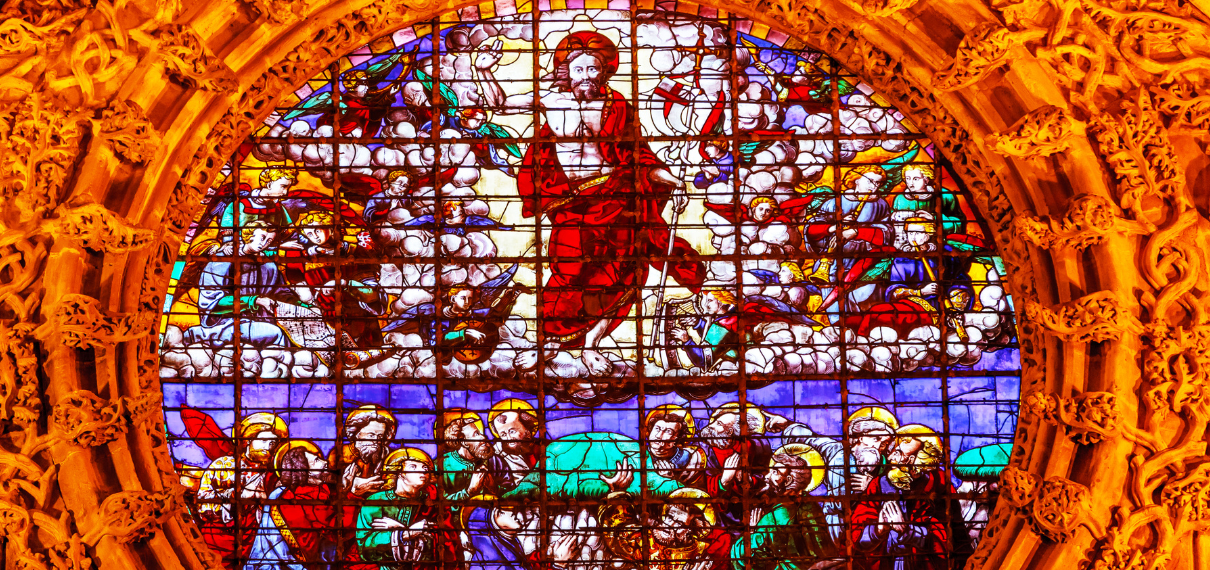
Top photo caption: Christ Ascension-Stained Glass Cathedral Saint Mary Seville Spain, Getty image.
A message from Bishop David M. O’Connell, C.M.
The Solemnity of the Ascension will be observed in all parishes of the Diocese of Trenton the weekend of May 16 and 17.
Since 2022, the dioceses of New Jersey have celebrated the Solemnity of the Ascension of the Lord on the Seventh Sunday of Easter, rather than on the traditional Thursday, 40 days after Easter. While some dioceses in the United States — including Philadelphia, Boston, New York, Hartford and Omaha — continue to observe Ascension Thursday, the Bishops of New Jersey, after consultation with pastors, discerned that celebrating the Ascension on Sunday allows far more of the faithful to participate in this important feast. Because Sunday is already a day of obligation, this shift has helped many Catholics reflect more deeply on the mystery of Christ’s Ascension.
The feast itself proclaims our belief that the Risen Lord Jesus, gathered with his disciples near Jerusalem, ascended body and soul into heaven, returning to the Father. Sacred Scripture gives us this testimony. Acts of the Apostles tells us: “As they were looking on, he was lifted up, and a cloud took him from their sight” (Acts 1:9). The Gospel of Mark adds: “The Lord… was taken up into heaven and took his seat at the right hand of God” (Mark 16:19).
Other passages point to this mystery as well. Matthew’s Gospel recounts the Great Commission, when the Risen Christ sends his disciples to baptize and teach all nations, promising, “I am with you always, until the end of the age” (Matthew 28:20). In John’s Gospel, Jesus speaks to Mary Magdalene of his return to the Father (John 20:17).
From the earliest days of the Church, Christians have professed this truth. The Fathers of the Church — including St. Augustine — reflected often on the meaning of Christ’s Ascension. The Nicene Creed, formulated in 325 A.D., solemnly proclaims that Jesus “ascended into heaven and is seated at the right hand of the Father.” Over time, the Church began to commemorate this mystery with its own liturgical feast.
As the Easter season draws to its close each year, the Ascension invites us to contemplate what Christ’s return to the Father means for us. His Ascension marks the completion of his earthly, bodily presence and the beginning of his universal, eternal presence among us. It prepares us for the coming of the Holy Spirit at Pentecost.
St. Paul reminds us: “Seek what is above, where Christ is seated at the right hand of God” (Colossians 3:1). And St. Augustine beautifully teaches that although Christ ascended alone, “we also ascend, because we are in him by grace.”
For Catholics — and for all Christians — the Solemnity of the Ascension strengthens our hope. It assures us that Christ reigns in glory, that his Spirit remains with us, and that we are called to be his witnesses until he comes again.