
By EmmaLee Italia, Contributing Editor
For biblical scholar Mary Elizabeth Sperry, the basic rule of thumb regarding Scripture is “if the Bible doesn’t make you feel uncomfortable and challenged, you’re not reading it right.”
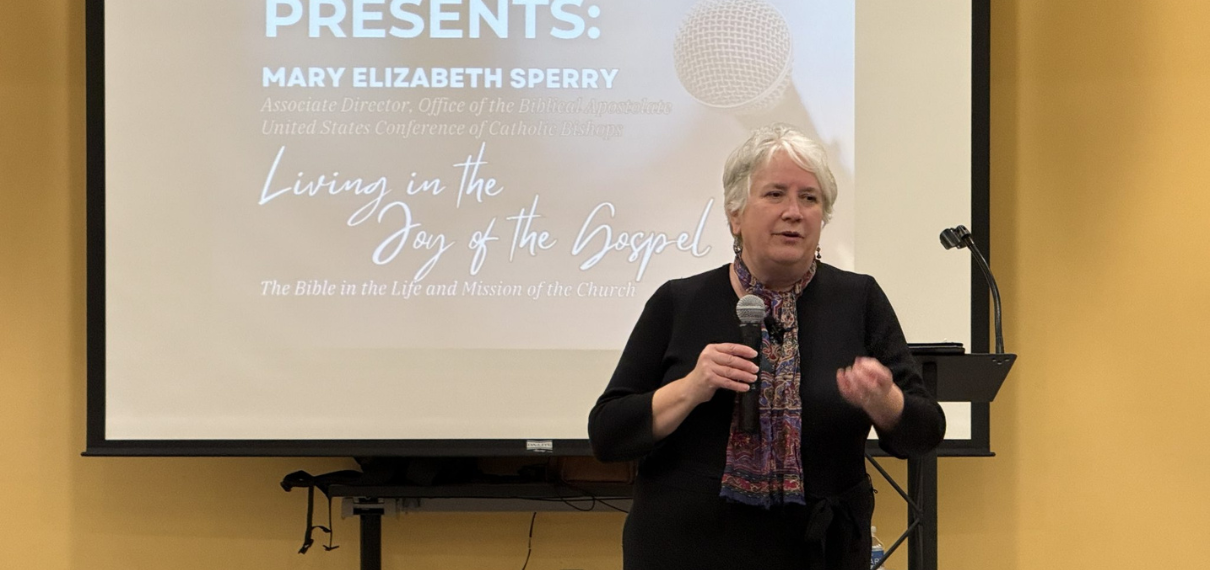
Sperry shared this insight and much more during her Feb. 25 presentation in St. Paul Parish, Princeton, “Living in the Joy of the Gospel: The Bible in the Life and Mission of the Church.”
“Reading and learning the Bible is about growing in your relationship with Jesus, and [that] means sharing his Cross,” she continued. “So, if the Bible’s not leading you to share the Cross of Jesus … you’re getting to know the Jesus that you want to know. And we’re all very good at reading exactly what we want to read into things.”
Catherine Vanderpool, St. Paul’s parishioner, said that Sperry “inspired many of us in the room to spend more time, joyfully, with the Word … and emphasized how our faith is also formed by 2,000 years of tradition, the hearts, minds and souls of millions who have come before us. Humbling.”
Revelation and Inspiration
Holding a master’s degree in in liturgical studies from The Catholic University of America, Washington, and a master’s degree in political science from the University of California, Los Angeles, Sperry is also the author of seven books and numerous articles, and has worked since 1994 in various positions for the United States Conference of Catholic Bishops, most recently leading the Office of the Biblical Apostolate. She is working on the publication of the newest Catholic Bible translation – the Catholic American Bible and La Biblia de la Iglesia en América – and is the first woman and the first American to serve as the Moderator of the Executive Committee of the Catholic Biblical Federation.
“To live in the joy of the Gospel, we need to understand what the Bible is, how the Church uses it and what the Church believes about it,” Sperry said. “Catholics are not ‘people of the book,’ we are people of the Word.’”
She pointed to Pope Leo XIV’s Wednesday series of talks on Scripture as revelation, quoting from Dei Verbum, the dogmatic constitution of defining revelation.
“Scripture and tradition make up revelation,” Sperry said. “You can’t separate one part from the other … Tradition builds on Scripture, and the Church’s tradition is saying, ‘these are the books we pray with, this is part of our canon.’”
The crux of revelation, Sperry emphasized, is “who God is, and what God wants from us.”
Inspiration, the Holy Spirit breathing into the works of Scripture, was not God acting as a ventriloquist, “treating human authors like puppets and telling them what to say,” she pointed out, but rather his guiding the truth of Jesus’ teachings as they were retold for decades before being recorded.
“By the time the Gospels were written down, the writers knew the end of the story,” Sperry said, “so they picked the pieces they knew led to the end … they were able to reflect and realize, ‘oh, that’s what he meant.’”
The Bible is true, but it’s not history, she stressed. “History is things happening on a certain date. Truth tells us who we are, who we are called to be, and puts us into the relationship with the one who made us.”
The goal of all Scripture interpretation, Sperry said, is actualization – finding out what God wants to reveal to us personally through his Word – which we tend to arrive at prematurely.
“Pay attention to the genre – parable, prophesy, history … and the notes at the bottom of the page in the Bible,” she advised. When certain readings are read at Mass, “they are there for a reason,” she said. “What might the Church be trying to tell me?”
New Perspectives
St. Paul parishioners Ron and Nancy Forrest, who have known Sperry for many years and were instrumental in her appearance, both found depth in what she presented.
Ron resonated with “the passion and joy that Mary demonstrated when talking about Scripture, and how pervasively Scripture is used in all aspects of the Mass. This has motivated me to be more attentive to the readings … and take more time to reflect on the messages and prayers we hear at Mass.”
Nancy noted that Sperry’s descriptions of “how Scripture and tradition are really inseparable … and the Psalms as a source of comfort, guidance and knowing others have gone through the same life challenges” were particularly enlightening.
“The one thing that sticks in my mind,” said fellow parishioner Patty Alizio “[was when] she spoke about Jesus being in four places at Mass: the congregation, the priest, the Eucharist and the Word – and that we should treat the Word with respect as we do the Eucharist. I found that to be very powerful.”