
The following briefs were recently posted by Catholic News Service:
Asia Bibi’s family: Pakistan Supreme Court to decide her fate this month
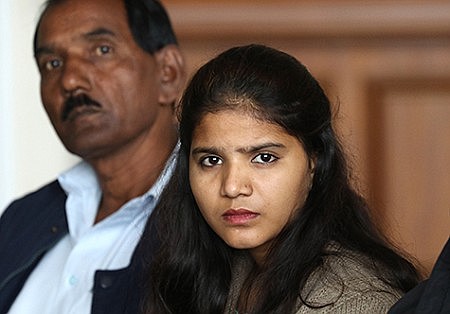
CHESTER, England — The first Catholic woman to be condemned to death under Pakistan’s blasphemy laws will discover her fate later this month, her family told Catholic News Service. Asia Bibi, who has been held in solitary confinement since November 2010, when she was sentenced to hang for insulting Muhammad, the founder of Islam, will learn the outcome of her appeal to the Pakistan Supreme Court later in October, her husband, Ashiq Masih, told CNS Oct. 5. If Bibi is released, he said, she and her family will immediately seek sanctuary in one of several countries that have offered them exile, because it was too dangerous for them to remain in Pakistan. Ashiq, a builder from Sheikhupura, Pakistan, was in England with his and Bibi’s youngest daughter, Eisham Ashiq, as guests of Aid to the Church in Need, a Catholic charity helping persecuted Christians. They said when they visited Bibi in Multan Prison Oct. 1 that she was in good health, contrary to speculation that she was developing dementia. During the interview at St Columba’s Church, Ashiq said Bibi was praying constantly and that she deeply believed she would win her freedom. “She is psychologically, physically and spiritually strong,” said Ashiq.
Mercy sisters decry report of immigrant children moved to tent city
WASHINGTON — The Sisters of Mercy of the Americas said they are “outraged and appalled” by a recent report of migrant children being moved to a tent city in Texas, adding that what is happening now “pales in comparison to the trauma and uncertainty these young girls and boys and their families will experience for years to come.” “The photos and reports of these detention centers for children are the most recent example of how the Trump administration has continued to ratchet up its aggressive approach to tearing immigrant families apart while offering no remedy to decades of failed U.S. foreign policy that has produced the conditions from which people are fleeing for their lives,” said an Oct. 3 statement by the Mercy sisters, based in the Washington suburb of Silver Spring, Maryland. A New York Times article Sept. 30 said migrant children in shelters across the country were being transported in the night in recent weeks to a tent city on desert property in Tornillo, Texas, outside of El Paso. At the time 1,600 children were at the site with more expected since it was expanded to house 3,800 and to remain open until at least the end of the year. Evelyn Stauffer, a spokeswoman for the U.S. Department of Health and Human Services, said in a statement to The New York Times that “it is common to use influx shelters as done on military bases in the past, and the intent is to use these temporary facilities only as long as needed.”
‘Unthinkable pain, raw emotion’ remain a year after shooting, says bishop
LAS VEGAS — This last year “has been a time of unthinkable pain and raw emotion for the Las Vegas community and for families devastated” by the mass shooting of Oct. 1, 2017, Bishop George L. Thomas said at an interfaith prayer service at Guardian Angel Cathedral. “But it has also been a time when Las Vegas has revealed the best the human family has to offer — the resilience of the human spirit in the face of incalculable odds,” said the bishop, who heads the Diocese of Las Vegas. He delivered the remarks during the evening service Sept. 30, where he was joined by a dozen leaders of other faiths. Described by many as an emotional gathering, it came on the eve of the first anniversary of the worst shooting in U.S. history, which left 58 people dead and 527 others injured. From his room on a top floor of a high-rise hotel, the shooter, later identified as 64-year-old Stephen Paddock, rained bullets down on a crowd gathered below for an outdoor country music festival on the Las Vegas Strip. As a refrain through his remarks, Bishop Thomas used lyrics from a song written in 1971 by Barry and Robin Gibb: “How can you mend a broken heart?” The words, he said, helped “to capture the struggles and challenges we are facing as a Las Vegas community.”
Toronto doctors lay out procedures for euthanasia for children
TORONTO — In a prestigious medical journal, doctors from Toronto’s Hospital for Sick Children have laid out policies and procedures for administering medically assisted death to children, including scenarios where the parents would not be informed until after the child dies. The article appears just three months before the Canadian Council of Academies is due to report to Parliament on the medical consensus about extending voluntary euthanasia in circumstances currently forbidden by law. The Canadian Council of Academies is specifically looking at extending so-called assisted dying to patients under 18, psychiatric patients and patients who have expressed a preference for euthanasia before they were rendered incapable by Alzheimer’s or some other disease. The Sept. 21 paper written by Sick Kids doctors, administrators and ethicists was published in the British Medical Journal’s J Med Ethics and backed by the University of Toronto’s Joint Centre for Bioethics. In a flowchart that outlines how a medically induced death would occur at Sick Kids, authors Carey DeMichelis, Randi Zlotnik Shaul and Adam Rapoport do not mention conversation with family or parents about how the child dies until after the death occurs in the “reflection period.” Patient confidentiality governs the decision about whether or not to include parents in a decision about an assisted death, the authors said. If capable minors under the age of 18 stipulate they don’t want their parents involved, doctors and nurses must respect the patients’ wishes.
Bill to make Calif. public universities offer abortion pill won’t be law
SACRAMENTO, Calif. — California Gov. Jerry Brown said Sept. 30 he would not sign a measure passed by the state Senate that would have required student health centers at public universities to offer abortion-inducing drugs. By not signing the bill, known as S.B. 320, he essentially vetoed it. “Access to reproductive health services including abortion, is a long-protected right in California,” he said in a letter to members of the state Senate. “According to a study sponsored by supporters of this legislation, the average distance to abortion providers in campus communities varies from five to seven miles, not an unreasonable distance. Because the services required by this bill are widely available off campus, this bill is not necessary,” added Brown, a Catholic who supports keeping abortion legal. Under the measure, every student health center at the University of California and California State University campuses would have had to offer abortion-inducing drugs, including the “abortion pill,” as RU-486 is known, by Jan. 1, 2022.
Ex-FCC commissioner protests outside FCC HQ to protect Lifeline service
WASHINGTON — Gloria Tristani, who served for four years on the Federal Communications Commission, spent part of her day Sept. 26 protesting outside FCC headquarters in Washington — as the current commissioners were meeting. She was there to demonstrate against potential drastic cuts to the FCC’s “Lifeline” program, which was put in place 12 years before Tristani began her 1997-2001 tenure at the FCC. Lifeline provides discounted telephone and — in the wake of Hurricane Katrina in 2005 — internet service to qualifying low-income households throughout the United States. Last November, the FCC, under new chairman Ajit Pai, proposed changes to the program that would cut off, according to its critics, up to 90 percent of all Lifeline users. “It’s really very hard to tell what the time frame is for this order,” Tristani told Catholic News Service in an Oct. 1 telephone interview. Although a comment period on the proposed changes ended in March, more than six months ago, the FCC has yet to schedule Lifeline on its agenda for a public meeting, and Pai himself was silent on any Lifeline plans at a post-meeting news conference Sept. 26. It could be that the FCC needs to rethink its approach after a federal court in August halted an FCC plan to remove a $25 subsidy to help low-income households on tribal lands gain phone and internet service.
U.S. Church urged to fight racism with same zeal waged for pro-life cause
PROVIDENCE, R.I. — The Catholic Church in the United States has a strong pro-life identity and is well-known for being passionately against abortion. But the nation’s Catholic community overall does not show the same determination to stamp out racism in society, said Bishop Shelton J. Fabre of Houma-Thibodaux, Louisiana. “Even in our own beloved Church, standing against racism is not considered an essential character of Catholic identity,” Bishop Fabre, the chairman of the U.S. Conference of Catholic Bishops’ Ad-Hoc Committee Against Racism, told a Providence audience. In an evening program titled “Where Do We Go From Here?” and hosted by several New England dioceses and Dominican-run Providence College, Bishop Fabre presented a historical overview of how the nation’s Catholic bishops in the 20th century spoke out against racism and tried to urge the faithful to take action. Bishop Fabre also described the work of the bishops’ conference’s ad-hoc committee, which has been meeting over the past year with communities of color in listening sessions across the nation, hearing from Catholics who have been harmed by bigotry in society and in the Church. “Racism is still felt in our land, in our society, and in Church structures,” said Bishop Fabre said in his remarks Sept. 17. He added that his committee is drafting a pastoral letter that will be introduced at the USCCB’s general assembly meeting in November.