


Bishop reflects on St. Vincent’s ‘eyes and heart’ during SJU Founder’s Week
September 26, 2025 at 10:23 a.m.
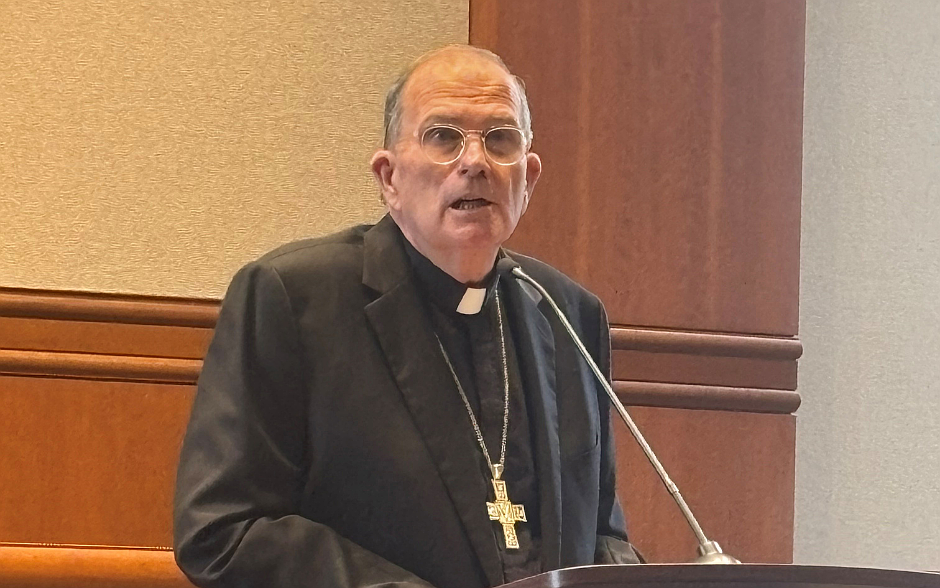
Honoring the legacy of St. Vincent de Paul and his life of service to those in need, St. John’s University, Queens, celebrated Founder’s Week, Sept. 22-29, welcoming as guest lecturer long-time educational leader and one of their own, Bishop David M. O’Connell, C.M., of the Diocese of Trenton.
Bishop O’Connell delivered the Vincentian Heritage Lecture on Sept. 22 to students, faculty, administrators, staff and alumni, kicking off the week-long observance that also included a walking tour, a day of service, a convocation with award presentations, and special luncheons.
Reality vs. possibility
In his talk, “Through St. Vincent’s Eyes and Heart: Vincentian Catholic Higher Education Today,” Bishop O’Connell said, “Great people have vision. They see with their eyes ‘what is’ but they also see with their hearts ‘what can be.’ That kind of vision leads to greatness.”
He continued, “Such dual vision of ‘eyes and heart’ – one grounded in objective reality and the other inspired by possibility – leads to greatness. It’s what drives empathy, imagination, innovation and meaningful change.”
St. Vincent de Paul was a person of such vision, said Bishop O’Connell, noting that Vincent “lived in Paris, in 17th century France, a time of extreme poverty and social inequality in the world and one of confusion and turmoil within the Church. With clear-eyed realism, he saw suffering in the people around him – orphans, prisoners, the sick and the poor – abandoned and overlooked by society. At the same time, he also recognized a Church in need of reform and what we would today call ‘evangelization.’”
Rather than ignoring the realities he saw “with his eyes” all around him in society and the Church and the circumstances that occasioned them, St. Vincent de Paul “saw with his heart,” said Bishop O’Connell, “and made these realities central to his mission and worldview. He envisioned a world and society where charity and compassion could make a difference. He imagined a Church engaging the world and society in the Gospel of Jesus Christ.”
Prompted by the Gospel, St. Vincent de Paul created and organized networks of support to care for those in need, materially, physically and spiritually, explained Bishop O’Connell. “His legacy proved that systemic change rooted in this dual vision made a better world possible, even in an era of limited resources. … He exemplified how greatness lay in combining clear perception with compassionate, creative imagination.”
Vincentian values in education
Bishop O’Connell stressed that at the heart of St. John University’s mission “lies a profound commitment to the Vincentian charism and passion – a legacy not merely confined to the biography of St. Vincent de Paul, but alive in his vision for the world and society, alive in compassion, service, justice, and a relentless, passionate pursuit of human dignity. Here at St. John’s University, we see Catholic higher education through St. Vincent’s eyes and heart.”
From its inception in 1870, when the first Bishop of Brooklyn, John Loughlin, invited the Congregation of the Mission to establish a school, “St. John’s College embodied Vincentian values in the Catholic education it imparted, stemming from the vision, ideals and works of St. Vincent de Paul. Its crest bears the words, Educatio Christiana animae perfectio, “Christian education is the perfection of the soul,” the Bishop said.
He shared that he first arrived at St. John’s in August of 1990 “to begin my assignment as associate dean of the college. As a Vincentian priest, I was very much aware of the University’s Catholic and Vincentian identity and mission, things that I simply took for granted given the University’s history and operations.”
Thirty-five years later, he said, “Those things have changed as the number of available Vincentians lessened and their responsibilities were altered or adapted to meet the changing times and circumstances. It is a different place than the St. John’s University I first knew in 1990. What has not changed, however, is its Vincentian identity, character and mission. In many respects, they seem to me stronger than ever.”
Bishop O’Connell observed that this is made possible through a number of initiatives undertaken at the University. “Like St. Vincent de Paul, they open the eyes of the entire University community . . . to see the needs of contemporary society, especially the poor and marginalized, and they inspire hearts to see with a passion how to respond concretely and effectively.”
Bishop O’Connell underscored that St. John’s University does not just teach Vincentian values. “It models and immerses students in them,” he said. “St. John’s University fosters a culture in and through which the vision and values of St. Vincent – service to the poor, a commitment to justice, compassionate leadership, holistic education and a deep sense of global responsibility – are not merely historical ideals but living, breathing principles.”
“St. John’s continues the work of St. Vincent de Paul by preparing students to make a much-needed difference in today’s world … and in doing so, forms graduates not only in intellect but also in character, conviction and conscience that last a lifetime.”
During his tenure at St. John's University, Bishop David M. O’Connell, C.M., served in various capacities, including professor of theology and religious studies, associate dean, then academic dean of St. John’s College of Liberal Arts and Sciences, and assistant to legal counsel. He also spent a year simultaneously serving as interim academic vice president of Niagara University.
In 1998, then Father O’Connell was named the 14th president of The Catholic University of America in Washington, a post he held until 2010 when he named coadjutor bishop of the Diocese of Trenton. Bishop O’Connell paid tribute to his Vincentian roots in the selection of his episcopal motto: “To serve, and not to be served.”
In addition to his diocesan responsibilities, Bishop O’Connell currently serves as chairman of the United States Conference of Catholic Bishops’ Committee on Catholic Education.
 Bishop O’Connell greets Brian Browne, associate vice president for university communications and public affairs at St. John’s University, during Founder’s Week in Queens, N.Y., Sept. 22. To the Bishop’s right is the Rev. Patrick Griffin, executive director of the Vincentian Center for Church and Society. Staff photo
Related Stories
Sunday, December 28, 2025



E-Editions
Events
Honoring the legacy of St. Vincent de Paul and his life of service to those in need, St. John’s University, Queens, celebrated Founder’s Week, Sept. 22-29, welcoming as guest lecturer long-time educational leader and one of their own, Bishop David M. O’Connell, C.M., of the Diocese of Trenton.
Bishop O’Connell delivered the Vincentian Heritage Lecture on Sept. 22 to students, faculty, administrators, staff and alumni, kicking off the week-long observance that also included a walking tour, a day of service, a convocation with award presentations, and special luncheons.
Reality vs. possibility
In his talk, “Through St. Vincent’s Eyes and Heart: Vincentian Catholic Higher Education Today,” Bishop O’Connell said, “Great people have vision. They see with their eyes ‘what is’ but they also see with their hearts ‘what can be.’ That kind of vision leads to greatness.”
He continued, “Such dual vision of ‘eyes and heart’ – one grounded in objective reality and the other inspired by possibility – leads to greatness. It’s what drives empathy, imagination, innovation and meaningful change.”
St. Vincent de Paul was a person of such vision, said Bishop O’Connell, noting that Vincent “lived in Paris, in 17th century France, a time of extreme poverty and social inequality in the world and one of confusion and turmoil within the Church. With clear-eyed realism, he saw suffering in the people around him – orphans, prisoners, the sick and the poor – abandoned and overlooked by society. At the same time, he also recognized a Church in need of reform and what we would today call ‘evangelization.’”
Rather than ignoring the realities he saw “with his eyes” all around him in society and the Church and the circumstances that occasioned them, St. Vincent de Paul “saw with his heart,” said Bishop O’Connell, “and made these realities central to his mission and worldview. He envisioned a world and society where charity and compassion could make a difference. He imagined a Church engaging the world and society in the Gospel of Jesus Christ.”
Prompted by the Gospel, St. Vincent de Paul created and organized networks of support to care for those in need, materially, physically and spiritually, explained Bishop O’Connell. “His legacy proved that systemic change rooted in this dual vision made a better world possible, even in an era of limited resources. … He exemplified how greatness lay in combining clear perception with compassionate, creative imagination.”
Vincentian values in education
Bishop O’Connell stressed that at the heart of St. John University’s mission “lies a profound commitment to the Vincentian charism and passion – a legacy not merely confined to the biography of St. Vincent de Paul, but alive in his vision for the world and society, alive in compassion, service, justice, and a relentless, passionate pursuit of human dignity. Here at St. John’s University, we see Catholic higher education through St. Vincent’s eyes and heart.”
From its inception in 1870, when the first Bishop of Brooklyn, John Loughlin, invited the Congregation of the Mission to establish a school, “St. John’s College embodied Vincentian values in the Catholic education it imparted, stemming from the vision, ideals and works of St. Vincent de Paul. Its crest bears the words, Educatio Christiana animae perfectio, “Christian education is the perfection of the soul,” the Bishop said.
He shared that he first arrived at St. John’s in August of 1990 “to begin my assignment as associate dean of the college. As a Vincentian priest, I was very much aware of the University’s Catholic and Vincentian identity and mission, things that I simply took for granted given the University’s history and operations.”
Thirty-five years later, he said, “Those things have changed as the number of available Vincentians lessened and their responsibilities were altered or adapted to meet the changing times and circumstances. It is a different place than the St. John’s University I first knew in 1990. What has not changed, however, is its Vincentian identity, character and mission. In many respects, they seem to me stronger than ever.”
Bishop O’Connell observed that this is made possible through a number of initiatives undertaken at the University. “Like St. Vincent de Paul, they open the eyes of the entire University community . . . to see the needs of contemporary society, especially the poor and marginalized, and they inspire hearts to see with a passion how to respond concretely and effectively.”
Bishop O’Connell underscored that St. John’s University does not just teach Vincentian values. “It models and immerses students in them,” he said. “St. John’s University fosters a culture in and through which the vision and values of St. Vincent – service to the poor, a commitment to justice, compassionate leadership, holistic education and a deep sense of global responsibility – are not merely historical ideals but living, breathing principles.”
“St. John’s continues the work of St. Vincent de Paul by preparing students to make a much-needed difference in today’s world … and in doing so, forms graduates not only in intellect but also in character, conviction and conscience that last a lifetime.”
During his tenure at St. John's University, Bishop David M. O’Connell, C.M., served in various capacities, including professor of theology and religious studies, associate dean, then academic dean of St. John’s College of Liberal Arts and Sciences, and assistant to legal counsel. He also spent a year simultaneously serving as interim academic vice president of Niagara University.
In 1998, then Father O’Connell was named the 14th president of The Catholic University of America in Washington, a post he held until 2010 when he named coadjutor bishop of the Diocese of Trenton. Bishop O’Connell paid tribute to his Vincentian roots in the selection of his episcopal motto: “To serve, and not to be served.”
In addition to his diocesan responsibilities, Bishop O’Connell currently serves as chairman of the United States Conference of Catholic Bishops’ Committee on Catholic Education.
Bishop O’Connell greets Brian Browne, associate vice president for university communications and public affairs at St. John’s University, during Founder’s Week in Queens, N.Y., Sept. 22. To the Bishop’s right is the Rev. Patrick Griffin, executive director of the Vincentian Center for Church and Society. Staff photo