


Icon of Humanity
Seeking hope through Mary was focal point of diocesan Pilgrimage
September 22, 2025 at 1:00 p.m.
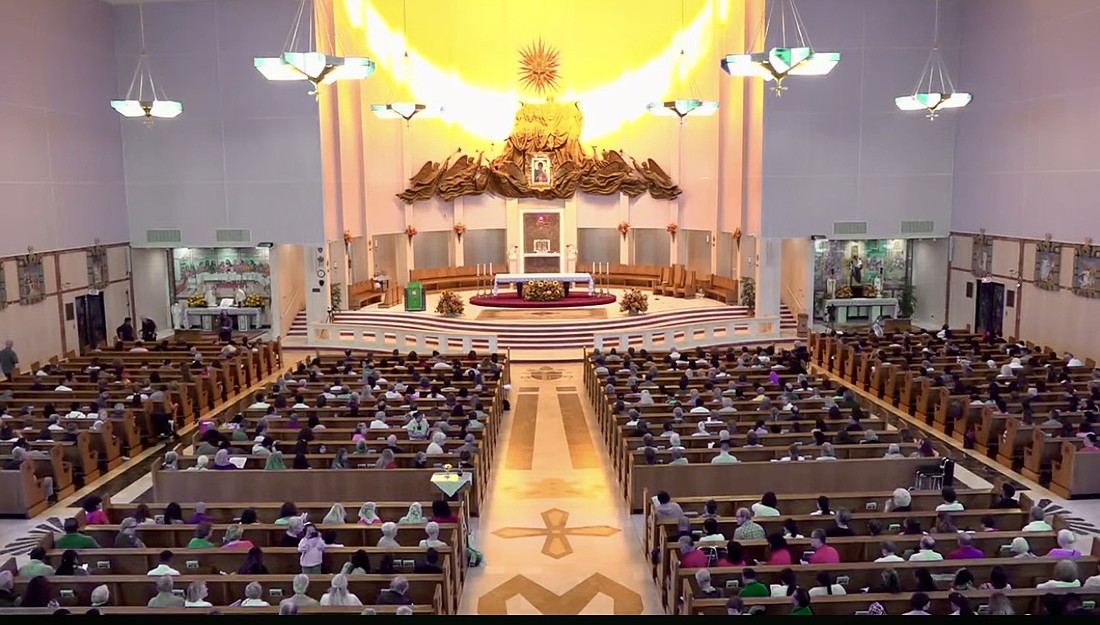
 Father Zack Swantek, Catholic chaplain of Aquinas Institute, leads a presentation on the history of the Black Madonna icon. John Batkowski photo
UPDATED SEPT. 22, 2025
Though they came from different communities across the Diocese of Trenton and beyond, the nearly 2,000 faithful who gathered for the Jubilee of Hope Pilgrimage Sept. 13 did so as one Church.
Preaching his homily in the National Shrine of Our Lady of Czestochowa in Doylestown, Pa., Bishop David M. O’Connell, C.M., spoke of the “gift it is to gather as one Church – priests and deacons, consecrated women and men, families, young people, the elderly, the poor, the searching – all drawn by the Spirit to this moment of renewal in our Diocese.”
Describing a Jubilee as “not simply a celebration,” the Bishop said, “It is a sacred interruption. A pause in the rhythm of our lives to remember who we are, whose we are and where we are going,” he said.
“It is a time to rediscover the beating heart of our faith: hope.”
PHOTO GALLERY: Diocesan Jubilee Pilgrimage of Hope
That rediscovery began when the pilgrims first disembarked from the buses or hiked their way from their parking spots to the shrine’s main entrance, where Bishop O’Connell took his time with many of the pilgrims, exchanging conversation and posing for lots of photos.
The Doylestown shrine was established in 1953 and houses a replica of the Black Madonna icon of Czestochowa, Poland. Of the image, Father Zack Swantek, a priest of the Diocese and one of the day’s speaker’s, described the Blessed Mother as being the “icon of humanity.”
“She is God’s gift to us,” he said.
Meaning of Jubilee
Bishop O’Connell reflected on St. Paul’s startling words to Timothy from the day’s Readings: “Christ Jesus came into the world to save sinners. Of these I am the foremost.”
“This is the essence of Jubilee, that no one is beyond redemption,” the Bishop said. “That God’s mercy is not a theory, but a lived reality. That the Church is not a museum of saints, but a field hospital for the wounded, as Pope Francis reminded us. And that each of us is called to be a living sign of that mercy and a ‘pilgrim of hope.’”
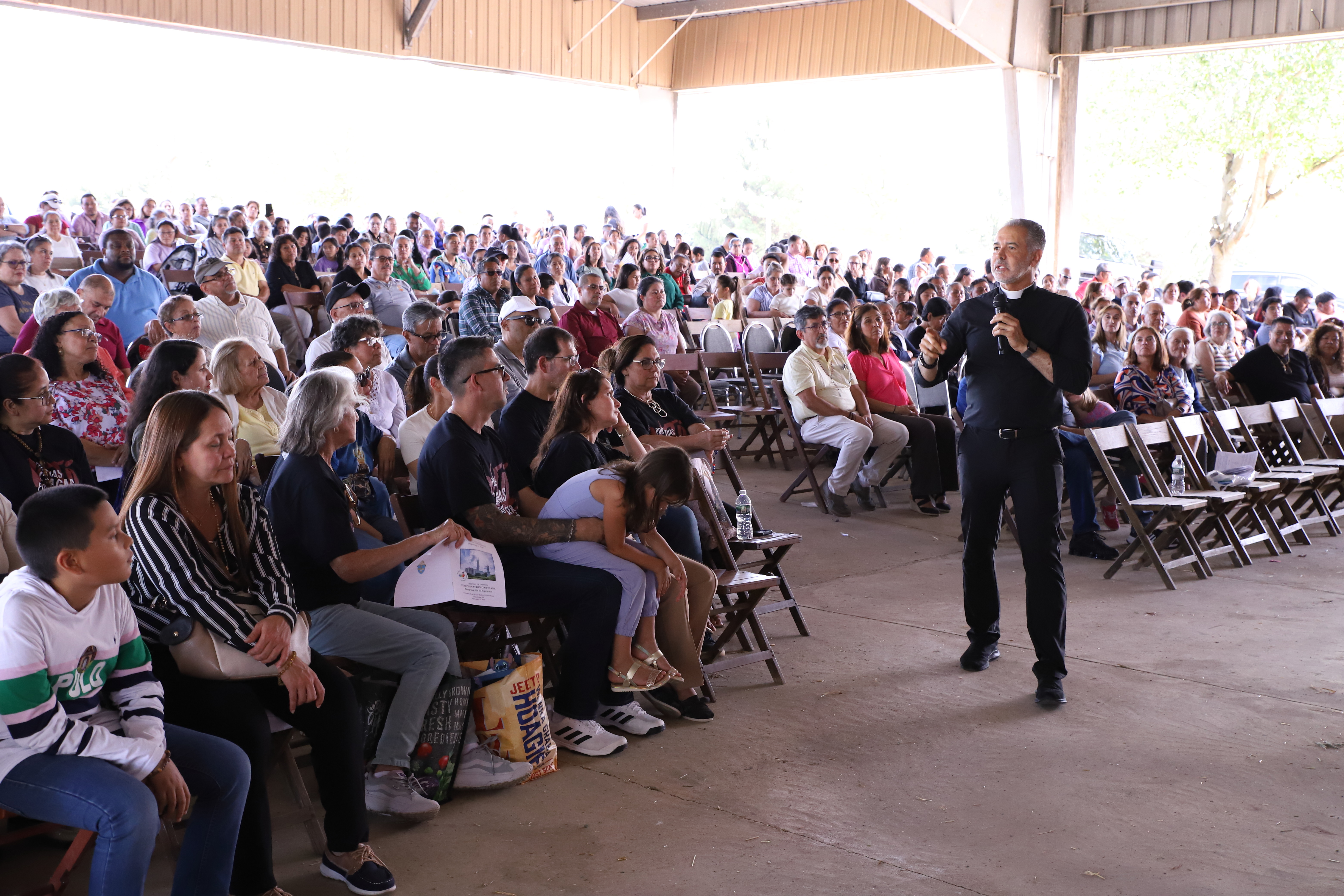 Father Javier Diaz, pastor of Christ the King Parish, Long Branch, led a presentation on the call to holiness and how people can achieve holiness in their lives. John Batkowski photo
Citing the Responsorial Psalm, “He raises up the lowly from the dust,” Bishop O’Connell stressed that it is “not poetic sentiment; it is divine truth. God sees the forgotten. God lifts the poor. God dwells not in lofty palaces, but in the humble heart.”
“In this Jubilee, we are called to be a Church and Diocese that lifts,” he said. “A Church and Diocese that sees. A Church and Diocese that walks with the poor, the immigrant, the addicted, the lonely, the unborn, the elderly, the prisoner. Not with pity but carrying the Divine Presence. Not with programs alone, but with love and hope.”
Distinguished History
Terry Ginther, diocesan chancellor and executive director of Pastoral Life and Mission, in opening remarks said that Catholics participate in pilgrimages for many reasons including opportunities for spiritual renewal and education and where they can deepen their connection to Scripture and the saints.
“Whatever your reason for being here today, our Blessed Mother is eager to listen to you,” Ginther said to the diocesan pilgrims. “She is eager to hold you close, to wrap her mantle of love around you and she is longing to lead you to her son, Jesus.”
A Busy Day
After Mass, the pilgrims had opportunities to go to Confession, pray during Eucharistic Adoration; tour the grounds and the shrine’s multiple chapels, view the replica of the Black Madonna in the Lower Church, and hear Father Swantek, Catholic chaplain of Aquinas Institute, Princeton, and Father Javier Diaz, pastor of Christ the King Parish, Long Branch, speak on the theme of hope.
An activity that drew widespread participation was one in which pilgrims were given a passport and asked to visit various locations in and around the Shrine. Among them were the Prayer Chapel, Grotto, Rosary Garden and statue of Our Lady of the Rosary.
At each site, pilgrims listened to presentations and had their passports stamped.
Perspectives on Hope
In Spanish, Father Diaz reflected on the call to holiness and how faithful can achieve holiness in their daily lives.
“While we are created in the image of God, we have the same capacity as God to love and forgive,” he said.
It’s easy “for us to get lost in the sea of our sins” and become “slaves to our passions,” he said, citing addictions that lead to sin – drugs, alcohol, pornography, and even technology.
For sins to be forgiven and to receive Holy Communion, a person must go to confession, he said. Also, if a person cannot receive Holy Communion physically, there is the option for them to receive spiritual communion.
“But spiritual communion can never be compared to physically receiving Jesus in the Eucharist … it’s when he truly becomes one with you,” he said.
Father Swantek largely focused on the history of the Black Madonna icon and it’s being enshrined in the Jasna Gora Monastery in Czestochowa Poland. He also reviewed the icon’s biblical imagery as reflected in St. Luke’s Gospel.
Father Swantek urged his listeners to remain close in their devotion to the Blessed Mother and to never lose sight of how: She is close to us in her suffering; she is a merciful intercessor, which is a sign of hope, and not only does she strive to bring Jesus to us, but that Jesus also leads us to her.
The pilgrimage concluded with the recitation of the Rosary in multiple languages: English, Polish, Spanish, Creole/French, Tagalog/Filipino.
Pilgrimage takeaways
Rosario Ramirez’s main reason for attending was to pray for the health of her family as well as for peace in the world, for migrants and for a personal situation in her life.
“All of that sometimes takes away our peace,” said Ramirez, a member of St. Mark Parish, Sea Girt. “But we trust in God, that he can soften hearts and perform miracles in our lives.” She added that it’s her hope that her fellow pilgrims understand “that God is love, that everything can be achieved through prayer and faith and that God can do everything if we truly believe.”
Ramirez’s husband, Javier, was moved to attend the Sacrament of Reconciliation with Bishop O’Connell and hear the Bishop preach his homily.
“The Bishop reminded us that it is not enough to come as pilgrims, that we must change,” Ramirez said. “It is useless to walk if there is no transformation in our lives.”
Emilio Larios of St. Ann Parish, Browns Mills, enjoyed observing people of all backgrounds and ethnicities coming together in prayer, then noted that he appreciated the reminder that “it is always possible to have a relationship with God and Christ.”
“Even if we cannot see or touch him, each person reflects a part of him. Every encounter with someone gives us the opportunity to serve him and help others,” Larios said. “When we try to follow his example, a true relationship is created … then we no longer feel alone. We know he is with us in good times and bad, teaching us to learn from mistakes and always move forward.”
Kat Padovano of St. Luke Parish, Toms River, was inspired to learn about the icon of Our Lady of Czestochowa’s rich and meaningful history, especially that St. Luke is credited for painting it.
“Though it was ravaged and scarred, with multiple attempts of artistic and meticulous repair, the scars miraculously reappeared,” Padovano said. “Our Lady wants to convey that she is wounded just like us. She is our merciful mother who we can turn to at all times.”
For John and Annie Napoli of Our Lady of Perpetual Help Parish, Maple Shade, the visit to the Doylestown shrine marked their first-ever pilgrimage.
“It was a blessing to be a part of everything from the Mass, to meeting the Bishop, to having a more spiritual experience with what was taking place today,” the Napolis said, adding that the day helped them to “experience God’s presence outside of everyday life. We were able to step away from the day-to-day events and become more spiritually inspired.”
Along with serving as a gift bearer for the Mass, Kyle McBride of St. Thomas More Parish, Manalapan, said it was an “amazing experience” to lead part of the first decade of the Rosary for the attendees.
“Praying the Rosary in five different languages truly highlights that the Catholic Church is universal and is enhanced by the cultural diversity of its members, especially here in the Diocese of Trenton,” McBride said.
He added that pilgrimages provided “a unique opportunity to place our faith into action, often requiring us to go outside of our comfort zone and grow from the discomfort we may encounter.”
“Spiritual growth can be great in new territory, especially from interacting with those on pilgrimage with us who may have different experiences of faith.”
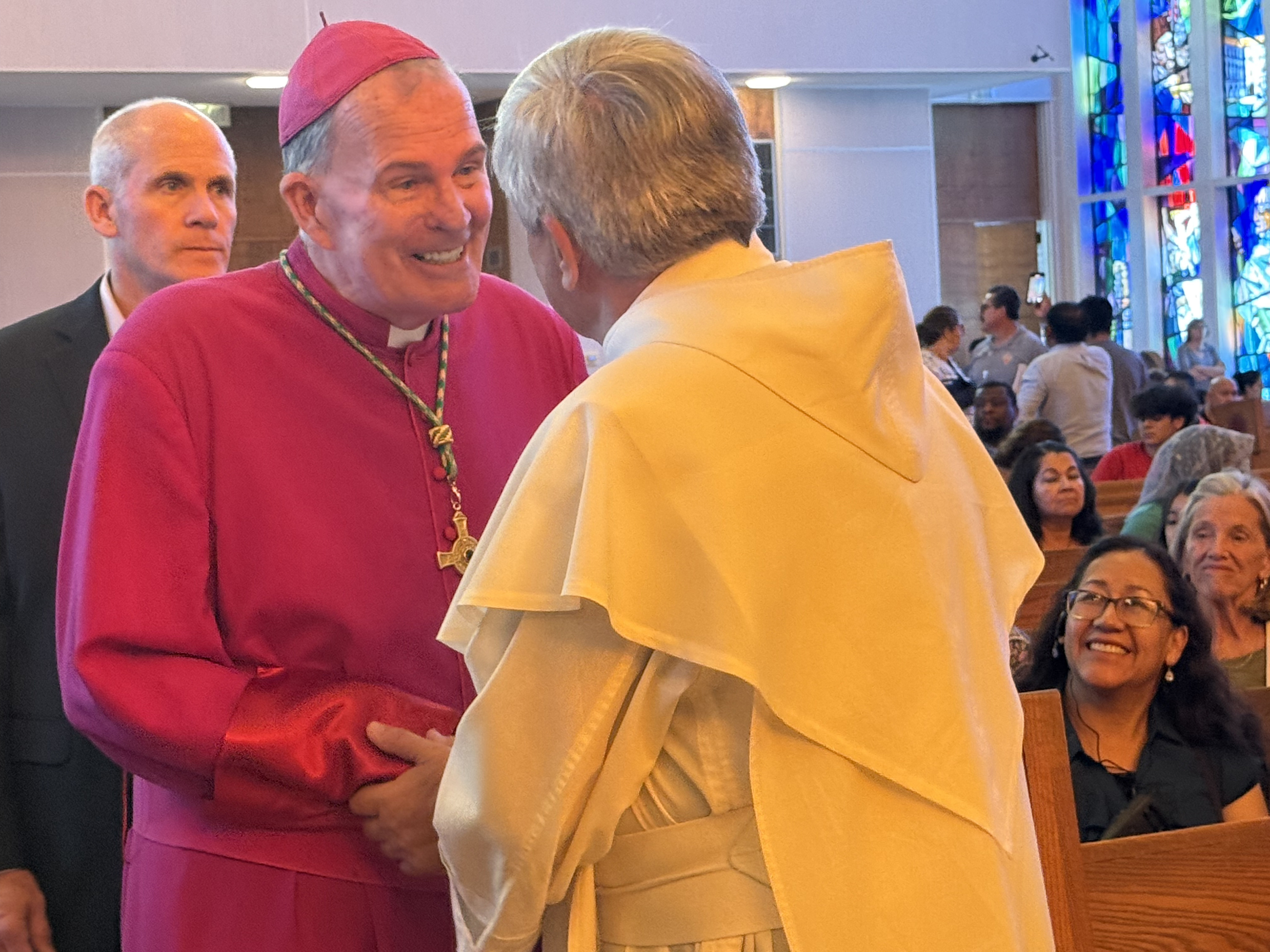 Bishop O'Connell greets Father Krzysztof Wieliczko, provincial of the Pauline priests and brothers who staff the National Shrine of Our Lady of Czestochowa. Rose O'Connor photos
Related Stories
Sunday, December 28, 2025


E-Editions
Events
Father Zack Swantek, Catholic chaplain of Aquinas Institute, leads a presentation on the history of the Black Madonna icon. John Batkowski photoUPDATED SEPT. 22, 2025
Though they came from different communities across the Diocese of Trenton and beyond, the nearly 2,000 faithful who gathered for the Jubilee of Hope Pilgrimage Sept. 13 did so as one Church.
Preaching his homily in the National Shrine of Our Lady of Czestochowa in Doylestown, Pa., Bishop David M. O’Connell, C.M., spoke of the “gift it is to gather as one Church – priests and deacons, consecrated women and men, families, young people, the elderly, the poor, the searching – all drawn by the Spirit to this moment of renewal in our Diocese.”
Describing a Jubilee as “not simply a celebration,” the Bishop said, “It is a sacred interruption. A pause in the rhythm of our lives to remember who we are, whose we are and where we are going,” he said.
“It is a time to rediscover the beating heart of our faith: hope.”
PHOTO GALLERY: Diocesan Jubilee Pilgrimage of Hope
That rediscovery began when the pilgrims first disembarked from the buses or hiked their way from their parking spots to the shrine’s main entrance, where Bishop O’Connell took his time with many of the pilgrims, exchanging conversation and posing for lots of photos.
The Doylestown shrine was established in 1953 and houses a replica of the Black Madonna icon of Czestochowa, Poland. Of the image, Father Zack Swantek, a priest of the Diocese and one of the day’s speaker’s, described the Blessed Mother as being the “icon of humanity.”
“She is God’s gift to us,” he said.
Meaning of Jubilee
Bishop O’Connell reflected on St. Paul’s startling words to Timothy from the day’s Readings: “Christ Jesus came into the world to save sinners. Of these I am the foremost.”
“This is the essence of Jubilee, that no one is beyond redemption,” the Bishop said. “That God’s mercy is not a theory, but a lived reality. That the Church is not a museum of saints, but a field hospital for the wounded, as Pope Francis reminded us. And that each of us is called to be a living sign of that mercy and a ‘pilgrim of hope.’”
Father Javier Diaz, pastor of Christ the King Parish, Long Branch, led a presentation on the call to holiness and how people can achieve holiness in their lives. John Batkowski photoCiting the Responsorial Psalm, “He raises up the lowly from the dust,” Bishop O’Connell stressed that it is “not poetic sentiment; it is divine truth. God sees the forgotten. God lifts the poor. God dwells not in lofty palaces, but in the humble heart.”
“In this Jubilee, we are called to be a Church and Diocese that lifts,” he said. “A Church and Diocese that sees. A Church and Diocese that walks with the poor, the immigrant, the addicted, the lonely, the unborn, the elderly, the prisoner. Not with pity but carrying the Divine Presence. Not with programs alone, but with love and hope.”
Distinguished History
Terry Ginther, diocesan chancellor and executive director of Pastoral Life and Mission, in opening remarks said that Catholics participate in pilgrimages for many reasons including opportunities for spiritual renewal and education and where they can deepen their connection to Scripture and the saints.
“Whatever your reason for being here today, our Blessed Mother is eager to listen to you,” Ginther said to the diocesan pilgrims. “She is eager to hold you close, to wrap her mantle of love around you and she is longing to lead you to her son, Jesus.”
A Busy Day
After Mass, the pilgrims had opportunities to go to Confession, pray during Eucharistic Adoration; tour the grounds and the shrine’s multiple chapels, view the replica of the Black Madonna in the Lower Church, and hear Father Swantek, Catholic chaplain of Aquinas Institute, Princeton, and Father Javier Diaz, pastor of Christ the King Parish, Long Branch, speak on the theme of hope.
An activity that drew widespread participation was one in which pilgrims were given a passport and asked to visit various locations in and around the Shrine. Among them were the Prayer Chapel, Grotto, Rosary Garden and statue of Our Lady of the Rosary.
At each site, pilgrims listened to presentations and had their passports stamped.
Perspectives on Hope
In Spanish, Father Diaz reflected on the call to holiness and how faithful can achieve holiness in their daily lives.
“While we are created in the image of God, we have the same capacity as God to love and forgive,” he said.
It’s easy “for us to get lost in the sea of our sins” and become “slaves to our passions,” he said, citing addictions that lead to sin – drugs, alcohol, pornography, and even technology.
For sins to be forgiven and to receive Holy Communion, a person must go to confession, he said. Also, if a person cannot receive Holy Communion physically, there is the option for them to receive spiritual communion.
“But spiritual communion can never be compared to physically receiving Jesus in the Eucharist … it’s when he truly becomes one with you,” he said.
Father Swantek largely focused on the history of the Black Madonna icon and it’s being enshrined in the Jasna Gora Monastery in Czestochowa Poland. He also reviewed the icon’s biblical imagery as reflected in St. Luke’s Gospel.
Father Swantek urged his listeners to remain close in their devotion to the Blessed Mother and to never lose sight of how: She is close to us in her suffering; she is a merciful intercessor, which is a sign of hope, and not only does she strive to bring Jesus to us, but that Jesus also leads us to her.
The pilgrimage concluded with the recitation of the Rosary in multiple languages: English, Polish, Spanish, Creole/French, Tagalog/Filipino.
Pilgrimage takeaways
Rosario Ramirez’s main reason for attending was to pray for the health of her family as well as for peace in the world, for migrants and for a personal situation in her life.
“All of that sometimes takes away our peace,” said Ramirez, a member of St. Mark Parish, Sea Girt. “But we trust in God, that he can soften hearts and perform miracles in our lives.” She added that it’s her hope that her fellow pilgrims understand “that God is love, that everything can be achieved through prayer and faith and that God can do everything if we truly believe.”
Ramirez’s husband, Javier, was moved to attend the Sacrament of Reconciliation with Bishop O’Connell and hear the Bishop preach his homily.
“The Bishop reminded us that it is not enough to come as pilgrims, that we must change,” Ramirez said. “It is useless to walk if there is no transformation in our lives.”
Emilio Larios of St. Ann Parish, Browns Mills, enjoyed observing people of all backgrounds and ethnicities coming together in prayer, then noted that he appreciated the reminder that “it is always possible to have a relationship with God and Christ.”
“Even if we cannot see or touch him, each person reflects a part of him. Every encounter with someone gives us the opportunity to serve him and help others,” Larios said. “When we try to follow his example, a true relationship is created … then we no longer feel alone. We know he is with us in good times and bad, teaching us to learn from mistakes and always move forward.”
Kat Padovano of St. Luke Parish, Toms River, was inspired to learn about the icon of Our Lady of Czestochowa’s rich and meaningful history, especially that St. Luke is credited for painting it.
“Though it was ravaged and scarred, with multiple attempts of artistic and meticulous repair, the scars miraculously reappeared,” Padovano said. “Our Lady wants to convey that she is wounded just like us. She is our merciful mother who we can turn to at all times.”
For John and Annie Napoli of Our Lady of Perpetual Help Parish, Maple Shade, the visit to the Doylestown shrine marked their first-ever pilgrimage.
“It was a blessing to be a part of everything from the Mass, to meeting the Bishop, to having a more spiritual experience with what was taking place today,” the Napolis said, adding that the day helped them to “experience God’s presence outside of everyday life. We were able to step away from the day-to-day events and become more spiritually inspired.”
Along with serving as a gift bearer for the Mass, Kyle McBride of St. Thomas More Parish, Manalapan, said it was an “amazing experience” to lead part of the first decade of the Rosary for the attendees.
“Praying the Rosary in five different languages truly highlights that the Catholic Church is universal and is enhanced by the cultural diversity of its members, especially here in the Diocese of Trenton,” McBride said.
He added that pilgrimages provided “a unique opportunity to place our faith into action, often requiring us to go outside of our comfort zone and grow from the discomfort we may encounter.”
“Spiritual growth can be great in new territory, especially from interacting with those on pilgrimage with us who may have different experiences of faith.”
Bishop O'Connell greets Father Krzysztof Wieliczko, provincial of the Pauline priests and brothers who staff the National Shrine of Our Lady of Czestochowa. Rose O'Connor photos