


Theology must address climate change, AI, other real concerns, Pope says
September 15, 2025 at 1:02 p.m.
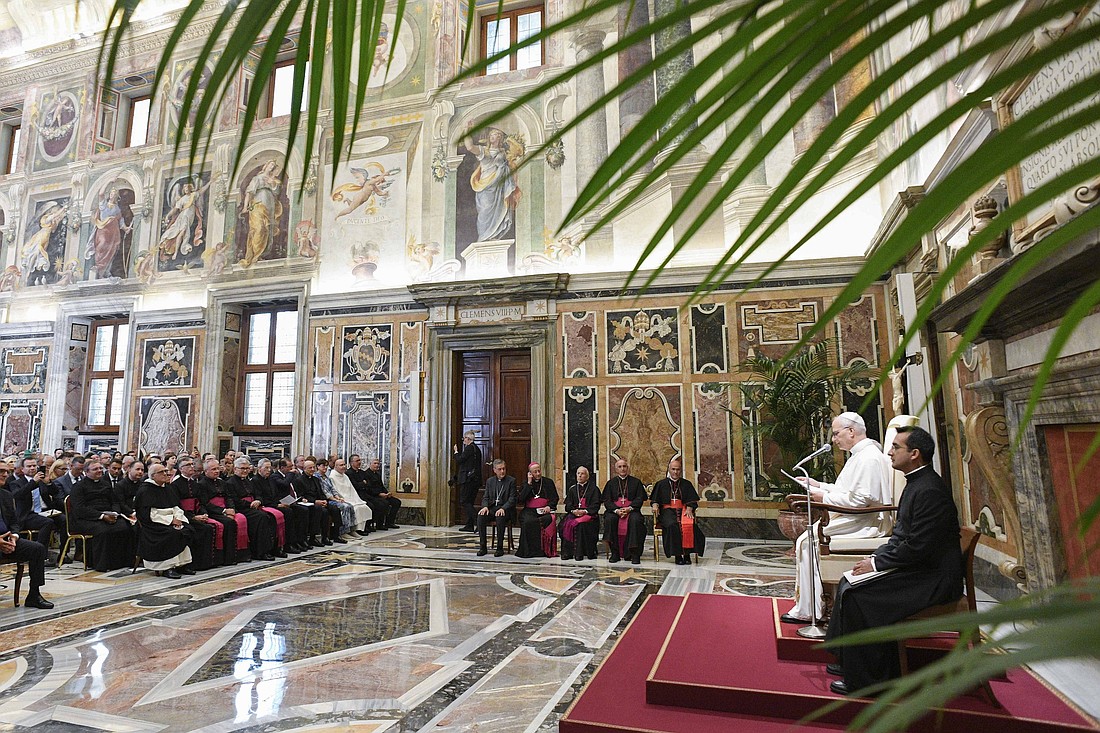
VATICAN CITY CNS – Because "true knowledge of God is realized in a life transformed by love," the Catholic Church needs theologians whose pursuit of understanding is framed by care for the real concerns of modern men and women, Pope Leo XIV said.
The Church's constant task of bringing the Gospel to all people requires "a theology that is incarnate, imbued with the human pains, joys, expectations and hopes of the women and men of our time," the Pope told members of the Pontifical Academy of Theology.
The Pope met Sept. 13 with academy members and participants in their seminar on "Creation, Nature, Environment for a World of Peace."
Pope Leo told the participants that the issues are of "urgent relevance" and "are very dear to me, just as they were to my venerable predecessors St. John Paul II, Benedict XVI and Francis."
"Environmental sustainability and the care of creation are essential commitments to ensure the survival of the human race," the Pope said. "They have a direct impact on the organization of our societies and on the possibility of peaceful and cooperative human coexistence."
The best theology, Pope Leo said, unites "faith and reason, reflection, prayer and practice."
"The ever-relevant example of St. Augustine is significant in this regard," said the Pope. "His theology was never a purely abstract pursuit but always the fruit of his experience of God and the life-giving relationship that flowed from it."
His theological reflections "were incarnate and capable of responding to the spiritual, doctrinal, pastoral and social needs of his time," the Pope said.
Theology must dialogue "with science, philosophy, art and all human experience," he said. "The theologian is a person who lives out, in his or her theological work, a missionary fervor by communicating to everyone the 'knowledge' and 'taste' of faith, so that it may illuminate our lives, redeem the weak and the excluded, touch and heal the suffering flesh of the poor, help us build a fraternal and supportive world, and lead us to an encounter with God."
Catholic social teaching, he said, is an area of theology that clearly places "the knowledge of faith at the service of humanity, in all its dimensions – personal, social and political."
Pope Leo encouraged the theologians to explore ways to ensure Catholic social doctrine can "provide wise answers to digital challenges. Theology must be directly involved because an exclusively ethical approach to the complex world of artificial intelligence is not enough."
When dealing with the challenges posed by the new technology, he said, "we need to refer to an anthropological vision that underpins ethical action and, therefore, return to the age-old question: What is a human being? What is his or her inherent dignity, which is irreconcilable with a digital android?"
Catholic journalism is needed now more than ever. Please consider supporting this work by signing up for a SUBSCRIPTION (click HERE) or making a DONATION to The Monitor (click HERE). Thank you for your support.
Related Stories
Saturday, December 27, 2025


E-Editions
Events
VATICAN CITY CNS – Because "true knowledge of God is realized in a life transformed by love," the Catholic Church needs theologians whose pursuit of understanding is framed by care for the real concerns of modern men and women, Pope Leo XIV said.
The Church's constant task of bringing the Gospel to all people requires "a theology that is incarnate, imbued with the human pains, joys, expectations and hopes of the women and men of our time," the Pope told members of the Pontifical Academy of Theology.
The Pope met Sept. 13 with academy members and participants in their seminar on "Creation, Nature, Environment for a World of Peace."
Pope Leo told the participants that the issues are of "urgent relevance" and "are very dear to me, just as they were to my venerable predecessors St. John Paul II, Benedict XVI and Francis."
"Environmental sustainability and the care of creation are essential commitments to ensure the survival of the human race," the Pope said. "They have a direct impact on the organization of our societies and on the possibility of peaceful and cooperative human coexistence."
The best theology, Pope Leo said, unites "faith and reason, reflection, prayer and practice."
"The ever-relevant example of St. Augustine is significant in this regard," said the Pope. "His theology was never a purely abstract pursuit but always the fruit of his experience of God and the life-giving relationship that flowed from it."
His theological reflections "were incarnate and capable of responding to the spiritual, doctrinal, pastoral and social needs of his time," the Pope said.
Theology must dialogue "with science, philosophy, art and all human experience," he said. "The theologian is a person who lives out, in his or her theological work, a missionary fervor by communicating to everyone the 'knowledge' and 'taste' of faith, so that it may illuminate our lives, redeem the weak and the excluded, touch and heal the suffering flesh of the poor, help us build a fraternal and supportive world, and lead us to an encounter with God."
Catholic social teaching, he said, is an area of theology that clearly places "the knowledge of faith at the service of humanity, in all its dimensions – personal, social and political."
Pope Leo encouraged the theologians to explore ways to ensure Catholic social doctrine can "provide wise answers to digital challenges. Theology must be directly involved because an exclusively ethical approach to the complex world of artificial intelligence is not enough."
When dealing with the challenges posed by the new technology, he said, "we need to refer to an anthropological vision that underpins ethical action and, therefore, return to the age-old question: What is a human being? What is his or her inherent dignity, which is irreconcilable with a digital android?"
Catholic journalism is needed now more than ever. Please consider supporting this work by signing up for a SUBSCRIPTION (click HERE) or making a DONATION to The Monitor (click HERE). Thank you for your support.