


Faith at Home: Pope Leo XIV: An American Pope for the whole world
September 11, 2025 at 1:59 p.m.
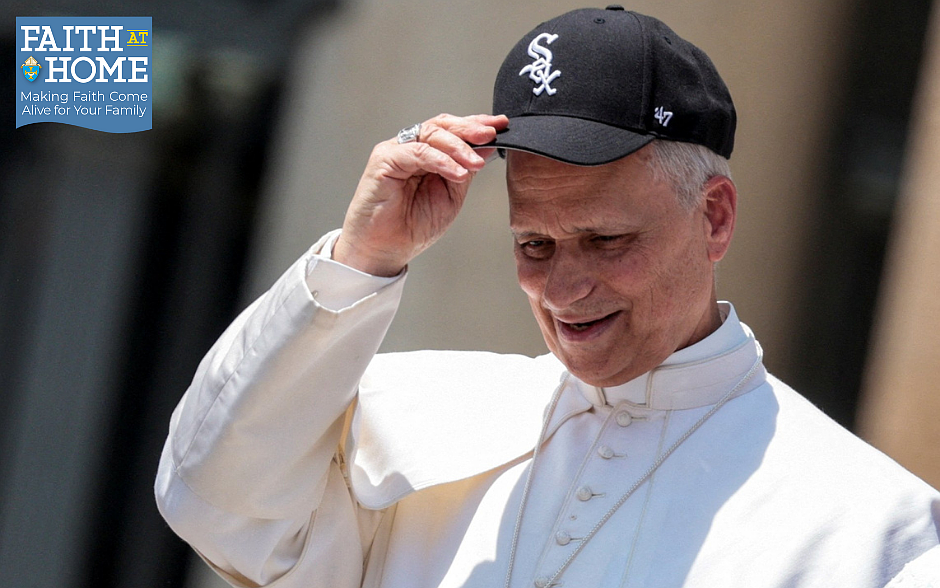
The election of Pope Leo XIV on May 8, 2025, is a great opportunity to teach children about the papacy and the Church. Most of us think of the “Church” as our local parish community. We often overlook the fact that the Roman Catholic Church consists of almost 1.4 billion people around the world. Also, given that up to this point, the Pope has come from some far-off country makes the Pope seem distant and foreign to American children. Even when we see images of the Pope when he visits the United States or at World Youth Day and he’s surrounded by millions of cheering young people, he doesn’t look or sound like us; he’s perceived as a remote personality. However, Pope Leo can change all that.
When Pope Francis was elected in 2013, he said that his brother cardinals “went to the ends of the earth” to select a Pope from Argentina in South America. Francis was the first non-European pope elected, acknowledging that Catholicism, though centered in Rome, is really a worldwide faith with most of its people living outside the political west. The election of Cardinal Robert Prevost, a native of Chicago, Ill., and educated at Villanova University in suburban Philadelphia, as the 266th successor of St. Peter the Apostle, the first Pope chosen by Jesus himself, solidifies that worldwide Catholic identity in very different ways. At the same time, his election also gives us in the United States the chance to reconnect with our Church in new and exciting ways.
Yes, Pope Leo was born here, but he has also spent most of his priesthood as a missionary outside the United States. Besides being a U.S. citizen, he holds dual citizenship in Peru where he served as priest and bishop. As the head of the Augustinian order of priests, he has traveled the world extensively and is probably better known outside his native country. He speaks multiple languages fluently, including Spanish, Italian, French and Portuguese. Still, when he speaks English, it is heavily accented with the sound of his home in the northern mid-west USA.
Like so many of us whose families came to this country from elsewhere in the world, Pope Leo’s ethnic background is a hodgepodge mixture. Through his blood run the flavors of Italy, France, Haiti, Spain and even Africa. He is truly a product of the American melting pot.
Why is this important? First, because it helps us – especially our children – connect with him more intimately. Pope Leo was told stories and shown pictures of his ancestors who came as immigrants to the U.S. just as we may show photos and talk about our family’s history with our children. Second, he has shared deeply in our American experience. He attended American schools. We can go to places where he has been. He continues to talk on the phone with his two brothers, Louis and John, who live in Florida and Illinois, respectively, and he understands our uniquely American politics and culture. He’s a big baseball fan, but we will have to forgive him for rooting for the Chicago White Sox instead of the Mets, Phillies or Yankees! He enjoys Chicago deep-dish pizza. Finally, he brings a distinctly American character to his new role – an openness to diversity in the Church – reportedly being a bit of a workaholic. His recent summer vacation to Castel Gandolfo has been described as a “working” one.
Right now, we really can’t tell what kind of a Pope Leo will be. He just completed the first 100 of his papacy. But at almost 69 years old, we probably have plenty of time to get to know him. He is sure to make a visit back “home” sometime soon. What he has shown us so far by his words and actions is that he is prayerful a man of peace with a warm smile, deeply in tune with modern culture, who carries a concern for working people, and who wants us to be closely united with Jesus and with each other. We’ll have to wait and see what more Pope Leo XIV has to teach us, but we can be certain that it will be delivered to the whole world with a uniquely American flavor.
God bless Pope Leo the XIV!
Mark Russoniello is parish catechetical leader in St. Robert Bellarmine Co-Cathedral, Freehold.
Faith at Home is a monthly column coordinated by the Diocese of Trenton’s Departments of Catechesis, Evangelization and Family Life, and Youth and Young Adult Ministry. For additional Faith at Home resources, visit dioceseoftrenton.org/faith-at-home.
Related Stories
Saturday, December 27, 2025


E-Editions
Events
The election of Pope Leo XIV on May 8, 2025, is a great opportunity to teach children about the papacy and the Church. Most of us think of the “Church” as our local parish community. We often overlook the fact that the Roman Catholic Church consists of almost 1.4 billion people around the world. Also, given that up to this point, the Pope has come from some far-off country makes the Pope seem distant and foreign to American children. Even when we see images of the Pope when he visits the United States or at World Youth Day and he’s surrounded by millions of cheering young people, he doesn’t look or sound like us; he’s perceived as a remote personality. However, Pope Leo can change all that.
When Pope Francis was elected in 2013, he said that his brother cardinals “went to the ends of the earth” to select a Pope from Argentina in South America. Francis was the first non-European pope elected, acknowledging that Catholicism, though centered in Rome, is really a worldwide faith with most of its people living outside the political west. The election of Cardinal Robert Prevost, a native of Chicago, Ill., and educated at Villanova University in suburban Philadelphia, as the 266th successor of St. Peter the Apostle, the first Pope chosen by Jesus himself, solidifies that worldwide Catholic identity in very different ways. At the same time, his election also gives us in the United States the chance to reconnect with our Church in new and exciting ways.
Yes, Pope Leo was born here, but he has also spent most of his priesthood as a missionary outside the United States. Besides being a U.S. citizen, he holds dual citizenship in Peru where he served as priest and bishop. As the head of the Augustinian order of priests, he has traveled the world extensively and is probably better known outside his native country. He speaks multiple languages fluently, including Spanish, Italian, French and Portuguese. Still, when he speaks English, it is heavily accented with the sound of his home in the northern mid-west USA.
Like so many of us whose families came to this country from elsewhere in the world, Pope Leo’s ethnic background is a hodgepodge mixture. Through his blood run the flavors of Italy, France, Haiti, Spain and even Africa. He is truly a product of the American melting pot.
Why is this important? First, because it helps us – especially our children – connect with him more intimately. Pope Leo was told stories and shown pictures of his ancestors who came as immigrants to the U.S. just as we may show photos and talk about our family’s history with our children. Second, he has shared deeply in our American experience. He attended American schools. We can go to places where he has been. He continues to talk on the phone with his two brothers, Louis and John, who live in Florida and Illinois, respectively, and he understands our uniquely American politics and culture. He’s a big baseball fan, but we will have to forgive him for rooting for the Chicago White Sox instead of the Mets, Phillies or Yankees! He enjoys Chicago deep-dish pizza. Finally, he brings a distinctly American character to his new role – an openness to diversity in the Church – reportedly being a bit of a workaholic. His recent summer vacation to Castel Gandolfo has been described as a “working” one.
Right now, we really can’t tell what kind of a Pope Leo will be. He just completed the first 100 of his papacy. But at almost 69 years old, we probably have plenty of time to get to know him. He is sure to make a visit back “home” sometime soon. What he has shown us so far by his words and actions is that he is prayerful a man of peace with a warm smile, deeply in tune with modern culture, who carries a concern for working people, and who wants us to be closely united with Jesus and with each other. We’ll have to wait and see what more Pope Leo XIV has to teach us, but we can be certain that it will be delivered to the whole world with a uniquely American flavor.
God bless Pope Leo the XIV!
Mark Russoniello is parish catechetical leader in St. Robert Bellarmine Co-Cathedral, Freehold.
Faith at Home is a monthly column coordinated by the Diocese of Trenton’s Departments of Catechesis, Evangelization and Family Life, and Youth and Young Adult Ministry. For additional Faith at Home resources, visit dioceseoftrenton.org/faith-at-home.