


Teaching is 'great act of love,' Pope tells educators
October 31, 2025 at 2:36 p.m.
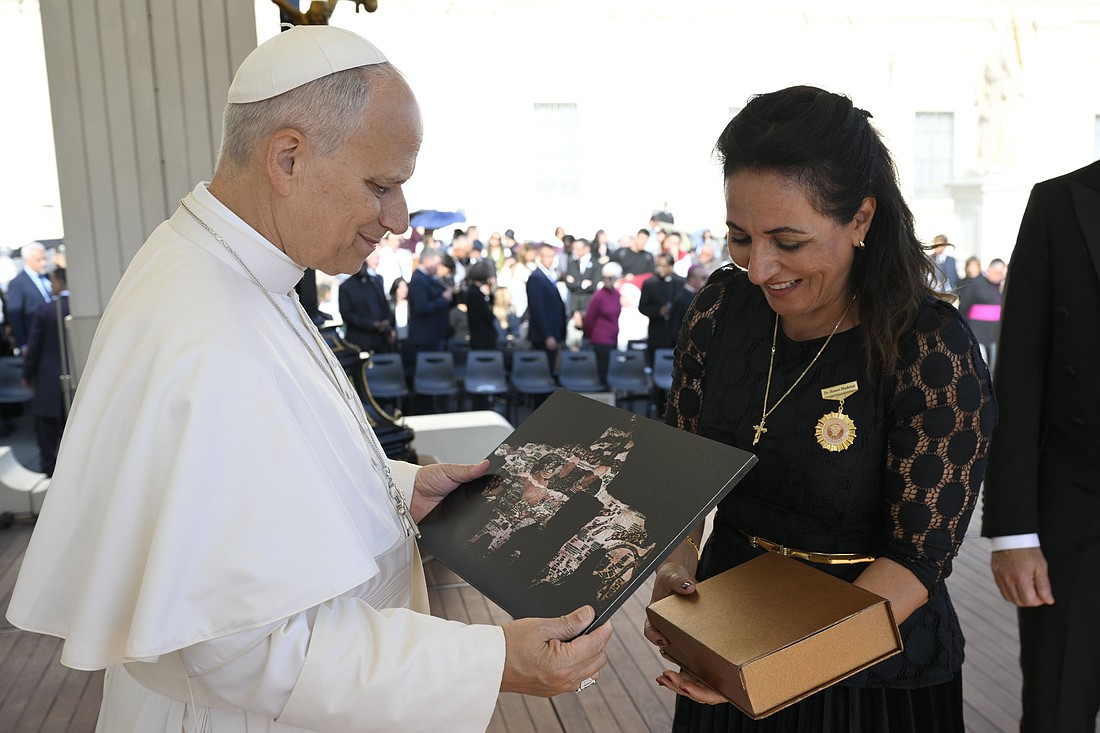
VATICAN CITY CNS – A human connection of love and care between a teacher and student is a key part of the educational process, Pope Leo XIV said, and one that is even more important at a time when so many students experience fragility.
Education is "a path that teachers and pupils walk together," the Pope said Oct. 31 as he met thousands of teachers, professors and other educators in St. Peter's Square as part of the Jubilee of the World of Education.
A banner featuring a portrait of St. John Henry Newman, whom the Pope recently proclaimed co-patron of education, hung from the central balcony of St. Peter's Basilica. Many people in the square planned to return Nov. 1 for Mass with the Pope and his proclamation of St. Newman as a "doctor of the Church."
Educators, "who are often tired and overburdened with bureaucratic tasks, run the real risk of forgetting what St. John Henry Newman summed up in the expression 'Cor ad cor loquitur' ('heart speaks to heart') and what St. Augustine said, 'Do not look without, return to yourself, for truth dwells within you,'" the Pope told them.
Pope Leo, who had been a teacher as an Augustinian, told the educators that "today, in our educational contexts, it is worrying to see the increasing symptoms of widespread inner fragility, at all ages."
"We cannot close our eyes to these silent cries for help," he said. "On the contrary, we must strive to identify their underlying causes."
Pope Leo cautioned that "artificial intelligence, in particular, with its technical, cold and standardized knowledge, can further cut off students who are already isolated, giving them the illusion that they do not need others or, worse still, the feeling that they are not worthy of them."
But teaching "is a human endeavor," the Pope said, "and the very joy of the educational process is a fully human engagement, a 'flame to melt our souls together, and out of many to make but one,'" as St. Augustine wrote.
Having a beautiful classroom, a full library and the latest technology does not guarantee that teaching and learning are occurring, he said.
"Truth does not spread through sounds, walls and corridors," the Pope said, "but in the profound encounter between people, without which any educational endeavor is doomed to fail."
Teaching is "a great act of love," he said, telling the educators that St. Augustine had said, "The love of God is the first commandment; the love of neighbor is the first practice."
As a Church and as teachers, he said, "each one of us might ask ourselves what commitment are we making to address the most urgent needs; what efforts are we making to build bridges of dialogue and peace, even within teaching communities; what skills are we developing to overcome preconceptions or narrow views; what openness are we showing in co-learning processes; and what efforts are we making to meet and respond to the needs of the most fragile, poor and excluded?"
"Sharing knowledge is not enough for teaching: love is needed," Pope Leo said.
According to the Dicastery for Culture and Education, the Catholic Church runs the largest network of schools and universities in the world. There are more than 231,000 Catholic-run educational institutions present in 171 countries. Almost 72 million students study at a Catholic school or university.
Earlier in the day, Pope Leo met with members of the Organization of Catholic Universities of Latin America and the Caribbean. He told them, "The aim of Catholic higher education is none other than to seek the integral development of the human person, forming minds with a critical sense, believing hearts and citizens committed to the common good."
In addition to serving the societies they are a part of, he said, Catholic universities must create "spaces of encounter between faith and culture in order to proclaim the Gospel within the university setting."
Catholic journalism is needed now more than ever. Please consider supporting this work by signing up for a SUBSCRIPTION (click HERE) or making a DONATION to The Monitor (click HERE). Thank you for your contribution.
Related Stories
Sunday, December 28, 2025


E-Editions
Events
VATICAN CITY CNS – A human connection of love and care between a teacher and student is a key part of the educational process, Pope Leo XIV said, and one that is even more important at a time when so many students experience fragility.
Education is "a path that teachers and pupils walk together," the Pope said Oct. 31 as he met thousands of teachers, professors and other educators in St. Peter's Square as part of the Jubilee of the World of Education.
A banner featuring a portrait of St. John Henry Newman, whom the Pope recently proclaimed co-patron of education, hung from the central balcony of St. Peter's Basilica. Many people in the square planned to return Nov. 1 for Mass with the Pope and his proclamation of St. Newman as a "doctor of the Church."
Educators, "who are often tired and overburdened with bureaucratic tasks, run the real risk of forgetting what St. John Henry Newman summed up in the expression 'Cor ad cor loquitur' ('heart speaks to heart') and what St. Augustine said, 'Do not look without, return to yourself, for truth dwells within you,'" the Pope told them.
Pope Leo, who had been a teacher as an Augustinian, told the educators that "today, in our educational contexts, it is worrying to see the increasing symptoms of widespread inner fragility, at all ages."
"We cannot close our eyes to these silent cries for help," he said. "On the contrary, we must strive to identify their underlying causes."
Pope Leo cautioned that "artificial intelligence, in particular, with its technical, cold and standardized knowledge, can further cut off students who are already isolated, giving them the illusion that they do not need others or, worse still, the feeling that they are not worthy of them."
But teaching "is a human endeavor," the Pope said, "and the very joy of the educational process is a fully human engagement, a 'flame to melt our souls together, and out of many to make but one,'" as St. Augustine wrote.
Having a beautiful classroom, a full library and the latest technology does not guarantee that teaching and learning are occurring, he said.
"Truth does not spread through sounds, walls and corridors," the Pope said, "but in the profound encounter between people, without which any educational endeavor is doomed to fail."
Teaching is "a great act of love," he said, telling the educators that St. Augustine had said, "The love of God is the first commandment; the love of neighbor is the first practice."
As a Church and as teachers, he said, "each one of us might ask ourselves what commitment are we making to address the most urgent needs; what efforts are we making to build bridges of dialogue and peace, even within teaching communities; what skills are we developing to overcome preconceptions or narrow views; what openness are we showing in co-learning processes; and what efforts are we making to meet and respond to the needs of the most fragile, poor and excluded?"
"Sharing knowledge is not enough for teaching: love is needed," Pope Leo said.
According to the Dicastery for Culture and Education, the Catholic Church runs the largest network of schools and universities in the world. There are more than 231,000 Catholic-run educational institutions present in 171 countries. Almost 72 million students study at a Catholic school or university.
Earlier in the day, Pope Leo met with members of the Organization of Catholic Universities of Latin America and the Caribbean. He told them, "The aim of Catholic higher education is none other than to seek the integral development of the human person, forming minds with a critical sense, believing hearts and citizens committed to the common good."
In addition to serving the societies they are a part of, he said, Catholic universities must create "spaces of encounter between faith and culture in order to proclaim the Gospel within the university setting."
Catholic journalism is needed now more than ever. Please consider supporting this work by signing up for a SUBSCRIPTION (click HERE) or making a DONATION to The Monitor (click HERE). Thank you for your contribution.