


A synodal Church evangelizes better, works together for justice, Pope says
October 27, 2025 at 4:21 p.m.
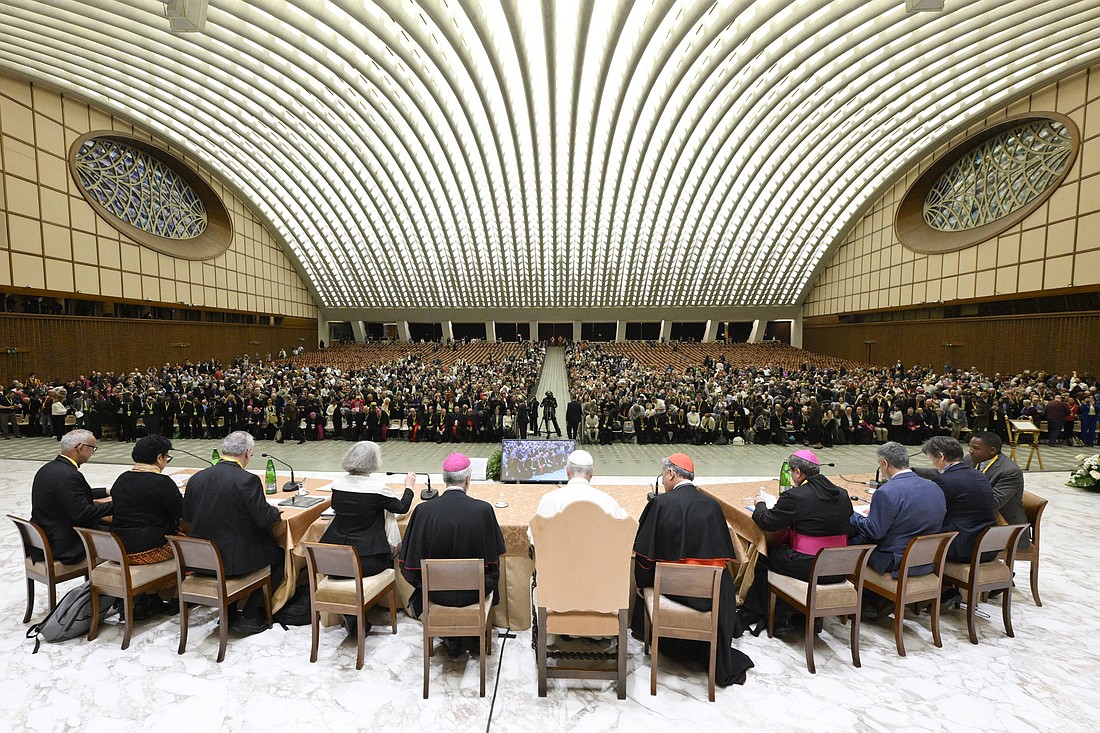
VATICAN CITY CNS – The pursuit of synodality should strengthen the Catholic Church's mission of proclaiming the Gospel and help all Catholics learn to collaborate to make the world a better place, Pope Leo XIV said.
"As Pope Francis reminded us on numerous occasions," the Pope said, the purpose of synodality "is to help the Church fulfill its primary role in the world, which is to be missionary, to announce the Gospel, to give witness to the person of Jesus Christ in every part of the world, to the ends of the earth."
That witness includes speaking up for justice, caring for the planet and promoting peace, Pope Leo said during a meeting late Oct. 24 with participants in the Jubilee of Synodal Teams and Participatory Bodies.
"The Church has a voice, and we need to be courageous in raising our voice to change the world, to make it a better place," he told the pilgrims, who included about 150 representatives from the United States with 15 U.S. bishops.
During the evening meeting, the Pope listened to seven regionals reports on the implementation of the 2021-2024 Synod of Bishops on synodality and answered a question from each regional representative. Pope Leo took notes during the presentations, and his responses appeared to be unscripted.
Two questions drew strong applause from participants, a reaction Pope Leo noted in his responses. The first applauded question was about changing the minds of "bishops and priests who are concerned that synodality may diminish their authority as pastors"; and the second was whether the Pope believed "equality between men and women in the Church can become a lived reality in the future."
Canadian Bishop Alain Faubert of Valleyfield, Quebec, gave the North American report, which ended with the question about getting all bishops and priests onboard.
Pope Leo said there is a need "to invite the priests, particularly, even more so than the bishops, I think, to somehow open their hearts and take part in these processes. Oftentimes, the resistances come out of fear and the lack of knowledge."
The synodal process of listening to one another without immediately judging or defending one's position has practical applications, he said.
Apparently referring to the breakdown of U.S.-Canada talks about trade and tariffs, the Pope noted that the two countries "are experiencing even great difficulties. Two countries that were once considered the closest allies, at times, become separated from one another, and it's another proof, another expression, of why synodality – listening and dialogue – are so important, and how they have concrete applications in our daily lives.
People committed to synodality in the Church need to be patient, though, he said. "We have to understand that we do not all run at the same speed, and sometimes we have to be patient with one another, rather than a few people running ahead and leaving a lot behind, which could cause even a break in an ecclesial experience."
Presenting the European report, Klara-Antonia Csiszar, a professor of theology in Linz, Austria, told Pope Leo that "the question of women remains an important issue throughout Europe. In many local Churches in the West, impatience for greater female participation is an open reality, while elsewhere, debates on the diaconate or on women's leadership encounter resistance, skepticism or fear."
Responding, the Pope began by telling the delegates that sometime in the 1970s he remembers asking his mother if she wanted to be equal to men. "And she said, 'No, because we are already better.' And she was not joking."
"Leaving aside the most difficult themes that are being studied by study groups," particularly the question of ordaining women to the diaconate, Pope Leo said he believed the lack of equality for women in the Church is due mainly to "cultural obstacles."
"I mean women could play a key role in the Church, but there are priests and bishops who hesitate," he said. "There are cultures in the Church where women still suffer because of inequality. In some cultures, women are considered as second-class citizens and in reality, do not enjoy the same rights as men."
A challenge for the Church, Pope Leo said, is to "understand how we can promote respect for the rights of everyone, men and women. How can we promote a culture in which these things become not only possible, but they become a reality, a culture in which there is co-participation of all the members of society, each according to their vocation, so everyone can play a role, can have a role of responsibility in the Church."
The Church, he said, must find ways to "to transform cultures according to the values of the Gospel. Unfortunately, often the way which we live out our faith is influenced more by our culture than by Gospel values."
Catholic journalism is needed now more than ever. Please consider supporting this work by signing up for a SUBSCRIPTION (click HERE) or making a DONATION to The Monitor (click HERE). Thank you for your contribution.
Related Stories
Sunday, December 28, 2025



E-Editions
Events
VATICAN CITY CNS – The pursuit of synodality should strengthen the Catholic Church's mission of proclaiming the Gospel and help all Catholics learn to collaborate to make the world a better place, Pope Leo XIV said.
"As Pope Francis reminded us on numerous occasions," the Pope said, the purpose of synodality "is to help the Church fulfill its primary role in the world, which is to be missionary, to announce the Gospel, to give witness to the person of Jesus Christ in every part of the world, to the ends of the earth."
That witness includes speaking up for justice, caring for the planet and promoting peace, Pope Leo said during a meeting late Oct. 24 with participants in the Jubilee of Synodal Teams and Participatory Bodies.
"The Church has a voice, and we need to be courageous in raising our voice to change the world, to make it a better place," he told the pilgrims, who included about 150 representatives from the United States with 15 U.S. bishops.
During the evening meeting, the Pope listened to seven regionals reports on the implementation of the 2021-2024 Synod of Bishops on synodality and answered a question from each regional representative. Pope Leo took notes during the presentations, and his responses appeared to be unscripted.
Two questions drew strong applause from participants, a reaction Pope Leo noted in his responses. The first applauded question was about changing the minds of "bishops and priests who are concerned that synodality may diminish their authority as pastors"; and the second was whether the Pope believed "equality between men and women in the Church can become a lived reality in the future."
Canadian Bishop Alain Faubert of Valleyfield, Quebec, gave the North American report, which ended with the question about getting all bishops and priests onboard.
Pope Leo said there is a need "to invite the priests, particularly, even more so than the bishops, I think, to somehow open their hearts and take part in these processes. Oftentimes, the resistances come out of fear and the lack of knowledge."
The synodal process of listening to one another without immediately judging or defending one's position has practical applications, he said.
Apparently referring to the breakdown of U.S.-Canada talks about trade and tariffs, the Pope noted that the two countries "are experiencing even great difficulties. Two countries that were once considered the closest allies, at times, become separated from one another, and it's another proof, another expression, of why synodality – listening and dialogue – are so important, and how they have concrete applications in our daily lives.
People committed to synodality in the Church need to be patient, though, he said. "We have to understand that we do not all run at the same speed, and sometimes we have to be patient with one another, rather than a few people running ahead and leaving a lot behind, which could cause even a break in an ecclesial experience."
Presenting the European report, Klara-Antonia Csiszar, a professor of theology in Linz, Austria, told Pope Leo that "the question of women remains an important issue throughout Europe. In many local Churches in the West, impatience for greater female participation is an open reality, while elsewhere, debates on the diaconate or on women's leadership encounter resistance, skepticism or fear."
Responding, the Pope began by telling the delegates that sometime in the 1970s he remembers asking his mother if she wanted to be equal to men. "And she said, 'No, because we are already better.' And she was not joking."
"Leaving aside the most difficult themes that are being studied by study groups," particularly the question of ordaining women to the diaconate, Pope Leo said he believed the lack of equality for women in the Church is due mainly to "cultural obstacles."
"I mean women could play a key role in the Church, but there are priests and bishops who hesitate," he said. "There are cultures in the Church where women still suffer because of inequality. In some cultures, women are considered as second-class citizens and in reality, do not enjoy the same rights as men."
A challenge for the Church, Pope Leo said, is to "understand how we can promote respect for the rights of everyone, men and women. How can we promote a culture in which these things become not only possible, but they become a reality, a culture in which there is co-participation of all the members of society, each according to their vocation, so everyone can play a role, can have a role of responsibility in the Church."
The Church, he said, must find ways to "to transform cultures according to the values of the Gospel. Unfortunately, often the way which we live out our faith is influenced more by our culture than by Gospel values."
Catholic journalism is needed now more than ever. Please consider supporting this work by signing up for a SUBSCRIPTION (click HERE) or making a DONATION to The Monitor (click HERE). Thank you for your contribution.