


Bishop stresses value of Catholic education as GCU rolls out new doctorate program
October 6, 2025 at 12:22 p.m.
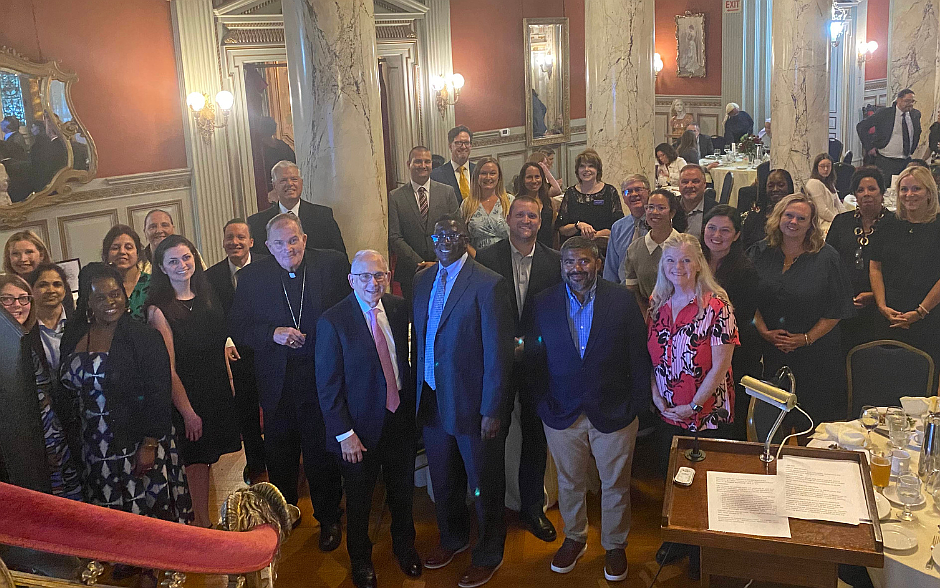
“The life of the Christian witness is nourished and strengthened within the community of people who are the Lord's disciples. You are those people,” said Bishop David M. O’Connell, C.M., addressing the first cohort of 14 students in the new Doctor of Education (Ed.D.) program at Georgian Court University, Lakewood, the Mercy University of New Jersey.
Bishop O’Connell delivered the keynote at the program’s kickoff event Sept. 19, emphasizing that the heart of Catholic education lies in its leaders and educators.
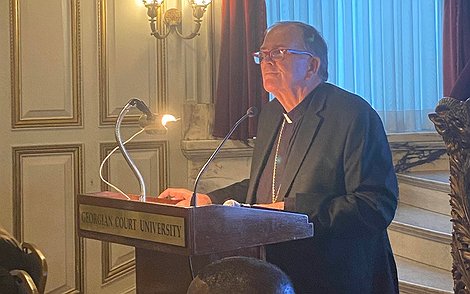 Bishop David M. O’Connell, C.M., delivers the keynote address Sept. 19 during the kickoff of Georgian Court University’s new Doctor of Education program in Lakewood. Kayla Latendresse photo
Catholic school representatives from Red Bank Catholic High School, St. Catherine School, Spring Lake, and St. John Vianney High School, Holmdel, attended as local partners.
The 54-credit, cohort-based Ed.D. program is designed to prepare leaders who desire to pursue careers in PreK–12 education or as administrators in nonprofit organizations, leading to roles such as principals, superintendents, deans, provosts, policy advocates, or faculty in higher education.
Unlike the traditional model of most doctoral programs, where the dissertation is completed after coursework, students begin dissertation work in the first semester of enrollment. This allows them to earn their degree in three years, compared to the typical five to ten years. The program offers flexible online courses, personal mentoring, two in-person on-campus residencies, and an international experience as a final residency.
Mission of Catholic education
“Our Catholic schools are, and must be, a place to encounter the living God,” Bishop O’Connell stated. “Our Catholic schools are one way that Jesus' promise continues to be fulfilled. That is our Catholic identity, and that's our hope.”
When a Catholic school believes in its identity and mission, he can feel the difference, the Bishop explained. What makes Catholic schools different is the way they educate. A Catholic education teaches the Good News and brings faith into every human situation.
“The enduring effects of what we do depend on how we do it, and that's what makes us different.” It’s the vision and the passion that drive the mission of Catholic education, he noted.
The vision “comes from the Gospel and creates the values by which the Catholic school is known and identified, and it makes its values real and alive and applicable to real life.”
The passion is evangelization. “Catholic schools are places, as the school saying goes, ‘where faith and knowledge meet,’ but unless that meeting inspires … engages … lights a fire … changes lives, our schools are simply just that, schools.”
Leaders in Catholic schools must work as dedicated partners, driven by a hope, vision and passion for excellence in living the Catholic faith and leading their students in this same pursuit.
Missionaries in Education
The doctoral program’s community and support will help the first cohort succeed and grow as leaders and learners.
Dr. Amuhelang Magaya, associate professor at Georgian Court and the program’s developer and director, explained that he desires the program “to belong, have an identity,” and everyone involved “to be missionaries for what is good.”
“We have hope, and our hope is in Christ,” he added. Georgian Court is built on the foundation of its Mercy core values of respect, integrity, justice, compassion, and service. These values shape each student, especially the courses in this program.
“By looking into our core values, I think we can find meaning … we are GCU and we stand for those values. We are the missionaries.”
Richard Van Pelt is a volunteer catechist at Visitation Parish, Brick. He holds a bachelor’s degree in history with a minor in religious studies and a Mercy Spirituality Certificate attached, as well as a master’s in theology and social work. He has a special interest in disability theology and hopes to become a lay minister or deacon, a dream this program could help fulfill.
Inspired by the Archbishop Fulton J. Sheen episodes on EWTN as a child, Van Pelt hopes to convey the “historical approach, the guided religious approach that Archbishop Sheen offered, as well as an awareness in disability theology” in his future leadership role.
“I hope to help instill the integrity and the respect … and all of the Mercy core values, but also Catholic core values, because I think the world really needs more of that.”
Related Stories
Sunday, December 28, 2025



E-Editions
Events
“The life of the Christian witness is nourished and strengthened within the community of people who are the Lord's disciples. You are those people,” said Bishop David M. O’Connell, C.M., addressing the first cohort of 14 students in the new Doctor of Education (Ed.D.) program at Georgian Court University, Lakewood, the Mercy University of New Jersey.
Bishop O’Connell delivered the keynote at the program’s kickoff event Sept. 19, emphasizing that the heart of Catholic education lies in its leaders and educators.
Bishop David M. O’Connell, C.M., delivers the keynote address Sept. 19 during the kickoff of Georgian Court University’s new Doctor of Education program in Lakewood. Kayla Latendresse photoCatholic school representatives from Red Bank Catholic High School, St. Catherine School, Spring Lake, and St. John Vianney High School, Holmdel, attended as local partners.
The 54-credit, cohort-based Ed.D. program is designed to prepare leaders who desire to pursue careers in PreK–12 education or as administrators in nonprofit organizations, leading to roles such as principals, superintendents, deans, provosts, policy advocates, or faculty in higher education.
Unlike the traditional model of most doctoral programs, where the dissertation is completed after coursework, students begin dissertation work in the first semester of enrollment. This allows them to earn their degree in three years, compared to the typical five to ten years. The program offers flexible online courses, personal mentoring, two in-person on-campus residencies, and an international experience as a final residency.
Mission of Catholic education
“Our Catholic schools are, and must be, a place to encounter the living God,” Bishop O’Connell stated. “Our Catholic schools are one way that Jesus' promise continues to be fulfilled. That is our Catholic identity, and that's our hope.”
When a Catholic school believes in its identity and mission, he can feel the difference, the Bishop explained. What makes Catholic schools different is the way they educate. A Catholic education teaches the Good News and brings faith into every human situation.
“The enduring effects of what we do depend on how we do it, and that's what makes us different.” It’s the vision and the passion that drive the mission of Catholic education, he noted.
The vision “comes from the Gospel and creates the values by which the Catholic school is known and identified, and it makes its values real and alive and applicable to real life.”
The passion is evangelization. “Catholic schools are places, as the school saying goes, ‘where faith and knowledge meet,’ but unless that meeting inspires … engages … lights a fire … changes lives, our schools are simply just that, schools.”
Leaders in Catholic schools must work as dedicated partners, driven by a hope, vision and passion for excellence in living the Catholic faith and leading their students in this same pursuit.
Missionaries in Education
The doctoral program’s community and support will help the first cohort succeed and grow as leaders and learners.
Dr. Amuhelang Magaya, associate professor at Georgian Court and the program’s developer and director, explained that he desires the program “to belong, have an identity,” and everyone involved “to be missionaries for what is good.”
“We have hope, and our hope is in Christ,” he added. Georgian Court is built on the foundation of its Mercy core values of respect, integrity, justice, compassion, and service. These values shape each student, especially the courses in this program.
“By looking into our core values, I think we can find meaning … we are GCU and we stand for those values. We are the missionaries.”
Richard Van Pelt is a volunteer catechist at Visitation Parish, Brick. He holds a bachelor’s degree in history with a minor in religious studies and a Mercy Spirituality Certificate attached, as well as a master’s in theology and social work. He has a special interest in disability theology and hopes to become a lay minister or deacon, a dream this program could help fulfill.
Inspired by the Archbishop Fulton J. Sheen episodes on EWTN as a child, Van Pelt hopes to convey the “historical approach, the guided religious approach that Archbishop Sheen offered, as well as an awareness in disability theology” in his future leadership role.
“I hope to help instill the integrity and the respect … and all of the Mercy core values, but also Catholic core values, because I think the world really needs more of that.”