


Eucharistic procession marks Feast of the Exaltation of the Holy Cross on Princeton campus
October 1, 2025 at 4:01 p.m.
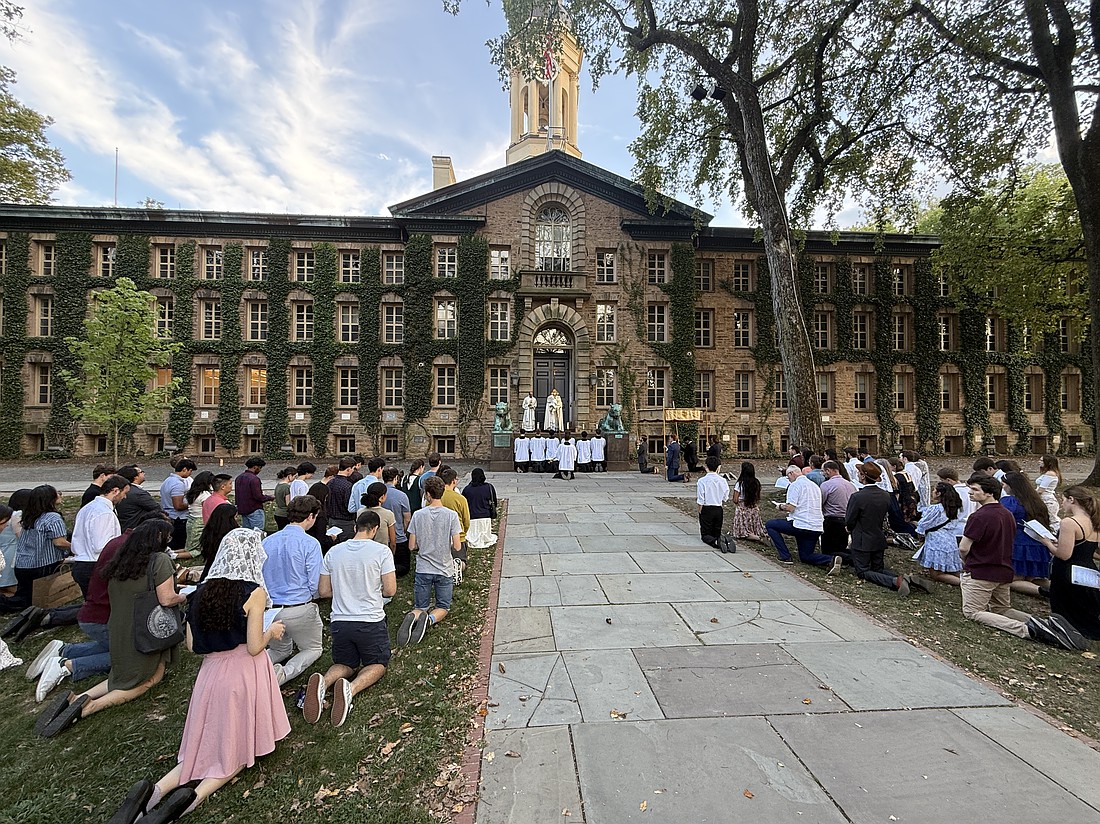
Bystanders watched curiously as a line of worshippers departed the Princeton University Chapel Sept. 14, following the Blessed Sacrament and a relic of the True Cross in procession while joyfully singing hymns of praise.
PHOTO GALLERY: Princeton University Eucharistic Procession
What was once a symbol of persecution and shame was turned into triumph when Jesus died on the Cross then rose again from the dead; thus, the Feast of the Exaltation of the Holy Cross on Sept. 14 reminds Christians of the power behind this most recognizable of Christian symbols.
Participants in the celebration attended an afternoon Mass in the University Chapel celebrated by Father Zachary Swantek, chaplain for the Aquinas Institute, Princeton University's Catholic campus ministry. They then joined the Eucharistic Procession from the chapel throughout university grounds, singing along with the Aquinas Institute Schola and stopping in front of Nassau Hall for a moment of Adoration.
Public Witnesses
In his homily, Father Swantek emphasized the visible testimony of both the procession and the lives of the students themselves “being sent back out to live as his witnesses in dorms, dining halls, classrooms, laboratories and libraries and in the friendships that shape our campus life.”
The annual Eucharistic Procession associated with the Feast of the Holy Cross, he continued, “embodies Aquinas’ mission to lead students to a growing relationship with Christ, equipping them to become lifelong, intentional missionary disciples.”
The procession, Father Swantek said, “reflects the patterns of discipleship that Jesus himself modeled first to win us over to Christ. The public witness of the Eucharistic procession draws hearts to Christ, just as Jesus first called his disciples with it with a simple ‘come and see.’”
Taking place every year on Princeton University’s campus, the celebration lends a threefold purpose, Father Swantek noted.
Offering an encounter with the Real Presence in the Eucharist “stirs curiosity and desire,” he noted. “Our goal is not to win arguments, but to win hearts for Christ,” Father Swantek said.
“Second is to build us up in our faith. Those who have been drawn in are invited to go deeper, to learn the faith, to grow in virtuous friendship and to practice worship regularly. The procession is not the end, but a doorway to the life of prayer, fellowship and formation.”
Finally, the event includes being sent out. “Having received Christ's blessing, students are commissioned to bring his love to others, making him known in word and deed across the campus,” he said. “In this way, the Eucharist perception is more than a single event. It is a living expression of evangelization, rooted in intimacy with God, strengthened by community with conflicts and flowing outward in influence with others.
“Through it, we hope not just to walk with Christ through Princeton's campus for one afternoon, but to ensure that Christ walks through Princeton every day in the heart of those whom he has won over.”
Father Swantek left the students and those present with two challenges: to identify a personal wound and bring it to Jesus in prayer, Adoration, Mass and Confession, and to ask the Lord to show them one person whose cross they control.
That may be “a classmate, lab partner, teammate or friend. Listen without hurry, pray with them, invite them to Mass, Adoration, Bible study or seminar and serve them in practical character, become a living monstrance,” he said. “Our Gospel Antiphon today comes from St. Francis of Assisi, that we're familiar with from the Stations of the Cross. ‘We adore you. Oh Christ, and we bless you, because by your Holy Cross, you have redeemed the world.’
“May the Holy Cross lift us up with Jesus, may his mercy bind our wounds, and may our lives lift high in his blood today and every day.”
Divine Encounter
Students shared their enthusiasm about the Mass and procession, and for the opportunity to witness to their Catholic faith.
A regular attendee of the 4:30 p.m. Mass in the University Chapel, Princeton University sophomore Mariana Schmitt took part in the procession last year, and was excited to do so again.
“It was so beautiful to walk behind the Blessed Sacrament, hear all of our voices sing praise to God, and see the rest of campus go silent in reverence for the procession, so I knew I had to participate in it again this year,” Schmitt said.
Daniel Kaiser, a Princeton University senior, has been serving at the altar since he came to campus three years ago, and the Eucharistic Procession “is one of my favorite traditions, and the Aquinas Institute has always done it very well,” he said.
“It is immensely important that we have these liturgical events on Princeton's campus, because the Princeton community – and our modern world – oftentimes lacks the opportunity to have genuine encounters with the divine.”
“I think it is so important to have events like this on Princeton’s campus because it shows that the faith is as strong with young Catholics now as it has ever been,” Schmitt said. “Princeton might be a secular institution, but that does not mean that there is any lack of faith and piety among the Catholic community here. The procession is a beautiful representation of how devout the Aquinas community is, and a sign that Catholics on college campuses are not afraid to boldly proclaim their faith.”
Kaiser agreed, noting that the procession presents an opportunity for everyone, no matter their religious affiliation, to encounter God.
“At the very least, there's an opportunity for them to think about what they just saw: a group of 100 or so students publicly singing to, praying to and worshipping God,” he explained. “The Catholic faith is both a private and public thing, and this Eucharistic procession reflects that in a fundamental, beautiful way.”
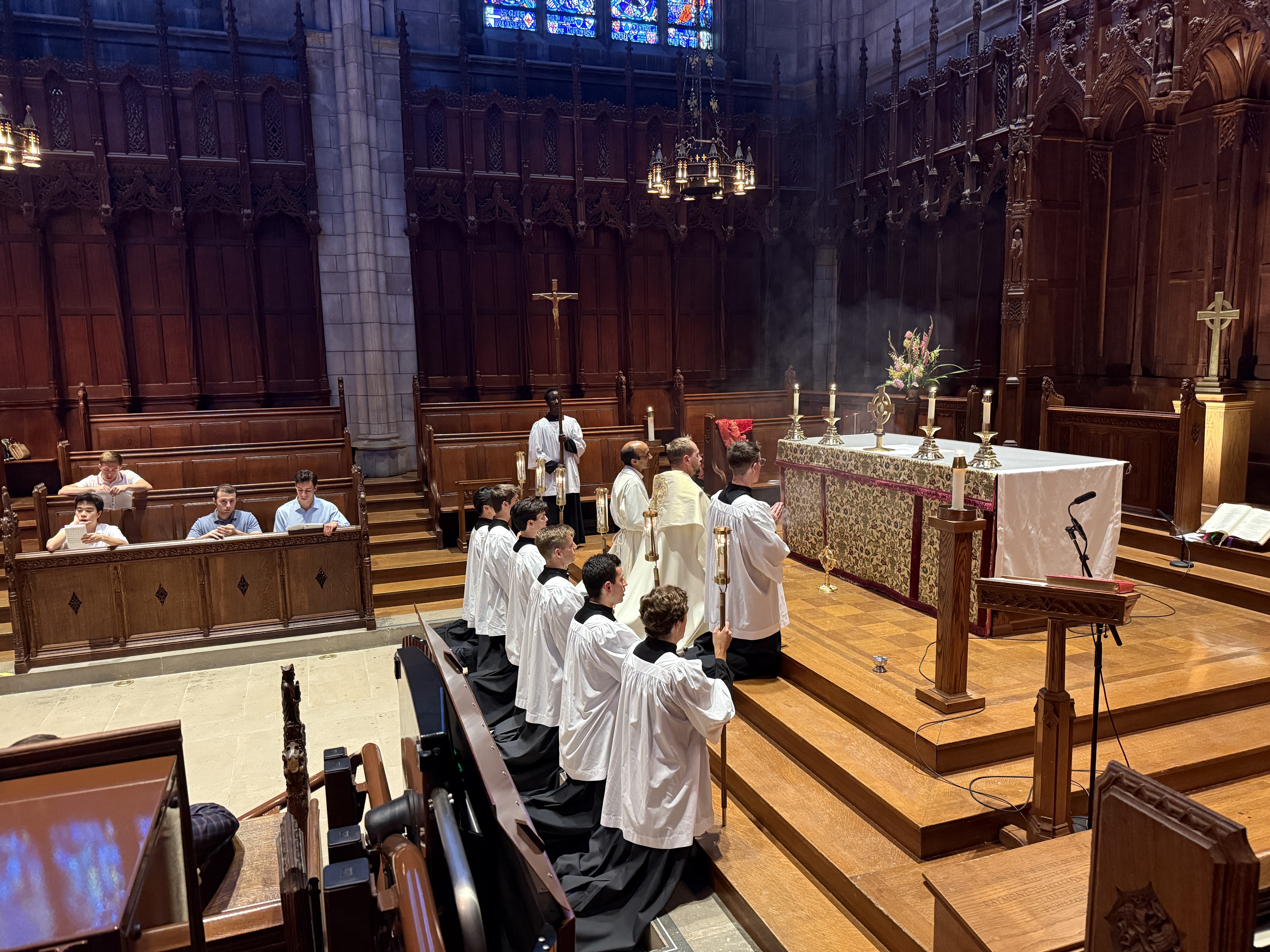 Father Zachary Swantek, chaplain for the Aquinas Institute, leads the praying of the Divine Praises after the Eucharistic Procession's return to Princeton University Chapel Sept. 14. EmmaLee Italia photo
Related Stories
Wednesday, January 07, 2026



E-Editions
Events
Bystanders watched curiously as a line of worshippers departed the Princeton University Chapel Sept. 14, following the Blessed Sacrament and a relic of the True Cross in procession while joyfully singing hymns of praise.
PHOTO GALLERY: Princeton University Eucharistic Procession
What was once a symbol of persecution and shame was turned into triumph when Jesus died on the Cross then rose again from the dead; thus, the Feast of the Exaltation of the Holy Cross on Sept. 14 reminds Christians of the power behind this most recognizable of Christian symbols.
Participants in the celebration attended an afternoon Mass in the University Chapel celebrated by Father Zachary Swantek, chaplain for the Aquinas Institute, Princeton University's Catholic campus ministry. They then joined the Eucharistic Procession from the chapel throughout university grounds, singing along with the Aquinas Institute Schola and stopping in front of Nassau Hall for a moment of Adoration.
Public Witnesses
In his homily, Father Swantek emphasized the visible testimony of both the procession and the lives of the students themselves “being sent back out to live as his witnesses in dorms, dining halls, classrooms, laboratories and libraries and in the friendships that shape our campus life.”
The annual Eucharistic Procession associated with the Feast of the Holy Cross, he continued, “embodies Aquinas’ mission to lead students to a growing relationship with Christ, equipping them to become lifelong, intentional missionary disciples.”
The procession, Father Swantek said, “reflects the patterns of discipleship that Jesus himself modeled first to win us over to Christ. The public witness of the Eucharistic procession draws hearts to Christ, just as Jesus first called his disciples with it with a simple ‘come and see.’”
Taking place every year on Princeton University’s campus, the celebration lends a threefold purpose, Father Swantek noted.
Offering an encounter with the Real Presence in the Eucharist “stirs curiosity and desire,” he noted. “Our goal is not to win arguments, but to win hearts for Christ,” Father Swantek said.
“Second is to build us up in our faith. Those who have been drawn in are invited to go deeper, to learn the faith, to grow in virtuous friendship and to practice worship regularly. The procession is not the end, but a doorway to the life of prayer, fellowship and formation.”
Finally, the event includes being sent out. “Having received Christ's blessing, students are commissioned to bring his love to others, making him known in word and deed across the campus,” he said. “In this way, the Eucharist perception is more than a single event. It is a living expression of evangelization, rooted in intimacy with God, strengthened by community with conflicts and flowing outward in influence with others.
“Through it, we hope not just to walk with Christ through Princeton's campus for one afternoon, but to ensure that Christ walks through Princeton every day in the heart of those whom he has won over.”
Father Swantek left the students and those present with two challenges: to identify a personal wound and bring it to Jesus in prayer, Adoration, Mass and Confession, and to ask the Lord to show them one person whose cross they control.
That may be “a classmate, lab partner, teammate or friend. Listen without hurry, pray with them, invite them to Mass, Adoration, Bible study or seminar and serve them in practical character, become a living monstrance,” he said. “Our Gospel Antiphon today comes from St. Francis of Assisi, that we're familiar with from the Stations of the Cross. ‘We adore you. Oh Christ, and we bless you, because by your Holy Cross, you have redeemed the world.’
“May the Holy Cross lift us up with Jesus, may his mercy bind our wounds, and may our lives lift high in his blood today and every day.”
Divine Encounter
Students shared their enthusiasm about the Mass and procession, and for the opportunity to witness to their Catholic faith.
A regular attendee of the 4:30 p.m. Mass in the University Chapel, Princeton University sophomore Mariana Schmitt took part in the procession last year, and was excited to do so again.
“It was so beautiful to walk behind the Blessed Sacrament, hear all of our voices sing praise to God, and see the rest of campus go silent in reverence for the procession, so I knew I had to participate in it again this year,” Schmitt said.
Daniel Kaiser, a Princeton University senior, has been serving at the altar since he came to campus three years ago, and the Eucharistic Procession “is one of my favorite traditions, and the Aquinas Institute has always done it very well,” he said.
“It is immensely important that we have these liturgical events on Princeton's campus, because the Princeton community – and our modern world – oftentimes lacks the opportunity to have genuine encounters with the divine.”
“I think it is so important to have events like this on Princeton’s campus because it shows that the faith is as strong with young Catholics now as it has ever been,” Schmitt said. “Princeton might be a secular institution, but that does not mean that there is any lack of faith and piety among the Catholic community here. The procession is a beautiful representation of how devout the Aquinas community is, and a sign that Catholics on college campuses are not afraid to boldly proclaim their faith.”
Kaiser agreed, noting that the procession presents an opportunity for everyone, no matter their religious affiliation, to encounter God.
“At the very least, there's an opportunity for them to think about what they just saw: a group of 100 or so students publicly singing to, praying to and worshipping God,” he explained. “The Catholic faith is both a private and public thing, and this Eucharistic procession reflects that in a fundamental, beautiful way.”
Father Zachary Swantek, chaplain for the Aquinas Institute, leads the praying of the Divine Praises after the Eucharistic Procession's return to Princeton University Chapel Sept. 14. EmmaLee Italia photo