


Vying for Leo
November 19, 2025 at 2:13 p.m.
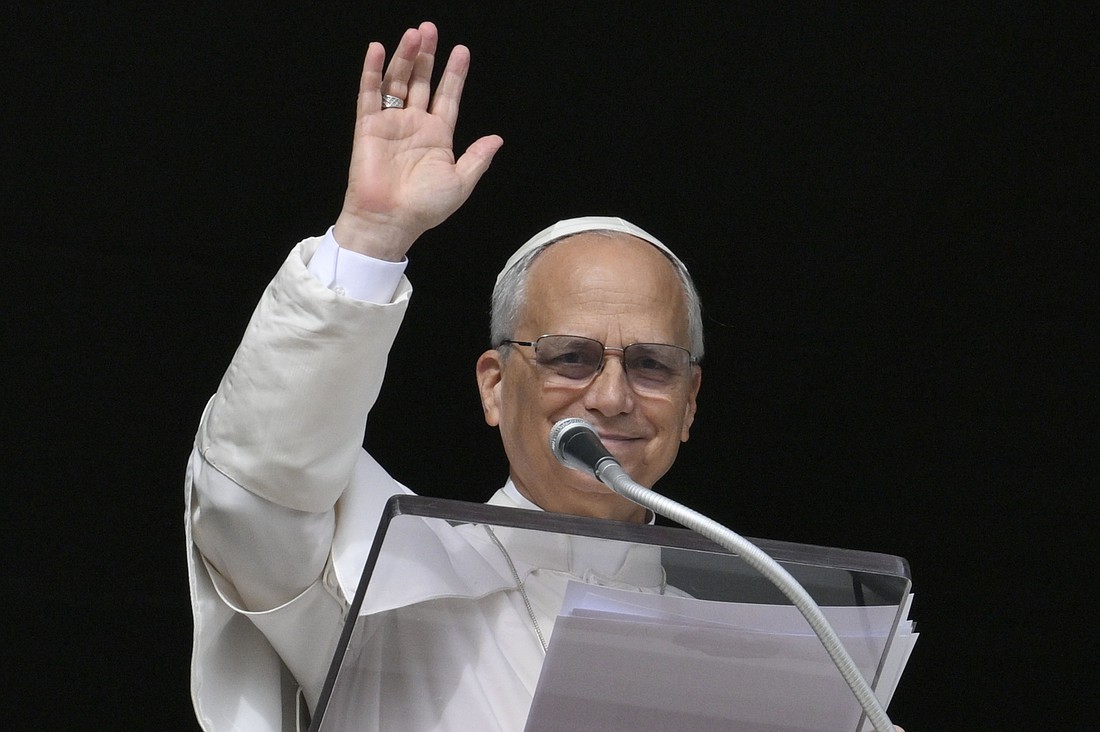
Six months into his papacy, as Pope Leo's activities have increased, so has the scrutiny observing his every move. We parse every word, every audience, every movement, and in so doing, we betray our fractured existence.
The temptation to filter this information through a political framework, as if that's the definition of our lives, grows daily too. Even as Leo has made clear his desire for unity, division remains all-too evident.
How many people today allow their thoughts on faith to be formed by the news outlet they visit, or personality they follow, as opposed to Scripture or doctrine? The responsibility to the truth that those of us in the media have is greater than ever, as Leo himself reminded a group of media professionals on Oct. 9.
"The world needs free, rigorous and objective information," Pope Leo said, and he encouraged journalists to "act as a barrier against those who, through the ancient art of lying, seek to create divisions in order to rule by dividing.
"You can also be a bulwark of civility against the quicksand of approximation and post-truth," Pope Leo added.
Without question, this is the ideal. But the opportunity for media to be a bulwark of civility is lost when the players are too busy constructing proofs that demonstrate that Leo is on his or her "side" – a position defined all too often by politics or ideology rather than truth. (Leo, though, has been careful not to pick a "side." His fidelity has been to the Gospel, which can be fully embraced by neither side nor party.)
Permit me two examples from recent weeks.
First, amid reports that Pope Leo has shown himself willing to help bridge the liturgical divide in the Church, some outlets were quick to emphasize that the Pope has not abrogated his predecessor's legal restrictions on the celebration of Mass according to the 1962 Roman Missal. At the same time, these outlets ignored or made light of other signs that may indicate a shift in thinking on behalf of the Holy See regarding liturgical matters.
Too many Catholics seem eager to jump in "the quicksand of approximation" and define Pope Leo according to whatever judgments they made about his predecessor. Pope Leo is in "perfect continuity" with Pope Francis, Jesuit Cardinal Michael Czerny, a close Francis ally, told the Associated Press Nov. 7. Just a month earlier, regular Francis critic Cardinal Gerhard M?ller cautioned against such a mindset, insisting "We must not make comparisons with previous Popes. Leo cannot imitate Francis, just as Francis could not imitate Benedict, and so on."
The same proclivity shaped reporting on the election of the new president of the U.S. Conference of Catholic Bishops. Some prognosticators wondered if presidential frontrunner Archbishop Paul S. Coakley of Oklahoma City was really the "Pope Leo candidate" – as if any American bishop would be so obviously opposed to the Pope could not win an election where precedent and respect for seniority has consistently decided the top post. Archbishop Coakley's win, claimed another analysis, meant that a candidate who would advance Leo's priorities did not win. What nonsense.
As I have been pondering this, one bishop drew my attention to a recent audience talk given by Leo, in which he spoke about the medieval intellectual generalist Nicholas of Cusa. Leo explained that Nicholas had hope amid so much fear on the part of his contemporaries who armed themselves for battle amid great uncertainties and opposition. "He believed in humanity," Leo said, adding that Nicholas "understood that there are opposites to be held together, that God is a mystery in which what is in tension finds unity."
Given how those unflinching in their parti pris can't quite define him, could Leo be a Nicholas of Cusa for our time? It's to the great benefit of the Church and the world if he is.
Michael R. Heinlein is author of "Glorifying Christ: The Life of Cardinal Francis E. George, O.M.I." and a promised member of the Association of Pauline Cooperators.
Related Stories
Monday, December 29, 2025

E-Editions
Events
Six months into his papacy, as Pope Leo's activities have increased, so has the scrutiny observing his every move. We parse every word, every audience, every movement, and in so doing, we betray our fractured existence.
The temptation to filter this information through a political framework, as if that's the definition of our lives, grows daily too. Even as Leo has made clear his desire for unity, division remains all-too evident.
How many people today allow their thoughts on faith to be formed by the news outlet they visit, or personality they follow, as opposed to Scripture or doctrine? The responsibility to the truth that those of us in the media have is greater than ever, as Leo himself reminded a group of media professionals on Oct. 9.
"The world needs free, rigorous and objective information," Pope Leo said, and he encouraged journalists to "act as a barrier against those who, through the ancient art of lying, seek to create divisions in order to rule by dividing.
"You can also be a bulwark of civility against the quicksand of approximation and post-truth," Pope Leo added.
Without question, this is the ideal. But the opportunity for media to be a bulwark of civility is lost when the players are too busy constructing proofs that demonstrate that Leo is on his or her "side" – a position defined all too often by politics or ideology rather than truth. (Leo, though, has been careful not to pick a "side." His fidelity has been to the Gospel, which can be fully embraced by neither side nor party.)
Permit me two examples from recent weeks.
First, amid reports that Pope Leo has shown himself willing to help bridge the liturgical divide in the Church, some outlets were quick to emphasize that the Pope has not abrogated his predecessor's legal restrictions on the celebration of Mass according to the 1962 Roman Missal. At the same time, these outlets ignored or made light of other signs that may indicate a shift in thinking on behalf of the Holy See regarding liturgical matters.
Too many Catholics seem eager to jump in "the quicksand of approximation" and define Pope Leo according to whatever judgments they made about his predecessor. Pope Leo is in "perfect continuity" with Pope Francis, Jesuit Cardinal Michael Czerny, a close Francis ally, told the Associated Press Nov. 7. Just a month earlier, regular Francis critic Cardinal Gerhard M?ller cautioned against such a mindset, insisting "We must not make comparisons with previous Popes. Leo cannot imitate Francis, just as Francis could not imitate Benedict, and so on."
The same proclivity shaped reporting on the election of the new president of the U.S. Conference of Catholic Bishops. Some prognosticators wondered if presidential frontrunner Archbishop Paul S. Coakley of Oklahoma City was really the "Pope Leo candidate" – as if any American bishop would be so obviously opposed to the Pope could not win an election where precedent and respect for seniority has consistently decided the top post. Archbishop Coakley's win, claimed another analysis, meant that a candidate who would advance Leo's priorities did not win. What nonsense.
As I have been pondering this, one bishop drew my attention to a recent audience talk given by Leo, in which he spoke about the medieval intellectual generalist Nicholas of Cusa. Leo explained that Nicholas had hope amid so much fear on the part of his contemporaries who armed themselves for battle amid great uncertainties and opposition. "He believed in humanity," Leo said, adding that Nicholas "understood that there are opposites to be held together, that God is a mystery in which what is in tension finds unity."
Given how those unflinching in their parti pris can't quite define him, could Leo be a Nicholas of Cusa for our time? It's to the great benefit of the Church and the world if he is.
Michael R. Heinlein is author of "Glorifying Christ: The Life of Cardinal Francis E. George, O.M.I." and a promised member of the Association of Pauline Cooperators.