


Diocese’s Catholic social services respond to increasing food needs
November 18, 2025 at 2:55 p.m.
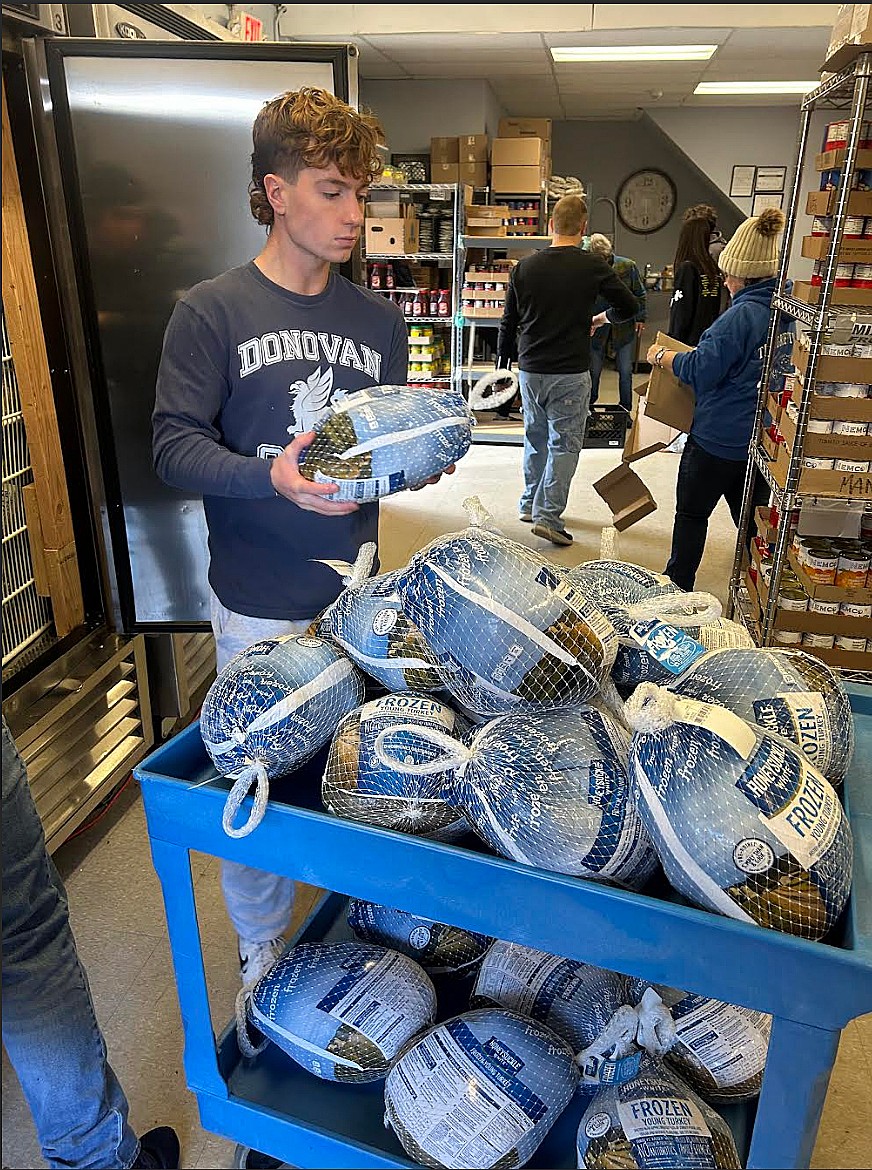
Seeds of Service executive director Christie Winters was beside herself Nov. 6 after a harrowing morning restocking the food pantry shelves and assisting patrons.
“We just saw 143 households in three hours,” she said tearfully. “We loaded shelves with 17 student volunteers from Donovan Catholic … and they’re just about empty again. People are parking in fire lanes; I just broke up fights in the parking lot … people are so upset.”
“Our shelves are already empty again,” she added. “We won’t get another food order until next week.”
As federal funding for SNAP food assistance programs ceased Nov. 1, social service agencies collectively steeled themselves for the inevitable: a sharply increased demand upon their already strapped resources.
The record-breaking government shutdown – surpassing five weeks at publication – comes on the heels of cutbacks in eligibility for federal social services like SNAP (Supplemental Nutritional Assistance Program) and WIC (Women, Infants and Children). Despite the Trump administration’s decision Nov. 3 to fund SNAP at 50% for November by using the program’s contingency fund, eligible recipients will likely not see those payments right away. And about 400,000 New Jersey households are left struggling.
RESOURCES STRAINED
Winters has been through plenty of difficult times in 22 years with Seeds of Service, which began at Visitation Parish and now operates in conjunction with Catholic Charities Diocese of Trenton. But this, she said, is different.
“It got really bad in the last week and a half, and now it’s worse. We’ve been through 9-11 and Hurricane Sandy,” she said. “Now people are desperate. They’re angry; some want to steal. I just walked a woman through the pantry, and [we watched] another woman run out with a case of peanut butter.” When another patron protested, Winters said, “Let it go, she must really need it.”
Local agencies that were meant to assist people occasionally are becoming a lifeline of necessity, says Daren Miller, executive director of Mount Carmel Guild in Trenton.
“We’ve seen a 25% increase in those coming to the food pantry,” Miller said of the pantry it also operates in cooperation with CCDOT. “For some, their SNAP benefits have run out and they have no way to get food. Many who are coming have never come before. Some have expressed embarrassment at having to go to a food pantry at all.”
Arnold Valentin, CCDOT’s community services area director, agreed with Miller’s observations.
“The pause on SNAP benefits presents a painful hardship for many of the people we serve,” he said. “These benefits are vital to their wellbeing. Knowing they have to find other ways to feed their families is unfair and will have a negative impact on their mental health.”
Since the beginning of the government shutdown, Valentin said that Catholic Charities has seen a more than 20% increase in traffic to its three food pantries. “Now, with the reduction of SNAP, we are anticipating even more visitors.”
Marlene Lao-Collins, CCDOT’s executive director, said they have already seen some of its nonprofit partners closing their doors due to reductions in funding at all levels.
“While Catholic Charities hasn’t seen drastic cuts, we have experienced reductions significant enough to warrant layoffs in our Family Reunification program and in some of our domestic violence services programs,” she said. “But we are committed to minimizing the impact this will have on the people we serve.”
“For every one meal Mount Carmel Guild provides, SNAP provided nine,” Miller pointed out. “When federal support shrinks, our partners face constraints, safety nets weaken and demand increases at our doorstep. As a result, we anticipate greater strain on our Community Support Program, which provides emergency food, utility assistance, and eviction prevention support, as well as our accredited Home Health Nursing Program, which enables seniors to age in place with dignity and care.”
MORE THAN HUNGER
While these decisions have taken place on a national level, they have left lasting effects on local communities nationwide. In a March 2025 podcast episode hosted by Goodfaith, a Lawrenceville-based non-profit apostolate, executive director Stephanie Peddicord emphasized the local, tangible aftershocks.
“Our hope is that we can offer a hyper-local window into the very real implications of the actions of our regional community,” she said, “to equip and empower everyday Catholics to take action and do something during what we at Goodfaith are viewing as a time of moral crisis.”
The loss of SNAP benefits is “just the first domino” according to Brenda Rascher, diocesan liaison for the Catholic Campaign for Human Development and executive director of the Diocese’s Office of Catholic Social Services.
“It will exacerbate the numbers even further,” she said. “It not only means going hungry – it means making difficult decisions. It’s a domino effect – if families lose their food stamps, now they have to decide, ‘do I feed my children, or do I pay the rent, or the utility bill?’ You can only make so many decisions on a limited income.”
Even before the government shutdown and the July 4 passing of the One Big Beautiful Bill Act – which aims to reform the American tax code, including provisions which call for large-scale funding cuts from federal social service programs like SNAP and Medicaid – the working poor were feeling the pinch, Rascher said.
“We were seeing the increased need because of inflation (the increase in price of goods and services over time) … and then utilities went up 17-20% across the board in summer,” she explained. “Those families now have to figure out how to get the same food on the little bit of money they have. So many live on minimum wage … do the math – it doesn’t make ends meet.”
According to the U.S. Bureau of Labor Statistics, overall inflation peaked in 2022 at 8%, and food at 10.4%; although rates of increase have dropped, inflation remains at 3.1%, above the federal reserve recommended 2% rate. Practically, this means costs are still rising and wages are not keeping pace, affecting those who can least afford it.
Rascher firmly believes social service agencies benefit the most from monetary donations they can use without restriction, which often comes with government-derived funding.
“They need unrestricted donations that will help address … whatever domino is getting ready to fall,” she said. “For example, rental assistance [from government] cannot be used to help someone who is living in a hotel to avoid homelessness.”
Winters echoed Rascher, saying monetary donations go further in their hands. “We have the ability to work with our partnerships; they can give us discounts, we can get to the food banks with our trucks, and we can purchase what we’re missing.”
Additionally, some food items donated with good intention, Rascher noted, “can’t be used by those suffering from high blood pressure because of high salt content, or by those with diabetes because of the sugar content, and some people have food allergies. Money enables food pantries to buy what families need.”
MEETING THE DEMAND
Ever proactive, social service agencies are responding to with campaigns designed to educate about what is most needed, and advertising additional food pantry hours.
“God bless our network we’ve built over the years,” Winters said of the many grocery stores and restaurants that contribute unsold food to Seeds of Service. “Our pantry is run by some amazing women and men volunteers.”
Generous donors recently made possible a matching funds program for up to $20,000 for SOS, which launched the weekend of Nov. 8-9.
“Thankfully, Catholic Charities USA will be delivering seven pallets of food to us during this vital time to provide extra support to people who are food insecure within the Diocese,” said Valentin. “The emergency funding awarded to New Jersey’s food banks – including the Food Bank of South Jersey, Fulfill and Mercer Street Friends – will help us stock the shelves at our three food pantries.”
As the holidays draw near, MCG is reinvigorating its annual campaign as the SNAP Gap Fund, which has already begun to roll out on social media and mailings to various partners, Miller said. “We get some help from various parishes and the Food Bank, but what we routinely receive is not going to be enough to meet the new demands. We have to look at doubling our efforts.”
Staff have also suggested offering Saturday hours for the pantry at least through Thanksgiving and possibly Christmas.
“We can always use more volunteers, especially during our busiest time of the year,” Miller said, adding that all donations of time and treasure “will be critical in helping us meet those needs.”
During listening sessions with care receivers, Miller observed that their needs go beyond food.
“A number who come by the pantry are repeat attendees … there are gaps from a personal and professional employment perspective,” he explained. “The issue is two-fold – their safety net is being unraveled, and [they’re lacking] information about opportunities and assistance to access to them.”
MCG has had to graduate to supplementing individuals on a day-to-day basis. Through its Dream Again Trenton program, “We want to try to align them with other organizations for skill development to help supplement their income,” he said.
Catholic Charities, too, is deeply committed to providing uninterrupted service to the community. In addition to the necessary direct service to the poor, Lao-Collins emphasizes the importance of civic duty in lobbying for policy change.
“By sharing stories of the people we serve and the impact these cuts will have on the quality of their lives, we hope to show our legislators and community how imperative it is to prioritize human dignity,” she said.
In Episode 5 of the “In Goodfaith” podcast, Peddicord urges listeners to view policy changes not as a partisan political issue, but a faith-based one. “No matter what politicians are in office,” she said, “as Catholics, it is our faith in Jesus first and foremost and our belief in the Gospel that should guide our actions.”
HOW YOU CAN HELP:
CATHOLIC CHARITIES, DIOCESE OF TRENTON: The CCDOT Community Services team operates three food pantries within the Diocese of Trenton:
Mercer County, in cooperation with Mount Carmel Guild: 73 North Clinton Ave., Trenton – Monday, Tuesday, Thursday, Friday from 10 a.m. – 12:30 p.m.; Wednesdays from 1 – 3 p.m.
Burlington County: 460 Veterans Dr., Burlington – Mondays, Tuesdays, Wednesdays from 9 a.m. – 12 p.m.; Thursdays 9 – 11:30 a.m. and 1:30 – 3:30 p.m.
Ocean County, in cooperation with Seeds of Service: 725 Mantoloking Rd., Brick – Mondays, Wednesdays, Fridays from 9 a.m. – 12 p.m. and 1 – 5 p.m.; Tuesdays and Thursdays from 1 – 7 p.m.
For more information on all of our Community Services, please visit: www.catholiccharitiestrenton.org/.../housing-food/
Donations of non-expired, shelf-stable food items can be dropped off at pantry locations during operating hours. Monetary donations can also be made online at www.catholiccharitiestrenton.org/donate/.
MOUNT CARMEL GUILD, TRENTON: Donate directly to Mount Carmel Guild online at www.mtcarmelguild.org. Donations can be mailed to: Mount Carmel Guild, 73 North Clinton Avenue, Trenton, NJ 08609.
SEEDS OF SERVICE, BRICK: The food pantry at Seeds of Service, Brick, is currently running a Mission Matching Funds Campaign. All monetary donations will be matched up to $20,000, for a total goal of $40,000. To make a donation, visit www.seedsofservice.help/.
Related Stories
Monday, December 29, 2025







E-Editions

Events
Seeds of Service executive director Christie Winters was beside herself Nov. 6 after a harrowing morning restocking the food pantry shelves and assisting patrons.
“We just saw 143 households in three hours,” she said tearfully. “We loaded shelves with 17 student volunteers from Donovan Catholic … and they’re just about empty again. People are parking in fire lanes; I just broke up fights in the parking lot … people are so upset.”
“Our shelves are already empty again,” she added. “We won’t get another food order until next week.”
As federal funding for SNAP food assistance programs ceased Nov. 1, social service agencies collectively steeled themselves for the inevitable: a sharply increased demand upon their already strapped resources.
The record-breaking government shutdown – surpassing five weeks at publication – comes on the heels of cutbacks in eligibility for federal social services like SNAP (Supplemental Nutritional Assistance Program) and WIC (Women, Infants and Children). Despite the Trump administration’s decision Nov. 3 to fund SNAP at 50% for November by using the program’s contingency fund, eligible recipients will likely not see those payments right away. And about 400,000 New Jersey households are left struggling.
RESOURCES STRAINED
Winters has been through plenty of difficult times in 22 years with Seeds of Service, which began at Visitation Parish and now operates in conjunction with Catholic Charities Diocese of Trenton. But this, she said, is different.
“It got really bad in the last week and a half, and now it’s worse. We’ve been through 9-11 and Hurricane Sandy,” she said. “Now people are desperate. They’re angry; some want to steal. I just walked a woman through the pantry, and [we watched] another woman run out with a case of peanut butter.” When another patron protested, Winters said, “Let it go, she must really need it.”
Local agencies that were meant to assist people occasionally are becoming a lifeline of necessity, says Daren Miller, executive director of Mount Carmel Guild in Trenton.
“We’ve seen a 25% increase in those coming to the food pantry,” Miller said of the pantry it also operates in cooperation with CCDOT. “For some, their SNAP benefits have run out and they have no way to get food. Many who are coming have never come before. Some have expressed embarrassment at having to go to a food pantry at all.”
Arnold Valentin, CCDOT’s community services area director, agreed with Miller’s observations.
“The pause on SNAP benefits presents a painful hardship for many of the people we serve,” he said. “These benefits are vital to their wellbeing. Knowing they have to find other ways to feed their families is unfair and will have a negative impact on their mental health.”
Since the beginning of the government shutdown, Valentin said that Catholic Charities has seen a more than 20% increase in traffic to its three food pantries. “Now, with the reduction of SNAP, we are anticipating even more visitors.”
Marlene Lao-Collins, CCDOT’s executive director, said they have already seen some of its nonprofit partners closing their doors due to reductions in funding at all levels.
“While Catholic Charities hasn’t seen drastic cuts, we have experienced reductions significant enough to warrant layoffs in our Family Reunification program and in some of our domestic violence services programs,” she said. “But we are committed to minimizing the impact this will have on the people we serve.”
“For every one meal Mount Carmel Guild provides, SNAP provided nine,” Miller pointed out. “When federal support shrinks, our partners face constraints, safety nets weaken and demand increases at our doorstep. As a result, we anticipate greater strain on our Community Support Program, which provides emergency food, utility assistance, and eviction prevention support, as well as our accredited Home Health Nursing Program, which enables seniors to age in place with dignity and care.”
MORE THAN HUNGER
While these decisions have taken place on a national level, they have left lasting effects on local communities nationwide. In a March 2025 podcast episode hosted by Goodfaith, a Lawrenceville-based non-profit apostolate, executive director Stephanie Peddicord emphasized the local, tangible aftershocks.
“Our hope is that we can offer a hyper-local window into the very real implications of the actions of our regional community,” she said, “to equip and empower everyday Catholics to take action and do something during what we at Goodfaith are viewing as a time of moral crisis.”
The loss of SNAP benefits is “just the first domino” according to Brenda Rascher, diocesan liaison for the Catholic Campaign for Human Development and executive director of the Diocese’s Office of Catholic Social Services.
“It will exacerbate the numbers even further,” she said. “It not only means going hungry – it means making difficult decisions. It’s a domino effect – if families lose their food stamps, now they have to decide, ‘do I feed my children, or do I pay the rent, or the utility bill?’ You can only make so many decisions on a limited income.”
Even before the government shutdown and the July 4 passing of the One Big Beautiful Bill Act – which aims to reform the American tax code, including provisions which call for large-scale funding cuts from federal social service programs like SNAP and Medicaid – the working poor were feeling the pinch, Rascher said.
“We were seeing the increased need because of inflation (the increase in price of goods and services over time) … and then utilities went up 17-20% across the board in summer,” she explained. “Those families now have to figure out how to get the same food on the little bit of money they have. So many live on minimum wage … do the math – it doesn’t make ends meet.”
According to the U.S. Bureau of Labor Statistics, overall inflation peaked in 2022 at 8%, and food at 10.4%; although rates of increase have dropped, inflation remains at 3.1%, above the federal reserve recommended 2% rate. Practically, this means costs are still rising and wages are not keeping pace, affecting those who can least afford it.
Rascher firmly believes social service agencies benefit the most from monetary donations they can use without restriction, which often comes with government-derived funding.
“They need unrestricted donations that will help address … whatever domino is getting ready to fall,” she said. “For example, rental assistance [from government] cannot be used to help someone who is living in a hotel to avoid homelessness.”
Winters echoed Rascher, saying monetary donations go further in their hands. “We have the ability to work with our partnerships; they can give us discounts, we can get to the food banks with our trucks, and we can purchase what we’re missing.”
Additionally, some food items donated with good intention, Rascher noted, “can’t be used by those suffering from high blood pressure because of high salt content, or by those with diabetes because of the sugar content, and some people have food allergies. Money enables food pantries to buy what families need.”
MEETING THE DEMAND
Ever proactive, social service agencies are responding to with campaigns designed to educate about what is most needed, and advertising additional food pantry hours.
“God bless our network we’ve built over the years,” Winters said of the many grocery stores and restaurants that contribute unsold food to Seeds of Service. “Our pantry is run by some amazing women and men volunteers.”
Generous donors recently made possible a matching funds program for up to $20,000 for SOS, which launched the weekend of Nov. 8-9.
“Thankfully, Catholic Charities USA will be delivering seven pallets of food to us during this vital time to provide extra support to people who are food insecure within the Diocese,” said Valentin. “The emergency funding awarded to New Jersey’s food banks – including the Food Bank of South Jersey, Fulfill and Mercer Street Friends – will help us stock the shelves at our three food pantries.”
As the holidays draw near, MCG is reinvigorating its annual campaign as the SNAP Gap Fund, which has already begun to roll out on social media and mailings to various partners, Miller said. “We get some help from various parishes and the Food Bank, but what we routinely receive is not going to be enough to meet the new demands. We have to look at doubling our efforts.”
Staff have also suggested offering Saturday hours for the pantry at least through Thanksgiving and possibly Christmas.
“We can always use more volunteers, especially during our busiest time of the year,” Miller said, adding that all donations of time and treasure “will be critical in helping us meet those needs.”
During listening sessions with care receivers, Miller observed that their needs go beyond food.
“A number who come by the pantry are repeat attendees … there are gaps from a personal and professional employment perspective,” he explained. “The issue is two-fold – their safety net is being unraveled, and [they’re lacking] information about opportunities and assistance to access to them.”
MCG has had to graduate to supplementing individuals on a day-to-day basis. Through its Dream Again Trenton program, “We want to try to align them with other organizations for skill development to help supplement their income,” he said.
Catholic Charities, too, is deeply committed to providing uninterrupted service to the community. In addition to the necessary direct service to the poor, Lao-Collins emphasizes the importance of civic duty in lobbying for policy change.
“By sharing stories of the people we serve and the impact these cuts will have on the quality of their lives, we hope to show our legislators and community how imperative it is to prioritize human dignity,” she said.
In Episode 5 of the “In Goodfaith” podcast, Peddicord urges listeners to view policy changes not as a partisan political issue, but a faith-based one. “No matter what politicians are in office,” she said, “as Catholics, it is our faith in Jesus first and foremost and our belief in the Gospel that should guide our actions.”
HOW YOU CAN HELP:
CATHOLIC CHARITIES, DIOCESE OF TRENTON: The CCDOT Community Services team operates three food pantries within the Diocese of Trenton:
Mercer County, in cooperation with Mount Carmel Guild: 73 North Clinton Ave., Trenton – Monday, Tuesday, Thursday, Friday from 10 a.m. – 12:30 p.m.; Wednesdays from 1 – 3 p.m.
Burlington County: 460 Veterans Dr., Burlington – Mondays, Tuesdays, Wednesdays from 9 a.m. – 12 p.m.; Thursdays 9 – 11:30 a.m. and 1:30 – 3:30 p.m.
Ocean County, in cooperation with Seeds of Service: 725 Mantoloking Rd., Brick – Mondays, Wednesdays, Fridays from 9 a.m. – 12 p.m. and 1 – 5 p.m.; Tuesdays and Thursdays from 1 – 7 p.m.
For more information on all of our Community Services, please visit: www.catholiccharitiestrenton.org/.../housing-food/
Donations of non-expired, shelf-stable food items can be dropped off at pantry locations during operating hours. Monetary donations can also be made online at www.catholiccharitiestrenton.org/donate/.
MOUNT CARMEL GUILD, TRENTON: Donate directly to Mount Carmel Guild online at www.mtcarmelguild.org. Donations can be mailed to: Mount Carmel Guild, 73 North Clinton Avenue, Trenton, NJ 08609.
SEEDS OF SERVICE, BRICK: The food pantry at Seeds of Service, Brick, is currently running a Mission Matching Funds Campaign. All monetary donations will be matched up to $20,000, for a total goal of $40,000. To make a donation, visit www.seedsofservice.help/.