


Catholic Church 'seeks closer ecumenical ties' in response to world needs
November 4, 2025 at 2:02 p.m.
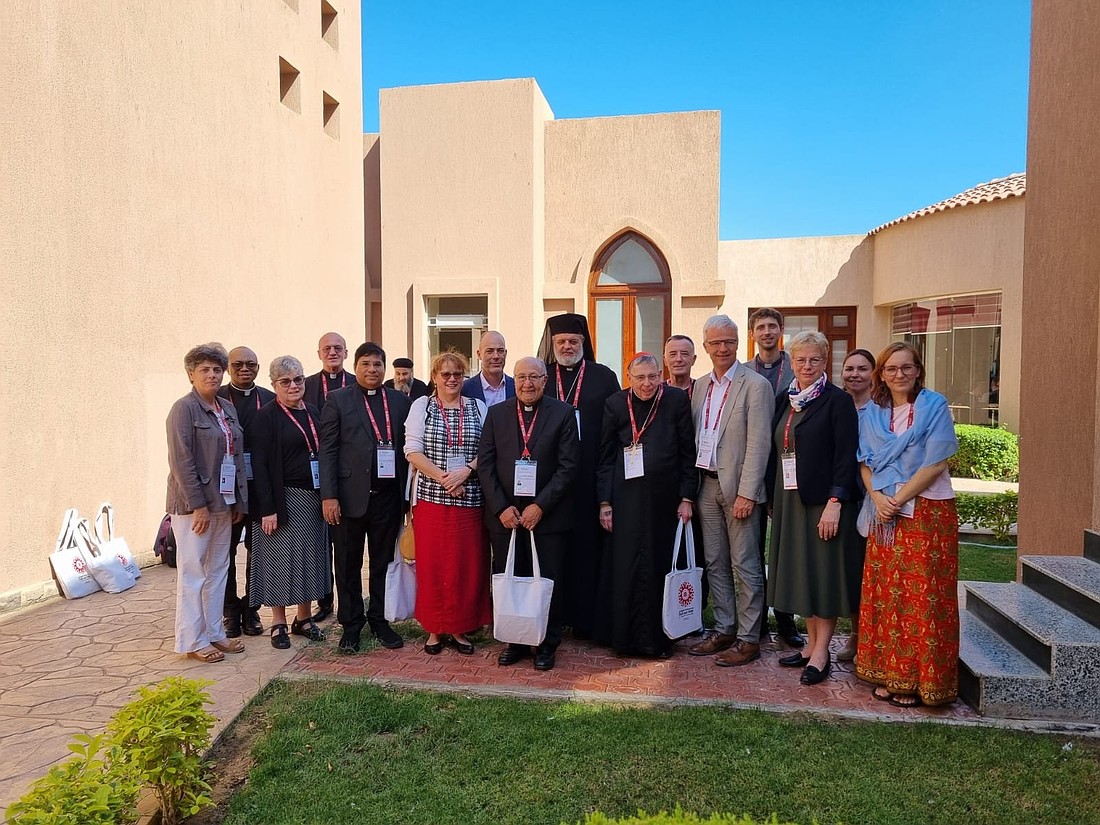
OSV News – Catholics are stepping up cooperation with other Christian denominations in the face of current worldwide challenges, according to Church delegates at a major ecumenical conference in Egypt marking the 1,700th anniversary of the Council of Nicaea.
"Our recent synod declared the Church wishes to be more ecumenical – if the Holy Spirit was at work then, the same is true now," said Myriam Wijlens, a Catholic professor and co-organizer working since 2008 with the Vatican's Dicastery for Promoting Christian Unity.
"The signals suggest we are all now following the same path in a world crying out for unity and peace, as Christians strive to contribute to a culture of mutual listening and dialogue," she said.
The Dutch-born theologian and canon lawyer spoke after attending the sixth World Conference on Faith and Order, organized by the World Council of Churches at the Coptic Orthodox Church's Logos Papal Center at Wadi El Natrun.
In an OSV News interview, she said article 138 of the final report of the 16th General Assembly of the Synod of Bishops, published in October 2024, had declared ecumenical dialogue to be fundamental to understanding synodality, and had called for "ecumenical synodal practices, including forms of consultation and discernment on questions of shared and urgent interest."
She added that the "whole Christian world" had been represented at the Egypt conference, with a new generation of participants demonstrating "a shift of perspectives to the Global South," and said ecumenical prayers and discussions had themselves resembled a "synodal process."
The Oct. 24-28 conference, attended by 400 participants from the Geneva-based WCC's 356 member-denominations, included a Vatican delegation headed by Cardinal Kurt Koch, the dicastery's prefect.
Opened by the Coptic Orthodox Pope Tawadros II, its keynote speakers included Presbyterian pastor the Rev. Jerry Pillay, the WCC's general secretary, as well as Norwegian pastor Stephanie Dietrich, moderator of the Council's Faith and Order Commission.
In an address, Cardinal Koch said the WCC, founded in 1948, clearly stood "on the ground of the Council of Nicaea," upholding a Trinitarian faith which enabled the "unity of the universal Church" to be "recognized and realized in the multiplicity of local Churches."
"Nicaea is of particular ecumenical significance because it took place when Christianity had not yet been wounded by numerous divisions that followed. Its Creed is therefore common to all Christian Churches and ecclesial communities, uniting them to this day," the Vatican prefect added.
"It is to be hoped and desired that the Council's 1700th anniversary will be celebrated by all of Christianity in an ecumenical spirit, and that the Creed will be reappropriated in ecumenical fellowship. This will allow further steps to be taken towards restoring the unity of the Church."
The Catholic Church does not formally participate in the WCC, whose Orthodox, Anglican, Baptist, Lutheran, Methodist and Reformed denominations claim to represent 580 million Christians in at least 120 countries.
However, it has been a full member of the WCC's Faith and Order Commission since 1968, providing a 10th of all delegates, and also co-organizes a separate Joint Working Group, which pledged to develop "ecumenical tools" at a September Rome plenary.
In her OSV News interview, Wijlens said a recent raising of training requirements by the Faith and Order Commission had contributed to a "higher-quality theological discourse," with most participants now claiming multilateral and international experience.
She added that topics debated at the conference, from accountability to baptismal ecclesiology, had overlapped with many themes covered by the Catholic Church's 2021-2024 Synod on Synodality, whose final report was adopted by Pope Francis into his papal magisterium.
The five-day Wadi El Natrun conference, focusing on "faith, mission and unity," drew on the work of five previous ecumenical assemblies, and closed with a top-level meeting of WCC leaders with Egypt's president, Abdel Fattah el-Sisi.
An "Ecumenical Affirmation," published Oct. 28, said Christ's call to unity remained "as urgent as ever," in a world where many Christians faced discrimination and suffering, but needed to be lived out "in personal encounters and meetings," not "solely by agreed texts."
"It is often in sharing together in God's mission that common ground is revealed between apparently incompatible Church structures and identities," the document noted.
"In a world fractured by fragmentation and division, riven by wars, injustice and uncertainties, our faith informs and undergirds our journey not only towards a common vision of the Church but towards shared action".
An accompanying "Call to all Christians" said the mission of Churches had sometimes been "entangled with histories of enslavement, colonialism, and power", and should now be "marked by repentance" and a reorientation towards "justice and reconciliation".
"Rooted in baptism, expressed in shared prayer, unity begins to be visible when we live together, moving towards mutual sharing of the Eucharist and recognition of each other's ministries," the message said.
In her interview, Wijlens said all WCC documents were "approved by consensus," rather than unanimity or majority vote, adding that participants could disagree with some formulations without feeling they contradicted their beliefs.
She added that Pope Leo XIV's upcoming Nov. 27-30 visit to Turkey for the Nicaea anniversary, which will include an ecumenical service and joint declaration with Bartholomew I, the Orthodox ecumenical patriarch, testified to interChurch progress achieved since the 1962-1965 Second Vatican Council.
"The Catholic Church has long since affirmed its relationship with other Churches, seeing them not as schismatics but as Churches in the true theological sense," said theologian Wijlens, who teaches at Germany's Erfurt University and was a consultor to the Rome synod.
"Over the past six decades, all Popes have continued meeting leaders of other Churches, and ecumenical signs are everywhere. With many great projects for the future, this world conference was one of the first great expressions of the Catholic Church's new synodal spirit."
Jonathan Luxmoore writes for OSV News from Oxford, England.
Catholic journalism is needed now more than ever. Please consider supporting this work by signing up for a SUBSCRIPTION (click HERE) or making a DONATION to The Monitor (click HERE). Thank you for your contribution.
Related Stories
Monday, December 29, 2025

E-Editions
Events
OSV News – Catholics are stepping up cooperation with other Christian denominations in the face of current worldwide challenges, according to Church delegates at a major ecumenical conference in Egypt marking the 1,700th anniversary of the Council of Nicaea.
"Our recent synod declared the Church wishes to be more ecumenical – if the Holy Spirit was at work then, the same is true now," said Myriam Wijlens, a Catholic professor and co-organizer working since 2008 with the Vatican's Dicastery for Promoting Christian Unity.
"The signals suggest we are all now following the same path in a world crying out for unity and peace, as Christians strive to contribute to a culture of mutual listening and dialogue," she said.
The Dutch-born theologian and canon lawyer spoke after attending the sixth World Conference on Faith and Order, organized by the World Council of Churches at the Coptic Orthodox Church's Logos Papal Center at Wadi El Natrun.
In an OSV News interview, she said article 138 of the final report of the 16th General Assembly of the Synod of Bishops, published in October 2024, had declared ecumenical dialogue to be fundamental to understanding synodality, and had called for "ecumenical synodal practices, including forms of consultation and discernment on questions of shared and urgent interest."
She added that the "whole Christian world" had been represented at the Egypt conference, with a new generation of participants demonstrating "a shift of perspectives to the Global South," and said ecumenical prayers and discussions had themselves resembled a "synodal process."
The Oct. 24-28 conference, attended by 400 participants from the Geneva-based WCC's 356 member-denominations, included a Vatican delegation headed by Cardinal Kurt Koch, the dicastery's prefect.
Opened by the Coptic Orthodox Pope Tawadros II, its keynote speakers included Presbyterian pastor the Rev. Jerry Pillay, the WCC's general secretary, as well as Norwegian pastor Stephanie Dietrich, moderator of the Council's Faith and Order Commission.
In an address, Cardinal Koch said the WCC, founded in 1948, clearly stood "on the ground of the Council of Nicaea," upholding a Trinitarian faith which enabled the "unity of the universal Church" to be "recognized and realized in the multiplicity of local Churches."
"Nicaea is of particular ecumenical significance because it took place when Christianity had not yet been wounded by numerous divisions that followed. Its Creed is therefore common to all Christian Churches and ecclesial communities, uniting them to this day," the Vatican prefect added.
"It is to be hoped and desired that the Council's 1700th anniversary will be celebrated by all of Christianity in an ecumenical spirit, and that the Creed will be reappropriated in ecumenical fellowship. This will allow further steps to be taken towards restoring the unity of the Church."
The Catholic Church does not formally participate in the WCC, whose Orthodox, Anglican, Baptist, Lutheran, Methodist and Reformed denominations claim to represent 580 million Christians in at least 120 countries.
However, it has been a full member of the WCC's Faith and Order Commission since 1968, providing a 10th of all delegates, and also co-organizes a separate Joint Working Group, which pledged to develop "ecumenical tools" at a September Rome plenary.
In her OSV News interview, Wijlens said a recent raising of training requirements by the Faith and Order Commission had contributed to a "higher-quality theological discourse," with most participants now claiming multilateral and international experience.
She added that topics debated at the conference, from accountability to baptismal ecclesiology, had overlapped with many themes covered by the Catholic Church's 2021-2024 Synod on Synodality, whose final report was adopted by Pope Francis into his papal magisterium.
The five-day Wadi El Natrun conference, focusing on "faith, mission and unity," drew on the work of five previous ecumenical assemblies, and closed with a top-level meeting of WCC leaders with Egypt's president, Abdel Fattah el-Sisi.
An "Ecumenical Affirmation," published Oct. 28, said Christ's call to unity remained "as urgent as ever," in a world where many Christians faced discrimination and suffering, but needed to be lived out "in personal encounters and meetings," not "solely by agreed texts."
"It is often in sharing together in God's mission that common ground is revealed between apparently incompatible Church structures and identities," the document noted.
"In a world fractured by fragmentation and division, riven by wars, injustice and uncertainties, our faith informs and undergirds our journey not only towards a common vision of the Church but towards shared action".
An accompanying "Call to all Christians" said the mission of Churches had sometimes been "entangled with histories of enslavement, colonialism, and power", and should now be "marked by repentance" and a reorientation towards "justice and reconciliation".
"Rooted in baptism, expressed in shared prayer, unity begins to be visible when we live together, moving towards mutual sharing of the Eucharist and recognition of each other's ministries," the message said.
In her interview, Wijlens said all WCC documents were "approved by consensus," rather than unanimity or majority vote, adding that participants could disagree with some formulations without feeling they contradicted their beliefs.
She added that Pope Leo XIV's upcoming Nov. 27-30 visit to Turkey for the Nicaea anniversary, which will include an ecumenical service and joint declaration with Bartholomew I, the Orthodox ecumenical patriarch, testified to interChurch progress achieved since the 1962-1965 Second Vatican Council.
"The Catholic Church has long since affirmed its relationship with other Churches, seeing them not as schismatics but as Churches in the true theological sense," said theologian Wijlens, who teaches at Germany's Erfurt University and was a consultor to the Rome synod.
"Over the past six decades, all Popes have continued meeting leaders of other Churches, and ecumenical signs are everywhere. With many great projects for the future, this world conference was one of the first great expressions of the Catholic Church's new synodal spirit."
Jonathan Luxmoore writes for OSV News from Oxford, England.
Catholic journalism is needed now more than ever. Please consider supporting this work by signing up for a SUBSCRIPTION (click HERE) or making a DONATION to The Monitor (click HERE). Thank you for your contribution.