


'Be bold for Jesus': Los Angeles closes out the National Eucharistic Revival
June 23, 2025 at 1:59 p.m.
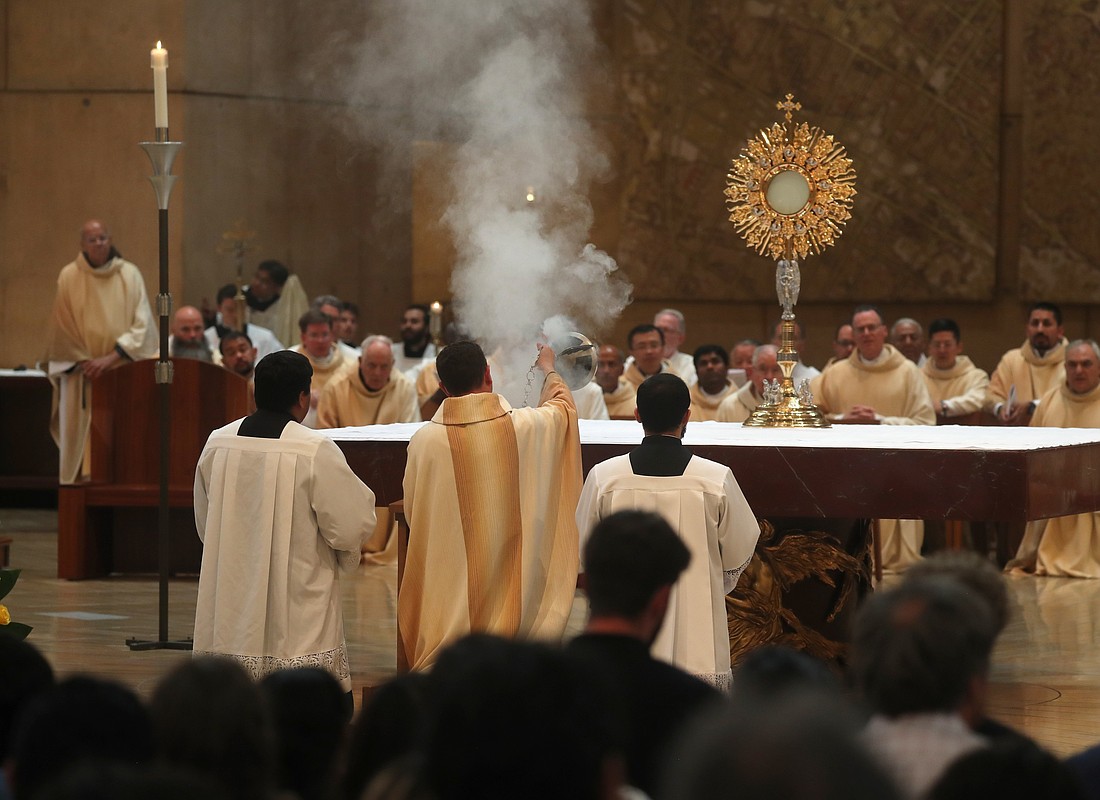
LOS ANGELES OSV News – The three-year National Eucharistic Revival closed in Los Angeles on Corpus Christi Sunday with a call to "become Eucharistic missionaries" and lead others back to the Catholic faith at a celebration scaled back due to unrest caused by recent immigration raids.
"The Eucharistic Revival does not end today but continues in each one of us, you and me," said Los Angeles Archbishop José H. Gomez in his homily at the June 22 Mass, which drew more than 3,000 people to the Cathedral of Our Lady of the Angels on a day of picture-perfect, balmy Southern California summer weather.
The Mass, together with the procession that followed, marked the official end of the month-long 2025 National Eucharistic Pilgrimage, which traveled more than 3,000 miles across 10 U.S. states from Indianapolis to LA and served as the national revival's final act.
The pilgrimage's closing weekend in Los Angeles included stops in two communities ravaged by the January 2025 wildfires, Altadena and Pacific Palisades, as well as two missions founded by St. Junípero Serra, San Buenaventura and San Gabriel.
Plans for a post-Mass festival and a procession through downtown LA on Sunday were shelved days earlier due to the unrest caused by mass raids targeting immigrants without legal permission to live and work in the U.S. But at the end of a shortened procession held inside the cathedral plaza, Archbishop Gomez briefly stepped out onto Temple Street carrying a monstrance holding the Blessed Sacrament and blessed the city of Los Angeles.
The moment was a fitting climax to an event marked by moments of silent prayer and rousing song, and attended by everyone from young families to cheery nuns and pilgrims – all expressing the kind of missionary enthusiasm that Archbishop Gomez had called for in his homily.
"Jesus is counting on us to bring people back to the Church, back to Mass," said the archbishop. "We can never approach the altar without wanting to bring others with us, to know the love that we know. So, let's be bold for Jesus!"
The Mass was presided by the papal ambassador to the U.S., Cardinal Christophe Pierre, and concelebrated by 10 bishops and more than 30 priests. In his opening remarks, Cardinal Pierre reported that while in Rome earlier this month, he told Pope Leo XIV that he would be visiting LA for the occasion.
"The Holy Father told me to greet you in a very special way, and I do," said Cardinal Pierre, who added that Pope Leo told him he was aware of the many pilgrimages held over the course of the National Eucharistic Revival.
Cardinal Pierre said the purpose of the feast of Corpus Christi was to celebrate the power of the Eucharist to transform people into "God's presence," including in their homes, schools, and even in politics.
"The Church is ourselves, because we receive the body of Christ," said Cardinal Pierre. "This is the good news of our faith, that we are the Church, that the Church is the presence of God in America."
The celebration's hopeful tone was a contrast to the weekend's more troubling news headlines, among them the bombing of three nuclear facilities in Iran by U.S. bombers, and the continued raids by U.S. Immigration and Customs Enforcement, or ICE, agents in Southern California targeting Latinos suspected of lacking legal status.
An intention read during the prayers of the faithful at the Mass asked "for healing and restoration, especially for all persons and communities impacted by wildfires, and those who live in fear of unrest and the separation of families."
Marianne Dyogi of Carson, California, came with her husband Gary and their five children to the cathedral on Sunday. She described the Mass and procession as "a very hope-filled event" during a "very dark time" marked not only by war and unrest, but also the growing mental health crisis and "a lot of brokenness in families and marriages" in society.
"People don't know if things are going to get better, and they're very nervous about what's coming in the future," said Dyogi, who attended the National Eucharistic Congress in Indianapolis last summer, and wanted to give her family a "taste" of what she experienced.
"There are a lot of things happening, but we brought our kids because their faith is really powerful. Their prayers work," she said.
After hearing about the revival over the last three years, Isaac Martinez couldn't resist the urge to participate in its finale. So on Sunday, he got in a car with his mother and drove more than two hours from the town of Delano in California's San Joaquin Valley.
"We just wanted to be a part of this big thing," said Martinez. "The center of our faith is the Eucharist, so it's an important place to be."
At the conclusion of the Mass, members of the Knights of Columbus and Knights and Dames from the Order of Malta and the Order of the Holy Sepulchre led a procession out of the cathedral, followed by women religious and clergy of the Archdiocese of Los Angeles.
As a cool breeze began to blow through the cathedral plaza, the procession wound through its north garden as a choir led faithful in singing the hymn "O Sacrament Most Holy, O Sacrament Divine." Then it passed the plaza's northern colonnade overlooking the same stretch of the 101 Freeway that two weeks earlier had seen violent clashes between protestors and law enforcement during the first days of the June immigration raids.
Before Archbishop Gomez and his fellow bishops finally reached Temple Street to bless the city, the procession paused at three prayer altars in the plaza, where the crowd kneeled to pray and sing before the monstrance.
Afterwards, the crowd gathered back inside the cathedral for one more moment of Eucharistic adoration and Benediction. Then the National Eucharistic Revival's lead organizer, Bishop Andrew H. Cozzens of Crookston, Minnesota, stepped to the lectern to thank the three-year initiative's various sponsors and supporters. Among them was Archbishop Gomez, who oversaw the revival's planning stage as president of the U.S. Conference of Catholic Bishops from 2019 to 2022.
Bishop Cozzens, who serves as president of the National Eucharistic Congress board, also thanked "all the people across this country who have felt in their own hearts that burning love of the heart of Jesus that flows from the Eucharist and have responded.
"You've really helped us to end this revival as a pilgrimage of hope," he told them.
But before everyone went home, the last word belonged to Archbishop Gomez.
"This has been a wonderful three years, a wonderful day today, but it is not over," he said with a grin, prompting some laughs. "We are the continuation of this beautiful gift of the presence of Jesus in the Eucharist."
Pablo Kay is editor in chief of Angelus, the news magazine of the Archdiocese of Los Angeles. This story originally appeared in Angelus, and is distributed in partnership with OSV News.
Please consider supporting this work by signing up for a SUBSCRIPTION (click HERE) or making a DONATION to The Monitor (click HERE). Thank you for your support.
Related Stories
Thursday, December 25, 2025


E-Editions
Events
LOS ANGELES OSV News – The three-year National Eucharistic Revival closed in Los Angeles on Corpus Christi Sunday with a call to "become Eucharistic missionaries" and lead others back to the Catholic faith at a celebration scaled back due to unrest caused by recent immigration raids.
"The Eucharistic Revival does not end today but continues in each one of us, you and me," said Los Angeles Archbishop José H. Gomez in his homily at the June 22 Mass, which drew more than 3,000 people to the Cathedral of Our Lady of the Angels on a day of picture-perfect, balmy Southern California summer weather.
The Mass, together with the procession that followed, marked the official end of the month-long 2025 National Eucharistic Pilgrimage, which traveled more than 3,000 miles across 10 U.S. states from Indianapolis to LA and served as the national revival's final act.
The pilgrimage's closing weekend in Los Angeles included stops in two communities ravaged by the January 2025 wildfires, Altadena and Pacific Palisades, as well as two missions founded by St. Junípero Serra, San Buenaventura and San Gabriel.
Plans for a post-Mass festival and a procession through downtown LA on Sunday were shelved days earlier due to the unrest caused by mass raids targeting immigrants without legal permission to live and work in the U.S. But at the end of a shortened procession held inside the cathedral plaza, Archbishop Gomez briefly stepped out onto Temple Street carrying a monstrance holding the Blessed Sacrament and blessed the city of Los Angeles.
The moment was a fitting climax to an event marked by moments of silent prayer and rousing song, and attended by everyone from young families to cheery nuns and pilgrims – all expressing the kind of missionary enthusiasm that Archbishop Gomez had called for in his homily.
"Jesus is counting on us to bring people back to the Church, back to Mass," said the archbishop. "We can never approach the altar without wanting to bring others with us, to know the love that we know. So, let's be bold for Jesus!"
The Mass was presided by the papal ambassador to the U.S., Cardinal Christophe Pierre, and concelebrated by 10 bishops and more than 30 priests. In his opening remarks, Cardinal Pierre reported that while in Rome earlier this month, he told Pope Leo XIV that he would be visiting LA for the occasion.
"The Holy Father told me to greet you in a very special way, and I do," said Cardinal Pierre, who added that Pope Leo told him he was aware of the many pilgrimages held over the course of the National Eucharistic Revival.
Cardinal Pierre said the purpose of the feast of Corpus Christi was to celebrate the power of the Eucharist to transform people into "God's presence," including in their homes, schools, and even in politics.
"The Church is ourselves, because we receive the body of Christ," said Cardinal Pierre. "This is the good news of our faith, that we are the Church, that the Church is the presence of God in America."
The celebration's hopeful tone was a contrast to the weekend's more troubling news headlines, among them the bombing of three nuclear facilities in Iran by U.S. bombers, and the continued raids by U.S. Immigration and Customs Enforcement, or ICE, agents in Southern California targeting Latinos suspected of lacking legal status.
An intention read during the prayers of the faithful at the Mass asked "for healing and restoration, especially for all persons and communities impacted by wildfires, and those who live in fear of unrest and the separation of families."
Marianne Dyogi of Carson, California, came with her husband Gary and their five children to the cathedral on Sunday. She described the Mass and procession as "a very hope-filled event" during a "very dark time" marked not only by war and unrest, but also the growing mental health crisis and "a lot of brokenness in families and marriages" in society.
"People don't know if things are going to get better, and they're very nervous about what's coming in the future," said Dyogi, who attended the National Eucharistic Congress in Indianapolis last summer, and wanted to give her family a "taste" of what she experienced.
"There are a lot of things happening, but we brought our kids because their faith is really powerful. Their prayers work," she said.
After hearing about the revival over the last three years, Isaac Martinez couldn't resist the urge to participate in its finale. So on Sunday, he got in a car with his mother and drove more than two hours from the town of Delano in California's San Joaquin Valley.
"We just wanted to be a part of this big thing," said Martinez. "The center of our faith is the Eucharist, so it's an important place to be."
At the conclusion of the Mass, members of the Knights of Columbus and Knights and Dames from the Order of Malta and the Order of the Holy Sepulchre led a procession out of the cathedral, followed by women religious and clergy of the Archdiocese of Los Angeles.
As a cool breeze began to blow through the cathedral plaza, the procession wound through its north garden as a choir led faithful in singing the hymn "O Sacrament Most Holy, O Sacrament Divine." Then it passed the plaza's northern colonnade overlooking the same stretch of the 101 Freeway that two weeks earlier had seen violent clashes between protestors and law enforcement during the first days of the June immigration raids.
Before Archbishop Gomez and his fellow bishops finally reached Temple Street to bless the city, the procession paused at three prayer altars in the plaza, where the crowd kneeled to pray and sing before the monstrance.
Afterwards, the crowd gathered back inside the cathedral for one more moment of Eucharistic adoration and Benediction. Then the National Eucharistic Revival's lead organizer, Bishop Andrew H. Cozzens of Crookston, Minnesota, stepped to the lectern to thank the three-year initiative's various sponsors and supporters. Among them was Archbishop Gomez, who oversaw the revival's planning stage as president of the U.S. Conference of Catholic Bishops from 2019 to 2022.
Bishop Cozzens, who serves as president of the National Eucharistic Congress board, also thanked "all the people across this country who have felt in their own hearts that burning love of the heart of Jesus that flows from the Eucharist and have responded.
"You've really helped us to end this revival as a pilgrimage of hope," he told them.
But before everyone went home, the last word belonged to Archbishop Gomez.
"This has been a wonderful three years, a wonderful day today, but it is not over," he said with a grin, prompting some laughs. "We are the continuation of this beautiful gift of the presence of Jesus in the Eucharist."
Pablo Kay is editor in chief of Angelus, the news magazine of the Archdiocese of Los Angeles. This story originally appeared in Angelus, and is distributed in partnership with OSV News.
Please consider supporting this work by signing up for a SUBSCRIPTION (click HERE) or making a DONATION to The Monitor (click HERE). Thank you for your support.