


As pilgrims flock to Ugandan shrine, authorities narrowly prevent massive terror attack
June 4, 2025 at 5:45 a.m.
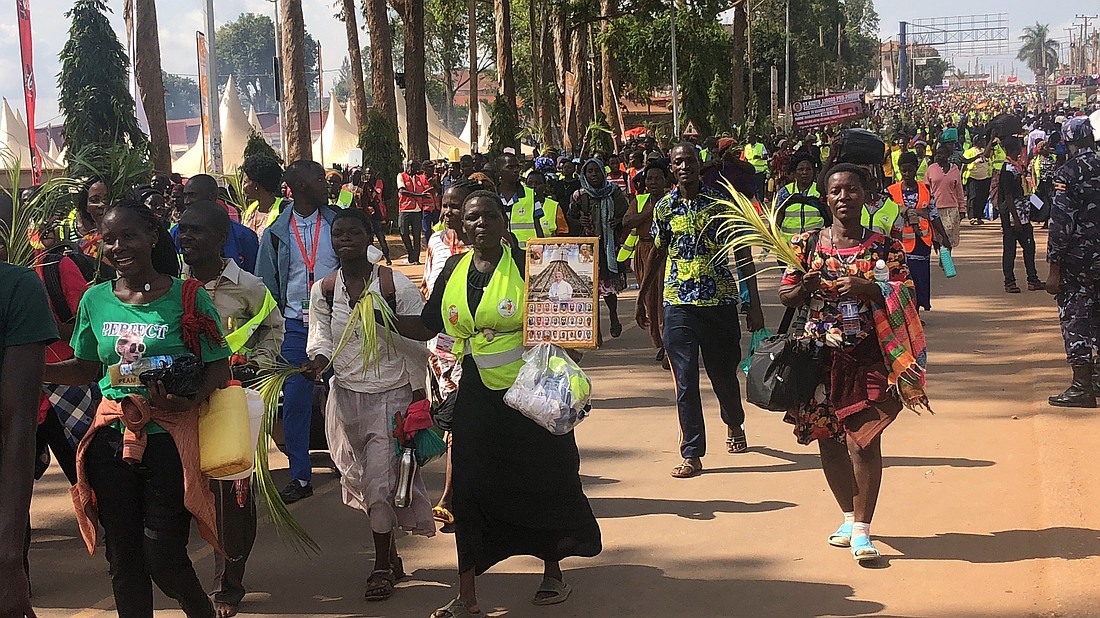
NAMUGONGO, Uganda OSV News – As millions of pilgrims flocked to the famed Ugandan shrine in Namugongo in the days leading to commemoration of the country's 45 Christian martyrs, local authorities prevented an attempted terror attack in what they said was a swift secret service operation, possibly saving hundreds from imminent death.
Suspected extremists, armed with explosive vests, were killed near the Munyonyo Basilica.
With rosaries in hand, wooden crucifixes around their necks and yellow jerry cans ready to collect holy water, what authorities estimate at ten of thousands of East African pilgrims knelt in prayer June 3 at Uganda's Catholic Martyrs Shrine of Namugongo in the suburbs of Kampala. They pleaded with the Uganda Martyrs to intercede for them – seeking relief from poverty, sickness, joblessness and unrest.
"I came to ask the martyrs to speak to God on behalf of my children," Mary Nasubu, a widow from northern Uganda's Diocese of Lira, who trekked over 250 miles with her two children in a journey that lasted two weeks, told OSV News. "Life has been tough, but I believe this sacred place holds power. Through the martyrs, I believe God will listen to our pleas."
Nasubu was among tens of thousands of faithful who gathered for Martyrs Day, an annual Catholic celebration honoring the 22 Catholics and 23 Anglicans martyred when they refused to denounce their faith and were killed on the orders of Kabaka Mwanga II, then king of Buganda, between 1885 and 1887.
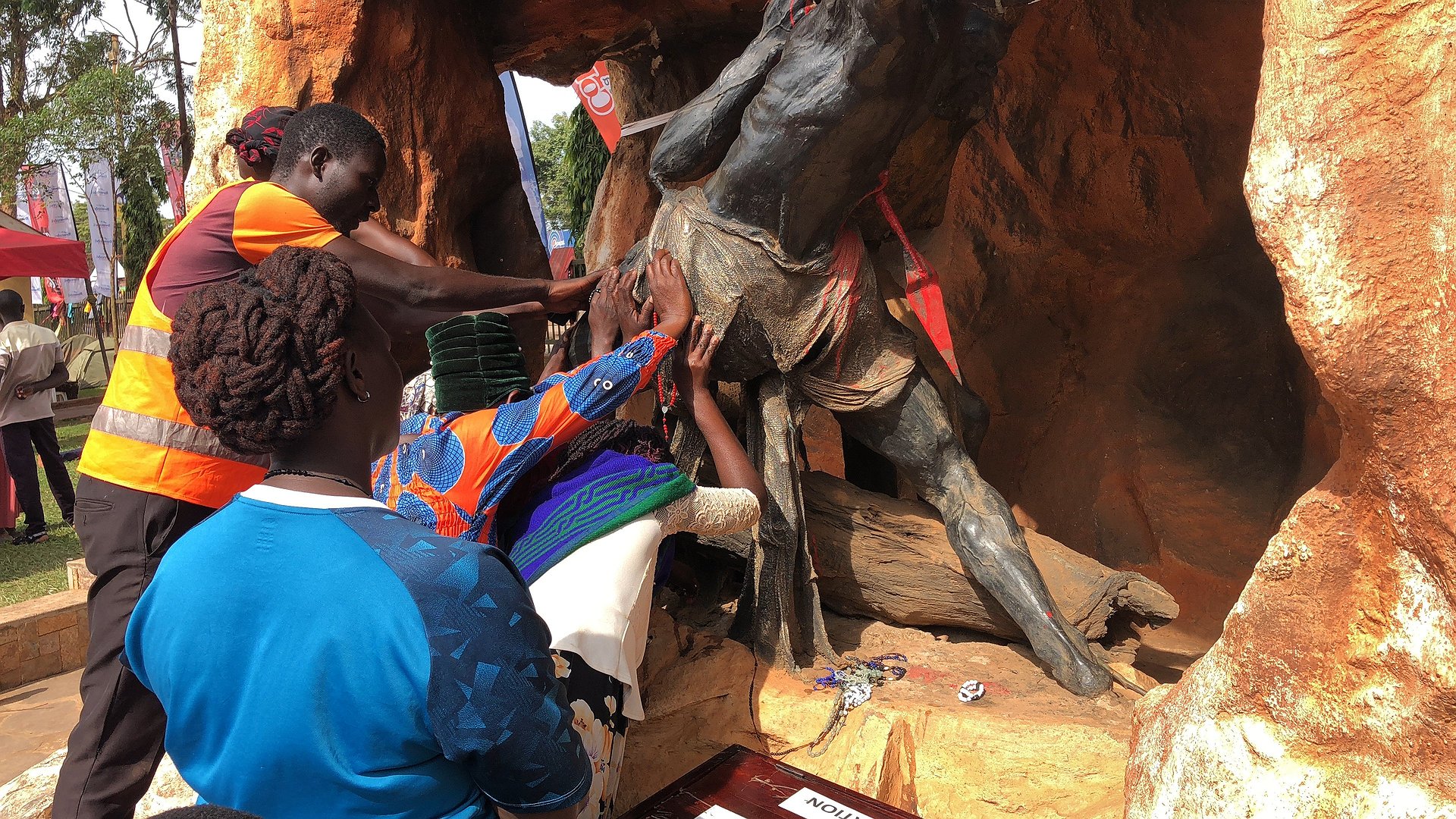 Devotees kneel and pray at a grotto representing the suffering of Uganda’s martyrs at Namugongo Catholic Shrine May 31, 2025, seeking divine intervention for personal and family challenges. (OSV News photo/Tonny Onyulo)
Tonny Onyulo
The Namugongo shrine is where St. Charles Lwanga, a Ugandan convert to the Catholic Church, and his companions were burned to death on June 3, 1886.
Some martyrs were dragged from their houses to Namugongo and other locations and were killed by beheading. Others were slaughtered and cut into pieces for their faith. Pope Paul VI canonized them in 1964.
Namugongo has become a spiritual magnet for pilgrims from across the region. In the Jubilee Year, worshippers came from Kenya, Tanzania, Rwanda, South Sudan, Congo and even as far as Nigeria.
The 2025 commemoration on June 3 marked a full return to pre-COVID-19 numbers, with pilgrims arriving in waves from every direction. Some walked for weeks, often barefoot or in battered shoes, traversing forests, crossing borders, and sleeping in Churchyards or along roadways.
President Yoweri Museveni, present during the ceremony, said it's wrong to mix religion and politics, highlighting the martyrdom as a powerful testament to African resilience and spiritual conviction.
"It was wrong for Kabaka Mwanga to want to kill this new perspective about the supernatural realm," the president said, adding: "It's good that some young boys and girls were ready to give up their lives for the new perspective religion had brought."
Hours before the main feast day Mass, Ugandan authorities thwarted an attempted terror attack near the Munyonyo Basilica, about 18 miles from Namugongo. Security forces described it as a swift and precise counter-terror operation.
Col. Chris Magezi, acting director of defense public information, said army units "intercepted" a suicide bomber and eliminated two armed suspects thought to be planning a suicide bombing. The individuals, riding a motorcycle and strapped with explosive vests, engaged in a brief shootout that led to an explosion, killing them instantly and damaging their bike.
Authorities suspect the attackers may have links to the Allied Democratic Forces, or ADF, rebels affiliated with Islamic State group and known for past extremist violence in the region. No civilian injuries were reported.
"Their aim was to hit a massive gathering," Magezi said, as reported by the Daily Monitor. The terrorists were stopped only 2,000 feet from the gate of the basilica packed with pilgrims. As many as 7,000 security officers were deployed to protect both Catholic and Protestant sites for the pilgrimage.
Beyond prayer, the pilgrimage became an outlet for expressing personal and collective pain. Pilgrims shared their frustrations over conflict in South Sudan, corruption in their governments and economic hardship across East Africa.
"People are worn out," said Majok Aluel, who walked from South Sudan. "Worn out by war, by hunger, by leadership that seems blind to our needs. This pilgrimage is both a cry for help and a sign that we're still standing."
He added, "This isn't just about devotion – it's also a call for justice, a longing to be seen and heard."
Father Mugagga Martin Kuteesa Lubowa, communications head for the Diocese of Lugazi, urged pilgrims to carry the martyrs' courage back to their communities.
"These young men died for truth – for Christ," said Father Lubowa. "We may not be called to martyrdom today, but we are called to confront the evils around us: corruption, division, violence and greed. Let your witness speak in your homes, your workplaces, your Churches."
He told pilgrims not to treat the day as a one-time spiritual retreat. "Let Namugongo mark a new beginning," he said. "Return to your lives transformed and ready to stand firm in faith."
The Namugongo shrine, now a sprawling complex featuring a basilica, museum and natural spring, holds deep religious and cultural value. Every year on June 3, Catholics and Anglicans alike believe the martyrs' intercession is at its most powerful.
Pilgrims prayed novenas, fasted, and sang hymns en route. Churches provided food and shelter, while police kept order and medics tended to the ill.
At the heart of the shrine is a small lake believed to contain healing waters. Pilgrims lined up with bottles and jerry cans to collect it – some pouring it on their heads, others taking it home for blessings or to help sick loved ones.
"I'm bringing this water to my wife, who's very ill," said Michael Katito, 45, from eastern Uganda. "We've gone to hospitals with no success. But I believe this water carries God's power."
Despite the punishing heat and physical exhaustion, many pilgrims shared with OSV News stories of answered prayers and personal breakthroughs – healed children, restored relationships and new jobs. They exchanged food, sang and supported one another, turning the site into a living testimony of hope.
"There's a sense of belonging here that we rarely feel back home," said Emmy Bazubagira, a first-time pilgrim from Rwanda. "I draw strength from everyone around me. I truly believe our prayers will be answered."
Many highlighted the importance of involving young people in the journey, presenting the martyrs as models of moral courage and spiritual strength in an age of uncertainty.
"Our youth face so much temptation and despair," Father Isaac Ojok from the Diocese of Lira told OSV News. "Bringing them here teaches them that real strength lies in faith. It shows that holiness isn't an old idea – it's something we can still live."
Sister Caroline Pifwa, of the Little Sisters of Mary Immaculate of Gulu, walked more than 300 miles to Namugongo to mark her 50th anniversary in religious life. Her prayers focused on the new Pope Leo XIV, her religious order's upcoming general chapter, her brother who is a priest and her family.
"This pilgrimage has refreshed my soul," she said joyfully. "It's been a journey of thanks – for the Uganda Martyrs and all that God has done in my life."
As dusk fell, pilgrims began their return journeys – some catching buses, others preparing for long walks. Many lingered for final prayers, or to fill one last container of holy water.
"I arrived here feeling empty, but I'm leaving full of hope," said Nasubu. "I don't know what's ahead, but I'm sure the martyrs heard me. Something will change."
For many, Namugongo is more than a site of faith. It is a testament to endurance, a sacred rebellion against despair, and a shared hope that transcends borders.
"This is Africa's miracle," said Katito. "Despite everything, we still believe."
The Church needs quality Catholic journalism now more than ever. Please consider supporting this work by signing up for a SUBSCRIPTION (click HERE) or making a DONATION to The Monitor (click HERE). Thank you for your support.
Related Stories
Thursday, December 25, 2025




E-Editions
Events
NAMUGONGO, Uganda OSV News – As millions of pilgrims flocked to the famed Ugandan shrine in Namugongo in the days leading to commemoration of the country's 45 Christian martyrs, local authorities prevented an attempted terror attack in what they said was a swift secret service operation, possibly saving hundreds from imminent death.
Suspected extremists, armed with explosive vests, were killed near the Munyonyo Basilica.
With rosaries in hand, wooden crucifixes around their necks and yellow jerry cans ready to collect holy water, what authorities estimate at ten of thousands of East African pilgrims knelt in prayer June 3 at Uganda's Catholic Martyrs Shrine of Namugongo in the suburbs of Kampala. They pleaded with the Uganda Martyrs to intercede for them – seeking relief from poverty, sickness, joblessness and unrest.
"I came to ask the martyrs to speak to God on behalf of my children," Mary Nasubu, a widow from northern Uganda's Diocese of Lira, who trekked over 250 miles with her two children in a journey that lasted two weeks, told OSV News. "Life has been tough, but I believe this sacred place holds power. Through the martyrs, I believe God will listen to our pleas."
Nasubu was among tens of thousands of faithful who gathered for Martyrs Day, an annual Catholic celebration honoring the 22 Catholics and 23 Anglicans martyred when they refused to denounce their faith and were killed on the orders of Kabaka Mwanga II, then king of Buganda, between 1885 and 1887.
Devotees kneel and pray at a grotto representing the suffering of Uganda’s martyrs at Namugongo Catholic Shrine May 31, 2025, seeking divine intervention for personal and family challenges. (OSV News photo/Tonny Onyulo)Tonny Onyulo
The Namugongo shrine is where St. Charles Lwanga, a Ugandan convert to the Catholic Church, and his companions were burned to death on June 3, 1886.
Some martyrs were dragged from their houses to Namugongo and other locations and were killed by beheading. Others were slaughtered and cut into pieces for their faith. Pope Paul VI canonized them in 1964.
Namugongo has become a spiritual magnet for pilgrims from across the region. In the Jubilee Year, worshippers came from Kenya, Tanzania, Rwanda, South Sudan, Congo and even as far as Nigeria.
The 2025 commemoration on June 3 marked a full return to pre-COVID-19 numbers, with pilgrims arriving in waves from every direction. Some walked for weeks, often barefoot or in battered shoes, traversing forests, crossing borders, and sleeping in Churchyards or along roadways.
President Yoweri Museveni, present during the ceremony, said it's wrong to mix religion and politics, highlighting the martyrdom as a powerful testament to African resilience and spiritual conviction.
"It was wrong for Kabaka Mwanga to want to kill this new perspective about the supernatural realm," the president said, adding: "It's good that some young boys and girls were ready to give up their lives for the new perspective religion had brought."
Hours before the main feast day Mass, Ugandan authorities thwarted an attempted terror attack near the Munyonyo Basilica, about 18 miles from Namugongo. Security forces described it as a swift and precise counter-terror operation.
Col. Chris Magezi, acting director of defense public information, said army units "intercepted" a suicide bomber and eliminated two armed suspects thought to be planning a suicide bombing. The individuals, riding a motorcycle and strapped with explosive vests, engaged in a brief shootout that led to an explosion, killing them instantly and damaging their bike.
Authorities suspect the attackers may have links to the Allied Democratic Forces, or ADF, rebels affiliated with Islamic State group and known for past extremist violence in the region. No civilian injuries were reported.
"Their aim was to hit a massive gathering," Magezi said, as reported by the Daily Monitor. The terrorists were stopped only 2,000 feet from the gate of the basilica packed with pilgrims. As many as 7,000 security officers were deployed to protect both Catholic and Protestant sites for the pilgrimage.
Beyond prayer, the pilgrimage became an outlet for expressing personal and collective pain. Pilgrims shared their frustrations over conflict in South Sudan, corruption in their governments and economic hardship across East Africa.
"People are worn out," said Majok Aluel, who walked from South Sudan. "Worn out by war, by hunger, by leadership that seems blind to our needs. This pilgrimage is both a cry for help and a sign that we're still standing."
He added, "This isn't just about devotion – it's also a call for justice, a longing to be seen and heard."
Father Mugagga Martin Kuteesa Lubowa, communications head for the Diocese of Lugazi, urged pilgrims to carry the martyrs' courage back to their communities.
"These young men died for truth – for Christ," said Father Lubowa. "We may not be called to martyrdom today, but we are called to confront the evils around us: corruption, division, violence and greed. Let your witness speak in your homes, your workplaces, your Churches."
He told pilgrims not to treat the day as a one-time spiritual retreat. "Let Namugongo mark a new beginning," he said. "Return to your lives transformed and ready to stand firm in faith."
The Namugongo shrine, now a sprawling complex featuring a basilica, museum and natural spring, holds deep religious and cultural value. Every year on June 3, Catholics and Anglicans alike believe the martyrs' intercession is at its most powerful.
Pilgrims prayed novenas, fasted, and sang hymns en route. Churches provided food and shelter, while police kept order and medics tended to the ill.
At the heart of the shrine is a small lake believed to contain healing waters. Pilgrims lined up with bottles and jerry cans to collect it – some pouring it on their heads, others taking it home for blessings or to help sick loved ones.
"I'm bringing this water to my wife, who's very ill," said Michael Katito, 45, from eastern Uganda. "We've gone to hospitals with no success. But I believe this water carries God's power."
Despite the punishing heat and physical exhaustion, many pilgrims shared with OSV News stories of answered prayers and personal breakthroughs – healed children, restored relationships and new jobs. They exchanged food, sang and supported one another, turning the site into a living testimony of hope.
"There's a sense of belonging here that we rarely feel back home," said Emmy Bazubagira, a first-time pilgrim from Rwanda. "I draw strength from everyone around me. I truly believe our prayers will be answered."
Many highlighted the importance of involving young people in the journey, presenting the martyrs as models of moral courage and spiritual strength in an age of uncertainty.
"Our youth face so much temptation and despair," Father Isaac Ojok from the Diocese of Lira told OSV News. "Bringing them here teaches them that real strength lies in faith. It shows that holiness isn't an old idea – it's something we can still live."
Sister Caroline Pifwa, of the Little Sisters of Mary Immaculate of Gulu, walked more than 300 miles to Namugongo to mark her 50th anniversary in religious life. Her prayers focused on the new Pope Leo XIV, her religious order's upcoming general chapter, her brother who is a priest and her family.
"This pilgrimage has refreshed my soul," she said joyfully. "It's been a journey of thanks – for the Uganda Martyrs and all that God has done in my life."
As dusk fell, pilgrims began their return journeys – some catching buses, others preparing for long walks. Many lingered for final prayers, or to fill one last container of holy water.
"I arrived here feeling empty, but I'm leaving full of hope," said Nasubu. "I don't know what's ahead, but I'm sure the martyrs heard me. Something will change."
For many, Namugongo is more than a site of faith. It is a testament to endurance, a sacred rebellion against despair, and a shared hope that transcends borders.
"This is Africa's miracle," said Katito. "Despite everything, we still believe."
The Church needs quality Catholic journalism now more than ever. Please consider supporting this work by signing up for a SUBSCRIPTION (click HERE) or making a DONATION to The Monitor (click HERE). Thank you for your support.