


Experts offer strategies for connection during Christmas amid US 'epidemic' of loneliness
December 19, 2025 at 12:37 p.m.

OSV News – The holidays are here, and the Savior comes – but for many, it will still be a blue Christmas, and possibly new year, too.
Why? They'll be lonely.
 Then-U.S. Surgeon General Vivek Murthy speaks during a hearing on Capitol Hill in Washington June 8, 2023. That year the former U.S. Surgeon General declared loneliness in America an epidemic, issuing an 82-page report warning of its dangers to "individual and population health, community safety, resilience and prosperity." (OSV News photo/Amanda Andrade-Rhoades, Reuters)
Amanda Andrade-Rhoades
In 2023, former U.S. Surgeon General Vivek Murthy declared loneliness in America an epidemic – and issued an 82-page report warning of its dangers to "individual and population health, community safety, resilience and prosperity."
The report – "Our Epidemic of Loneliness and Isolation" – advised readers loneliness is "far more than just a bad feeling"; indeed, it warned "the mortality impact of being socially disconnected is similar to that caused by smoking up to 15 cigarettes a day."
Failure to address loneliness, Murthy added, will come at a price: "We will continue to splinter and divide until we can no longer stand as a community or a country."
Which raises at least two questions: What can the Catholic Church do about it? And how can lonely people connect at Christmas?
"Loneliness is not just an issue of the Church. Loneliness is a cultural thing," Marcel LeJeune – president and founder of Catholic Missionary Disciples in College Station, Texas – told OSV News. "And there's no one reason that people are lonely; it can come from a multitude of issues or reasons. We see it in people that don't have good relationships – that could be, they don't have good friendships; their marriages are struggling; they can't find community."
It's part of LeJeune's job to build that community – to, as the name of his ministry implies, help Churches forge disciples. But the state of societal trust poses a challenge.
"What's happened in our world – especially in the United States – we've seen the breakdown of community institutions. So there's just little trust put into the Church right now," he explained. "People don't see the parish as a place where they can find meaningful relationships. And that's an unfortunate reality. Can you still find meaningful relationships in a parish? Absolutely – but you've got to work at it."
The reason for that, LeJeune said, is "our institutions aren't set up, for the most part, to address the issue of loneliness. What we're set up to do is to gather people for the sacraments, for events and for programs. There's nothing that's wrong with that – in fact, flowing out of that, you might find friendship; connection; relationships. But the issue is," he added, "that unless we intentionally try to help make that happen, it probably won't happen in those places."
LeJeune is not, however, discouraged.
"I do believe that the loneliness people feel in this culture … is also the greatest opportunity for the Church in the 21st century," he shared. "Because if we address the loneliness people feel – and we offer an antidote through community and relationships that are meaningful – then guess what happens? You've earned that trust that's necessary to build a relationship wherein evangelization and discipleship can take place."
And the template for that?
"We've got to go beyond just the norm of the average parish, which is stuck in the status quo," LeJeune emphasized. "If we go back to what the grassroots methodology of Jesus was, he didn't run programs. He had very few events, and he didn't teach a class – even though he taught. So, what did he do?" asked LeJeune. "He gathered people together, and did meaningful things. They would eat together. They would travel together. They would pray together, and they would have conversations about things that mattered."
In 2024, the Harvard Graduate School of Education's "Making Caring Common" project released a four-year investigation of the underlying causes of loneliness.
"Loneliness in America: Just the Tip of the Iceberg" found people between 30 and 44 years old were the loneliest, with 29% saying they were "frequently" or "always" lonely. For 18- to 29-year-olds, the rate was 24%; 45- to 64-year-olds, 20%; 65-plus, 10%.
Men and women experienced similar rates of loneliness, and neither race or ethnicity appeared to have a role (although those with more than one racial identity had levels of loneliness at 42%). Income was a factor – Americans earning less than $30,000 were the loneliest – but not education. Busy and tired people (62%) also obviously have less time with family (66%).
Kevin Vost – a Catholic psychologist and author of "The Catholic Guide to Loneliness: How Science and Faith Can Help Us Understand It, Grow from It, and Conquer It" (Sophia Institute Press) – died unexpectedly in 2023. But when his book was published in 2017, Vost was already alerting readers "the prevalence of loneliness seems to be escalating at an alarming rate in our time."
On the Dec. 19, 2017, broadcast of "Divine Intimacy Radio" – a show heard on EWTN Catholic Radio Network – Vost explained, "People who are lonely for a long time become more like people with depression. And there's quite an overlap, and they can become very negative. They tend to remember just negative personal experiences or losses in the past. They might be hesitant to reach out to others, or they might fear rejection."
He added that psychologists try to turn that thinking around.
"The psychological techniques – the most effective found in studies – are the ones that focus on that perception, the way we think about the situation, because they found most adults already do have social skills," noted Vost. "It's just this distorted thinking that's preventing them to reach out. So one of the most important components in dealing with a person who is distressed by a loneliness is to try to train them to think more realistically and rationally about their situation."
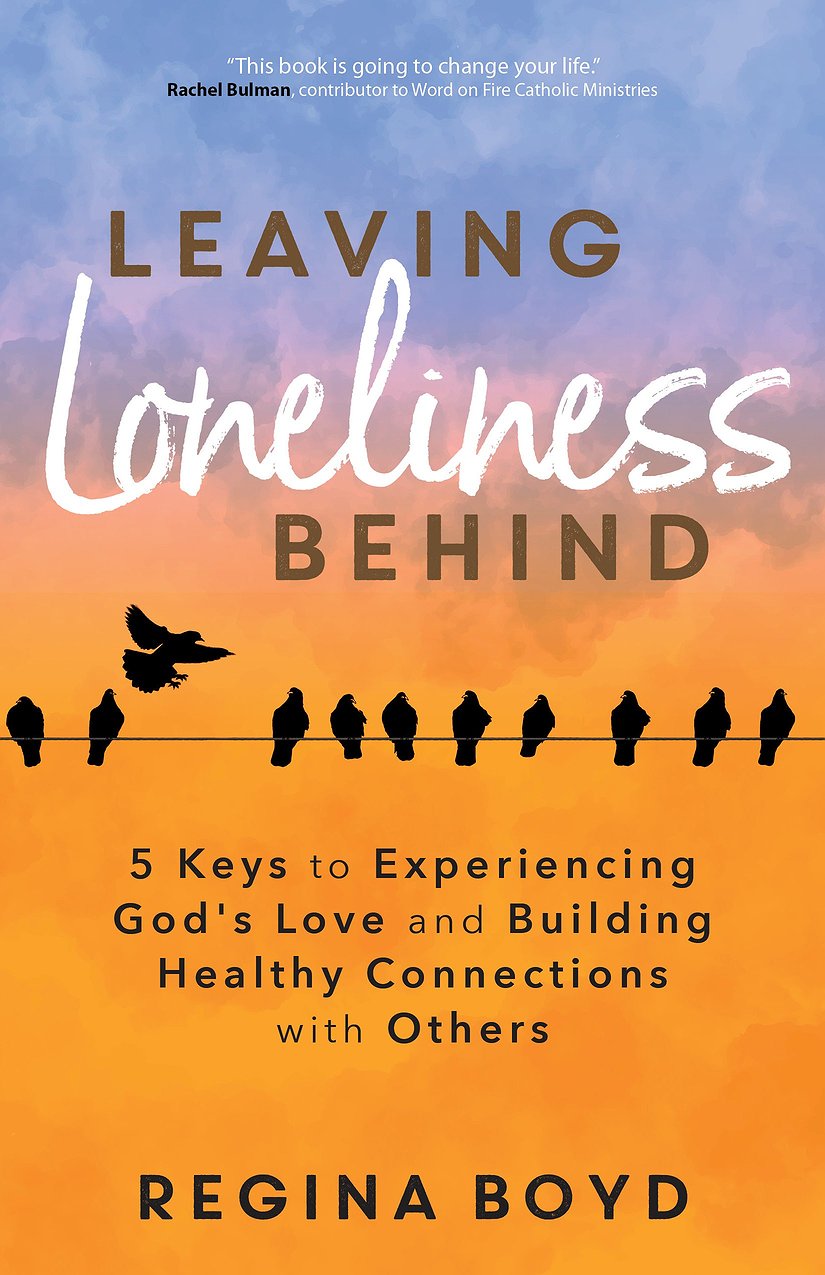 This is the cover of "Leaving Loneliness Behind: 5 Keys to Experiencing God's Love and Building Healthy Connections with Others" (Ave Maria Press) by Regina Boyd. Boyd is founder of Heartspace Therapy Center in Lake Mary, Fla., and a licensed mental health counselor. (OSV News photo/Ave Maria Press)
None
Regina Boyd – founder of Heartspace Therapy Center in Lake Mary, Florida, a licensed mental health counselor, and author of "Leaving Loneliness Behind: 5 Keys to Experiencing God's Love and Building Healthy Connections with Others" (Ave Maria Press) – told OSV News while everyone seems digitally connected at all times, it's a different kind of bonding than in-person communication.
"Even though we have this ability to connect online and develop relationships – which is a beautiful gift of convenience – I think it also shortens experiences in a lot of ways," Boyd suggested.
"One person that I spoke to recently made an observation about birthdays – they get less phone calls on their birthdays because it's so much easier to just send a text. Whereas maybe 30 years ago, they were on the phone throughout the day receiving phone calls from people. In a way, we're connected – but also disconnected."
The 2024 Harvard Graduate School of Education study also reported 73% of those surveyed selected technology as contributing to loneliness.
And as to the melancholy so many experience at this time of the year, Boyd thinks she knows why.
"The holidays sort of amplify whatever we might be experiencing or going through. So if we're feeling joyful, it feels brighter during the holidays, but also if we're feeling lonely, it feels heavier," she observed. "And we have the experience of social comparisons. We see all of these beautiful images on social media, talking about togetherness and happiness."
Changed routines, Boyd added, also allow for reflection.
"Emotional needs are coming to the surface – when maybe in our typical routines, we can put those emotions aside, and push past them. And when there's loss – missed family members; people who are no longer present – the holidays provide that opportunity for grief, and reminders of those relationships that have changed.
Her recommendation?
"It comes down to intentionality," advised Boyd. "Rather than us waiting for a magical moment to happen, we need to take some more control back, and make moments happen for ourselves. And so maybe we have some intentional activities planned each week, once a week – taking a walk with a friend; going to that local Bible study; going to the holiday gathering you might have typically skipped. Or creating smaller, more seemingly meaningless connections – that brief conversation with your co-worker; with the employee across the counter; with your neighbor – just taking extra time to have those brief moments of connection."
And set realistic expectations for yourself, said Boyd.
"We put so much pressure on ourselves – and it's OK to not have the picture perfect holiday to feel connected."
Kimberley Heatherington is an OSV News correspondent. She writes from Virginia.
Related Stories
Friday, December 19, 2025





E-Editions

Events
OSV News – The holidays are here, and the Savior comes – but for many, it will still be a blue Christmas, and possibly new year, too.
Why? They'll be lonely.
Then-U.S. Surgeon General Vivek Murthy speaks during a hearing on Capitol Hill in Washington June 8, 2023. That year the former U.S. Surgeon General declared loneliness in America an epidemic, issuing an 82-page report warning of its dangers to "individual and population health, community safety, resilience and prosperity." (OSV News photo/Amanda Andrade-Rhoades, Reuters)Amanda Andrade-Rhoades
In 2023, former U.S. Surgeon General Vivek Murthy declared loneliness in America an epidemic – and issued an 82-page report warning of its dangers to "individual and population health, community safety, resilience and prosperity."
The report – "Our Epidemic of Loneliness and Isolation" – advised readers loneliness is "far more than just a bad feeling"; indeed, it warned "the mortality impact of being socially disconnected is similar to that caused by smoking up to 15 cigarettes a day."
Failure to address loneliness, Murthy added, will come at a price: "We will continue to splinter and divide until we can no longer stand as a community or a country."
Which raises at least two questions: What can the Catholic Church do about it? And how can lonely people connect at Christmas?
"Loneliness is not just an issue of the Church. Loneliness is a cultural thing," Marcel LeJeune – president and founder of Catholic Missionary Disciples in College Station, Texas – told OSV News. "And there's no one reason that people are lonely; it can come from a multitude of issues or reasons. We see it in people that don't have good relationships – that could be, they don't have good friendships; their marriages are struggling; they can't find community."
It's part of LeJeune's job to build that community – to, as the name of his ministry implies, help Churches forge disciples. But the state of societal trust poses a challenge.
"What's happened in our world – especially in the United States – we've seen the breakdown of community institutions. So there's just little trust put into the Church right now," he explained. "People don't see the parish as a place where they can find meaningful relationships. And that's an unfortunate reality. Can you still find meaningful relationships in a parish? Absolutely – but you've got to work at it."
The reason for that, LeJeune said, is "our institutions aren't set up, for the most part, to address the issue of loneliness. What we're set up to do is to gather people for the sacraments, for events and for programs. There's nothing that's wrong with that – in fact, flowing out of that, you might find friendship; connection; relationships. But the issue is," he added, "that unless we intentionally try to help make that happen, it probably won't happen in those places."
LeJeune is not, however, discouraged.
"I do believe that the loneliness people feel in this culture … is also the greatest opportunity for the Church in the 21st century," he shared. "Because if we address the loneliness people feel – and we offer an antidote through community and relationships that are meaningful – then guess what happens? You've earned that trust that's necessary to build a relationship wherein evangelization and discipleship can take place."
And the template for that?
"We've got to go beyond just the norm of the average parish, which is stuck in the status quo," LeJeune emphasized. "If we go back to what the grassroots methodology of Jesus was, he didn't run programs. He had very few events, and he didn't teach a class – even though he taught. So, what did he do?" asked LeJeune. "He gathered people together, and did meaningful things. They would eat together. They would travel together. They would pray together, and they would have conversations about things that mattered."
In 2024, the Harvard Graduate School of Education's "Making Caring Common" project released a four-year investigation of the underlying causes of loneliness.
"Loneliness in America: Just the Tip of the Iceberg" found people between 30 and 44 years old were the loneliest, with 29% saying they were "frequently" or "always" lonely. For 18- to 29-year-olds, the rate was 24%; 45- to 64-year-olds, 20%; 65-plus, 10%.
Men and women experienced similar rates of loneliness, and neither race or ethnicity appeared to have a role (although those with more than one racial identity had levels of loneliness at 42%). Income was a factor – Americans earning less than $30,000 were the loneliest – but not education. Busy and tired people (62%) also obviously have less time with family (66%).
Kevin Vost – a Catholic psychologist and author of "The Catholic Guide to Loneliness: How Science and Faith Can Help Us Understand It, Grow from It, and Conquer It" (Sophia Institute Press) – died unexpectedly in 2023. But when his book was published in 2017, Vost was already alerting readers "the prevalence of loneliness seems to be escalating at an alarming rate in our time."
On the Dec. 19, 2017, broadcast of "Divine Intimacy Radio" – a show heard on EWTN Catholic Radio Network – Vost explained, "People who are lonely for a long time become more like people with depression. And there's quite an overlap, and they can become very negative. They tend to remember just negative personal experiences or losses in the past. They might be hesitant to reach out to others, or they might fear rejection."
He added that psychologists try to turn that thinking around.
"The psychological techniques – the most effective found in studies – are the ones that focus on that perception, the way we think about the situation, because they found most adults already do have social skills," noted Vost. "It's just this distorted thinking that's preventing them to reach out. So one of the most important components in dealing with a person who is distressed by a loneliness is to try to train them to think more realistically and rationally about their situation."
This is the cover of "Leaving Loneliness Behind: 5 Keys to Experiencing God's Love and Building Healthy Connections with Others" (Ave Maria Press) by Regina Boyd. Boyd is founder of Heartspace Therapy Center in Lake Mary, Fla., and a licensed mental health counselor. (OSV News photo/Ave Maria Press)None
Regina Boyd – founder of Heartspace Therapy Center in Lake Mary, Florida, a licensed mental health counselor, and author of "Leaving Loneliness Behind: 5 Keys to Experiencing God's Love and Building Healthy Connections with Others" (Ave Maria Press) – told OSV News while everyone seems digitally connected at all times, it's a different kind of bonding than in-person communication.
"Even though we have this ability to connect online and develop relationships – which is a beautiful gift of convenience – I think it also shortens experiences in a lot of ways," Boyd suggested.
"One person that I spoke to recently made an observation about birthdays – they get less phone calls on their birthdays because it's so much easier to just send a text. Whereas maybe 30 years ago, they were on the phone throughout the day receiving phone calls from people. In a way, we're connected – but also disconnected."
The 2024 Harvard Graduate School of Education study also reported 73% of those surveyed selected technology as contributing to loneliness.
And as to the melancholy so many experience at this time of the year, Boyd thinks she knows why.
"The holidays sort of amplify whatever we might be experiencing or going through. So if we're feeling joyful, it feels brighter during the holidays, but also if we're feeling lonely, it feels heavier," she observed. "And we have the experience of social comparisons. We see all of these beautiful images on social media, talking about togetherness and happiness."
Changed routines, Boyd added, also allow for reflection.
"Emotional needs are coming to the surface – when maybe in our typical routines, we can put those emotions aside, and push past them. And when there's loss – missed family members; people who are no longer present – the holidays provide that opportunity for grief, and reminders of those relationships that have changed.
Her recommendation?
"It comes down to intentionality," advised Boyd. "Rather than us waiting for a magical moment to happen, we need to take some more control back, and make moments happen for ourselves. And so maybe we have some intentional activities planned each week, once a week – taking a walk with a friend; going to that local Bible study; going to the holiday gathering you might have typically skipped. Or creating smaller, more seemingly meaningless connections – that brief conversation with your co-worker; with the employee across the counter; with your neighbor – just taking extra time to have those brief moments of connection."
And set realistic expectations for yourself, said Boyd.
"We put so much pressure on ourselves – and it's OK to not have the picture perfect holiday to feel connected."
Kimberley Heatherington is an OSV News correspondent. She writes from Virginia.