


Advent reflections from the women doctors of the Church
December 19, 2025 at 12:06 p.m.
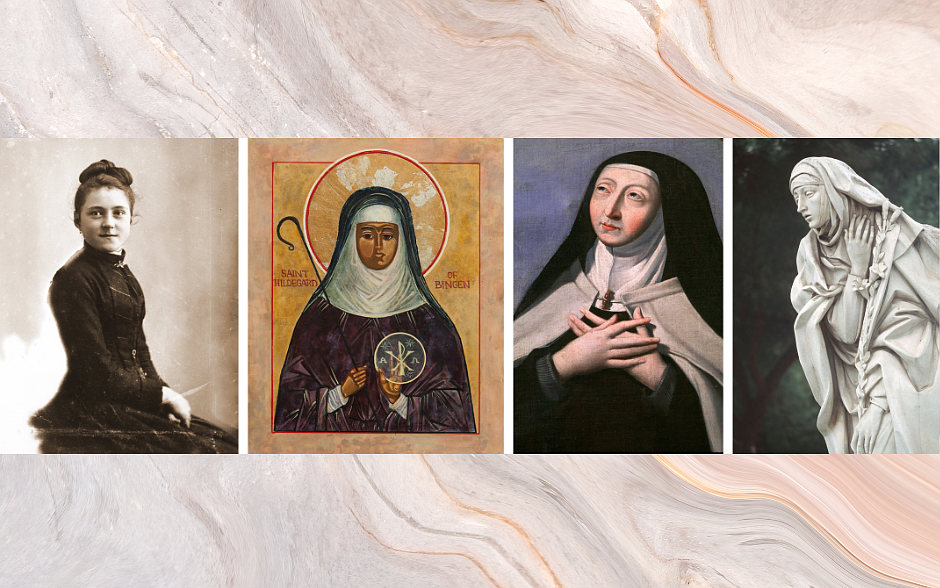
Advent calls us beyond the false security of the merely virtuous person and into the daring surrender to God’s love of the saint. Thankfully, what the Advent season calls us to, it also makes possible.
As we contemplate Advent themes, we welcome into our company four radiant women, all doctors of the Church, who put all their hope in God’s love: Thérèse of Lisieux, Hildegard of Bingen, Teresa of Avila and Catherine of Siena.
St. Thérèse of Lisieux on Consistency
A particular genius of St. Thérèse of Lisieux was to live in trust of God’s love for her and thus to be an unwavering beacon of divine goodness. This is unmistakable in Thérèse’s response to the trial of faith of her last 18 months.
After first describing to her prioress her experience of a relentless “night of nothingness” in which “everything has disappeared,” Thérèse articulates her stance of steadfast trust. She writes: “My dear Mother, I may perhaps appear to you to be exaggerating my trial. In fact … I must appear to you as a soul filled with consolations and one for whom the veil of faith is almost torn aside; and yet it is no longer a veil for me, it is a wall which reaches right up to the heavens and covers the starry firmament. When I sing of the happiness of heaven and of the eternal possession of God, I feel no joy in this, for I sing simply what I want to believe.”
Try to live in the spirit of St. Thérèse of Lisieux, acting not according to your changing feelings, but rather according to what you want to believe.
St. Hildegard of Bingen on Transformation
The writings of St. Hildegard of Bingen crackle with a living awareness of the transforming power of the Holy Spirit. For Hildegard, the Holy Spirit is the source of “viriditas,” or greenness – that vitality, freshness, dynamism which makes all life, both physical and spiritual, alive.
She writes in a letter to a friend: “May He anoint you with the viridity of the Holy Spirit, and may He work good and holy works in you through that devotion with which true worshipers worship God.”
We again hear Hildegard portraying the Holy Spirit’s power to make the divine life take root within us in her “Antiphon to the Holy Spirit”:
“The Spirit of God / is a life that bestows life, / root of world-tree / and the wind in its boughs. / Scrubbing out sin, / she rubs oil into wounds. / She is glistening life / alluring all praise, / all-awakening, / all-resurrecting.”
Take time this week to notice creation around you. Ask the Holy Spirit to stir such surprising vitality in the dormant and barren areas of your interior life.
St. Teresa of Avila on Encounter
Advent challenges us to confront the presumption that we know the Lord and beckons us to deepen our personal relationship with him.
The Christian spiritual tradition teaches that praying with the Gospels is a singularly effective way of coming to know Jesus more intimately. For St. Teresa of Avila, the Gospels are a fruitful context for focusing our attention on Jesus and speaking with him in faith.
A beautiful demonstration is when she contemplates keeping Jesus company in the Garden of Gethsemane. She had been writing to her sisters about prayer, but she spontaneously bursts into prayer: “O Lord of the world, my true Spouse! … Are You so in need, my Lord and my Love, that You would want to receive such poor company as mine, for I see by your expression that you have been consoled by me?”
Teresa makes the stunning claim here that we can console the Lord in his sufferings. When she teaches us about encountering Jesus in the Gospels, she is not merely suggesting some imaginative exercise or reconstructing in our minds a historical scene. She is talking about encountering a living person.
St. Catherine of Siena on Christian Identity
St. Catherine of Siena had a vivid insight how our true self flourishes as we grow in union with God. Her prayer “My Nature is Fire” takes our self-understanding to new depths and profoundly enriches our sense of what our life in Christ offers others.
The prayer reads: “In your nature, eternal Godhead, I shall come to know my nature. And what is my nature, boundless love?
“It is fire, because you are nothing but a fire of love. And you have given humankind a share in this nature, for by the fire of love you created us. And so with all other people and every created thing; you made them out of love. … O eternal Trinity, my sweet love! You, light, give us light. You, wisdom, give us wisdom. You, supreme strength, strengthen us. Today, eternal God, let our cloud be dissipated so that we may perfectly know and follow your Truth in truth, with a free and simple heart.”
Advent both reminds us of our transcendent calling and nurtures its fulfillment within us. Throughout this sacred season, we are created into beacons of divine tenderness as the Holy Spirit shapes our lives into Jesus’ “yes” to the Father’s love.
Michelle Jones writes from Australia.
Related Stories
Friday, December 19, 2025







E-Editions
Events
Advent calls us beyond the false security of the merely virtuous person and into the daring surrender to God’s love of the saint. Thankfully, what the Advent season calls us to, it also makes possible.
As we contemplate Advent themes, we welcome into our company four radiant women, all doctors of the Church, who put all their hope in God’s love: Thérèse of Lisieux, Hildegard of Bingen, Teresa of Avila and Catherine of Siena.
St. Thérèse of Lisieux on Consistency
A particular genius of St. Thérèse of Lisieux was to live in trust of God’s love for her and thus to be an unwavering beacon of divine goodness. This is unmistakable in Thérèse’s response to the trial of faith of her last 18 months.
After first describing to her prioress her experience of a relentless “night of nothingness” in which “everything has disappeared,” Thérèse articulates her stance of steadfast trust. She writes: “My dear Mother, I may perhaps appear to you to be exaggerating my trial. In fact … I must appear to you as a soul filled with consolations and one for whom the veil of faith is almost torn aside; and yet it is no longer a veil for me, it is a wall which reaches right up to the heavens and covers the starry firmament. When I sing of the happiness of heaven and of the eternal possession of God, I feel no joy in this, for I sing simply what I want to believe.”
Try to live in the spirit of St. Thérèse of Lisieux, acting not according to your changing feelings, but rather according to what you want to believe.
St. Hildegard of Bingen on Transformation
The writings of St. Hildegard of Bingen crackle with a living awareness of the transforming power of the Holy Spirit. For Hildegard, the Holy Spirit is the source of “viriditas,” or greenness – that vitality, freshness, dynamism which makes all life, both physical and spiritual, alive.
She writes in a letter to a friend: “May He anoint you with the viridity of the Holy Spirit, and may He work good and holy works in you through that devotion with which true worshipers worship God.”
We again hear Hildegard portraying the Holy Spirit’s power to make the divine life take root within us in her “Antiphon to the Holy Spirit”:
“The Spirit of God / is a life that bestows life, / root of world-tree / and the wind in its boughs. / Scrubbing out sin, / she rubs oil into wounds. / She is glistening life / alluring all praise, / all-awakening, / all-resurrecting.”
Take time this week to notice creation around you. Ask the Holy Spirit to stir such surprising vitality in the dormant and barren areas of your interior life.
St. Teresa of Avila on Encounter
Advent challenges us to confront the presumption that we know the Lord and beckons us to deepen our personal relationship with him.
The Christian spiritual tradition teaches that praying with the Gospels is a singularly effective way of coming to know Jesus more intimately. For St. Teresa of Avila, the Gospels are a fruitful context for focusing our attention on Jesus and speaking with him in faith.
A beautiful demonstration is when she contemplates keeping Jesus company in the Garden of Gethsemane. She had been writing to her sisters about prayer, but she spontaneously bursts into prayer: “O Lord of the world, my true Spouse! … Are You so in need, my Lord and my Love, that You would want to receive such poor company as mine, for I see by your expression that you have been consoled by me?”
Teresa makes the stunning claim here that we can console the Lord in his sufferings. When she teaches us about encountering Jesus in the Gospels, she is not merely suggesting some imaginative exercise or reconstructing in our minds a historical scene. She is talking about encountering a living person.
St. Catherine of Siena on Christian Identity
St. Catherine of Siena had a vivid insight how our true self flourishes as we grow in union with God. Her prayer “My Nature is Fire” takes our self-understanding to new depths and profoundly enriches our sense of what our life in Christ offers others.
The prayer reads: “In your nature, eternal Godhead, I shall come to know my nature. And what is my nature, boundless love?
“It is fire, because you are nothing but a fire of love. And you have given humankind a share in this nature, for by the fire of love you created us. And so with all other people and every created thing; you made them out of love. … O eternal Trinity, my sweet love! You, light, give us light. You, wisdom, give us wisdom. You, supreme strength, strengthen us. Today, eternal God, let our cloud be dissipated so that we may perfectly know and follow your Truth in truth, with a free and simple heart.”
Advent both reminds us of our transcendent calling and nurtures its fulfillment within us. Throughout this sacred season, we are created into beacons of divine tenderness as the Holy Spirit shapes our lives into Jesus’ “yes” to the Father’s love.
Michelle Jones writes from Australia.