


Experts, educators and parents consider path for ethical AI use in schools
December 16, 2025 at 7:35 a.m.
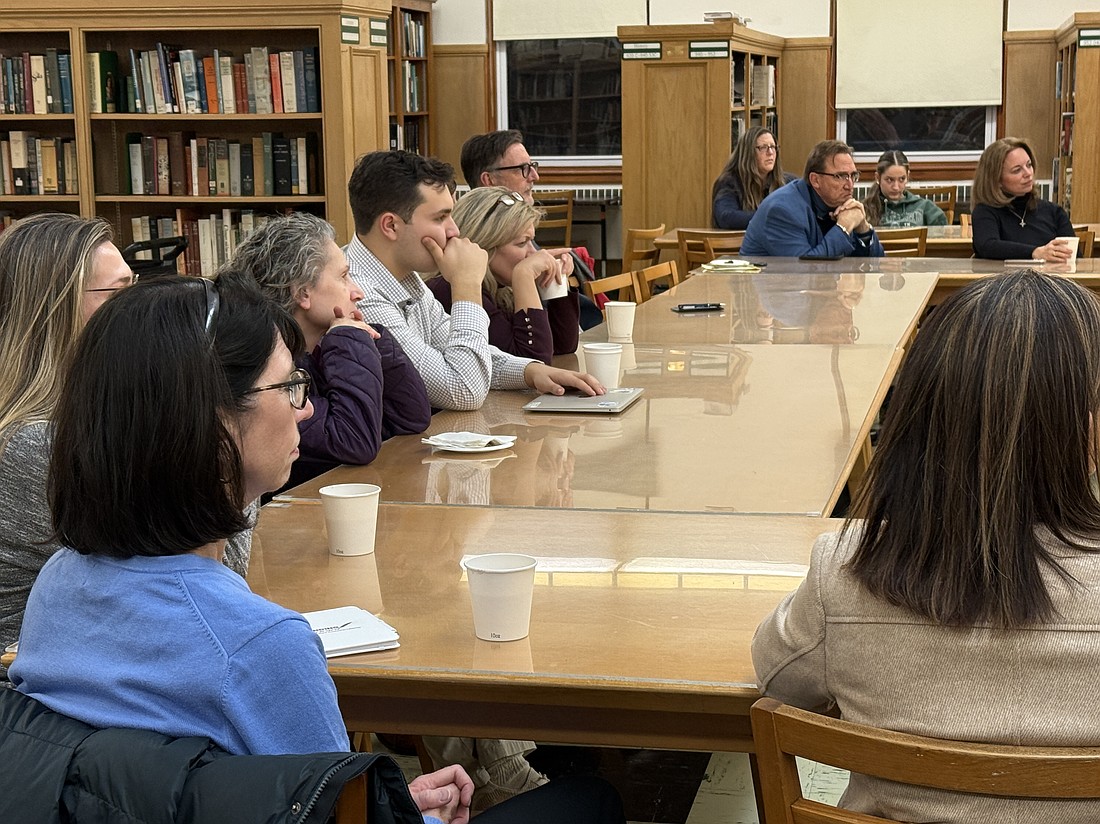
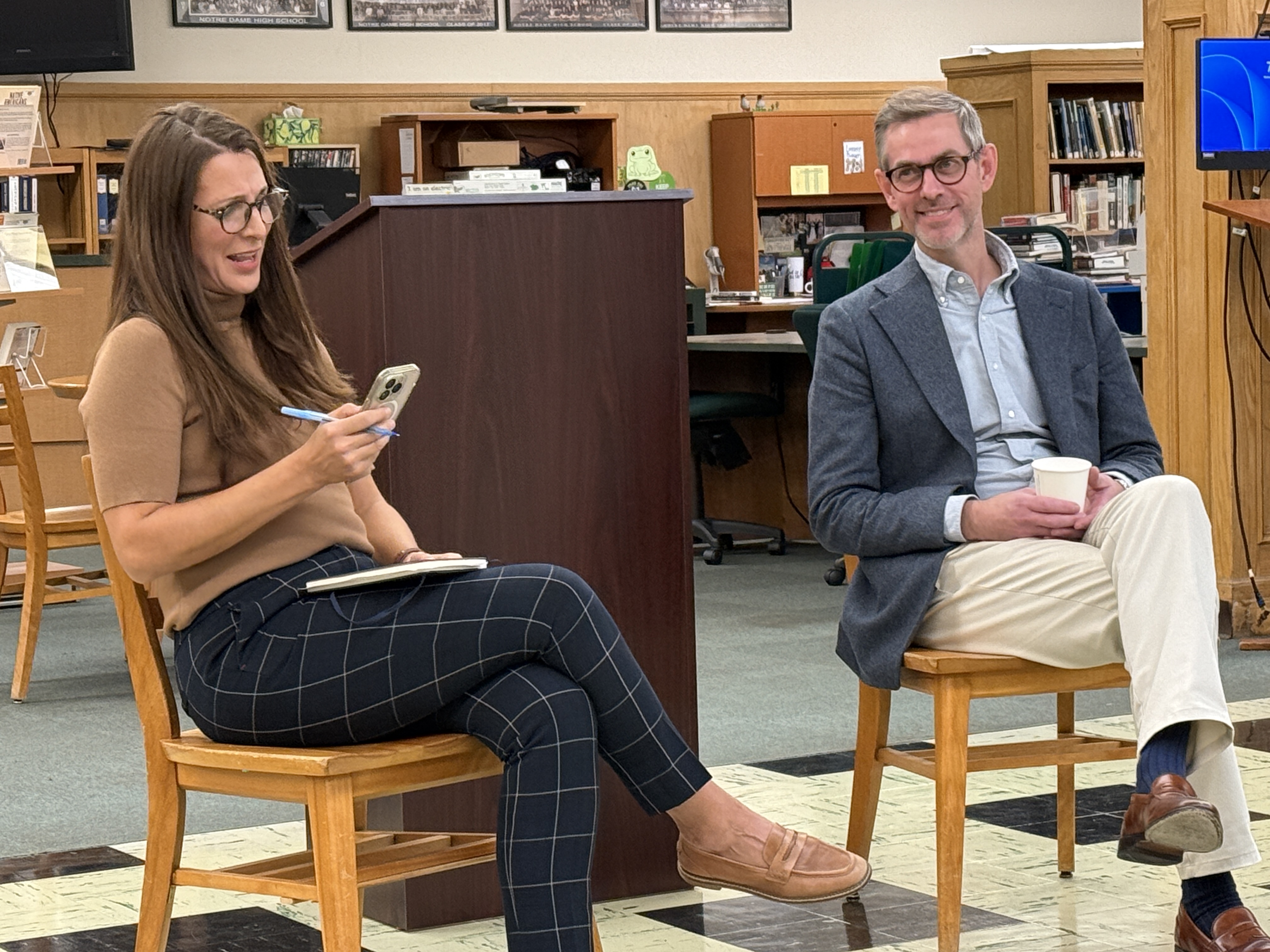 A moderated discussion Nov. 12 between Dr. Ana Samuel and Dr. R.J. Snell, both of the Witherspoon Institute in Princeton, addresses the concerns over how artificial intelligence is used and implemented. Artificial Intelligence is supposed to think like a human being, but it has no moral safeguards, said Dr. R.J. Snell, director of academic programs and editor-in-chief of Public Discourse for the Witherspoon Institute, Princeton.
A fundamental misunderstanding of human intelligence, Dr. Snell said, is now going into the creation of a tool “which we think is like us and is not like us. Insofar as we’ve misunderstood intelligence, we’re also misunderstanding God.”
Parents and school administrators gathered in Notre Dame High School, Lawrenceville, Nov. 12 to hear Dr. Snell as he explored what A.I. is and what it is not, in a moderated discussion with Dr. Ana Samuel, NDHS parent and fellow Witherspoon Institute scholar.
Potential vs. Peril
The chatter about A.I. in the news, Dr. Snell said, is divided.
“Some think this is the best of times, that A.I. is going to cure cancer, we will have unlimited wealth and clean energy,” he said. “Others think A.I. is going to succeed momentously, and that will be the destruction of our human society; no one will work, the rich will become extremely rich, and everyone else will become extremely poor and dependent on universal basic income. You will not have meaningful work ever again.”
Dr. Snell said he believes a key concern is how A.I. is being created in the image of people, and “whether that image … is true to the human being. I think it is extremely false.”
Having so degraded the vision of the human person over time, he said, “we are creating a new tool, either for good or for ill, that reveals how we think of ourselves, and that image … is not very true, helpful or promising.”
Although A.I. is a sophisticated tool, Dr. Snell said, it does not have consciousness or self-knowledge. It can analyze and recognize predictive patterns, but it doesn’t have what he calls the “aha” moment of discovery, of working out a problem and coming to understanding like humans do.
And perhaps even more importantly, he noted, A.I. does not experience whether it “ought” to do something.
“You know what it’s like to have done wrong,” Dr. Snell said. “The algorithm has no sense of that experience … no idea what it means … its safeguards are not moral functions.”
Several parents and teachers noted that they use A.I. for jobs or to help with computational, data-heavy work. But on its use by students, they remained guarded.
“I want students to walk out of (our school) independent, critical thinkers,” said NDHS English teacher and parent Kellyanne Stewart, “and not have to defer to something A.I. is doing or saying; I want them to figure it out. … They don’t open computers in my classroom.”
Building Guardrails
“How can we help guide our children to use A.I. in an ethical way?” Dr. Samuel asked.
Dr. Snell noted that A.I. can be simply a discovery tool. However, “no tool should be used when the exercise … is asking for understanding,” he said. “The point of education is not just return on investment … it’s to develop our personhood.”
He advocated for students taking liberal arts subjects like history to learn “the deeds of great men and women … [otherwise] they won’t know what magnanimity is.” He suggested classes in logic, “because if you can’t control or order your speech, you won’t be able to act … like a citizen in your community,” and art history, “because the soul bereft of beauty is a soul just bereft.”
Dr. Vincent de Paul Schmidt, diocesan superintendent of Catholic schools, asked how administrators and teachers can help protect students.
“We have to provide better, richer alternatives,” Dr. Snell answered, such as exposure to real art and in-person experiences. “We might not be able to prohibit phones and A.I. at home … but you [can] introduce your students to the real.”
Technology tends to “widen attention rather than deepen it,” he said. “It takes your experience sideways … whereas a real work of art intensifies your attention … it arrests you.”
Reclaiming Humanity
The Church’s great challenge and response, he continued, should be to “reintroduce humanity to itself … to proclaim what it means to be a human being … as a friend of God.”
Regarding job displacement by A.I., Dr. Samuel asked what timeless truths Catholics should consider.
Referencing St. Leo XIII’s encyclical Rerum Novarum and the chaplain of Poland’s Solidarity Movement, Father Józef Tischner, Dr. Snell talked about the dignity of work.
“Father Tischner wrote that ‘work is conversation, because it is always with someone, for someone and from someone.’ So work is a dialogue of persons,” Dr. Snell said.
Parent Frank Gramlich, a member of St. Paul Parish, Princeton, said he appreciated Dr. Snell’s highlight of humans as “made in the image of God, body and soul. Humans have dignity, and [we have to] keep that in mind during all the different iterations of A.I.”
Ken Stewart, NDHS parent, said the session made him realize, “Being human is that which makes you pause,” and “nothing in A.I. is going to make you pause.”
 Catholic Media Association releases new AI guidelines to keep ‘human dignity’ central
Monday, January 05, 2026


E-Editions
Events
A moderated discussion Nov. 12 between Dr. Ana Samuel and Dr. R.J. Snell, both of the Witherspoon Institute in Princeton, addresses the concerns over how artificial intelligence is used and implemented. Artificial Intelligence is supposed to think like a human being, but it has no moral safeguards, said Dr. R.J. Snell, director of academic programs and editor-in-chief of Public Discourse for the Witherspoon Institute, Princeton.A fundamental misunderstanding of human intelligence, Dr. Snell said, is now going into the creation of a tool “which we think is like us and is not like us. Insofar as we’ve misunderstood intelligence, we’re also misunderstanding God.”
Parents and school administrators gathered in Notre Dame High School, Lawrenceville, Nov. 12 to hear Dr. Snell as he explored what A.I. is and what it is not, in a moderated discussion with Dr. Ana Samuel, NDHS parent and fellow Witherspoon Institute scholar.
Potential vs. Peril
The chatter about A.I. in the news, Dr. Snell said, is divided.
“Some think this is the best of times, that A.I. is going to cure cancer, we will have unlimited wealth and clean energy,” he said. “Others think A.I. is going to succeed momentously, and that will be the destruction of our human society; no one will work, the rich will become extremely rich, and everyone else will become extremely poor and dependent on universal basic income. You will not have meaningful work ever again.”
Dr. Snell said he believes a key concern is how A.I. is being created in the image of people, and “whether that image … is true to the human being. I think it is extremely false.”
Having so degraded the vision of the human person over time, he said, “we are creating a new tool, either for good or for ill, that reveals how we think of ourselves, and that image … is not very true, helpful or promising.”
Although A.I. is a sophisticated tool, Dr. Snell said, it does not have consciousness or self-knowledge. It can analyze and recognize predictive patterns, but it doesn’t have what he calls the “aha” moment of discovery, of working out a problem and coming to understanding like humans do.
And perhaps even more importantly, he noted, A.I. does not experience whether it “ought” to do something.
“You know what it’s like to have done wrong,” Dr. Snell said. “The algorithm has no sense of that experience … no idea what it means … its safeguards are not moral functions.”
Several parents and teachers noted that they use A.I. for jobs or to help with computational, data-heavy work. But on its use by students, they remained guarded.
“I want students to walk out of (our school) independent, critical thinkers,” said NDHS English teacher and parent Kellyanne Stewart, “and not have to defer to something A.I. is doing or saying; I want them to figure it out. … They don’t open computers in my classroom.”
Building Guardrails
“How can we help guide our children to use A.I. in an ethical way?” Dr. Samuel asked.
Dr. Snell noted that A.I. can be simply a discovery tool. However, “no tool should be used when the exercise … is asking for understanding,” he said. “The point of education is not just return on investment … it’s to develop our personhood.”
He advocated for students taking liberal arts subjects like history to learn “the deeds of great men and women … [otherwise] they won’t know what magnanimity is.” He suggested classes in logic, “because if you can’t control or order your speech, you won’t be able to act … like a citizen in your community,” and art history, “because the soul bereft of beauty is a soul just bereft.”
Dr. Vincent de Paul Schmidt, diocesan superintendent of Catholic schools, asked how administrators and teachers can help protect students.
“We have to provide better, richer alternatives,” Dr. Snell answered, such as exposure to real art and in-person experiences. “We might not be able to prohibit phones and A.I. at home … but you [can] introduce your students to the real.”
Technology tends to “widen attention rather than deepen it,” he said. “It takes your experience sideways … whereas a real work of art intensifies your attention … it arrests you.”
Reclaiming Humanity
The Church’s great challenge and response, he continued, should be to “reintroduce humanity to itself … to proclaim what it means to be a human being … as a friend of God.”
Regarding job displacement by A.I., Dr. Samuel asked what timeless truths Catholics should consider.
Referencing St. Leo XIII’s encyclical Rerum Novarum and the chaplain of Poland’s Solidarity Movement, Father Józef Tischner, Dr. Snell talked about the dignity of work.
“Father Tischner wrote that ‘work is conversation, because it is always with someone, for someone and from someone.’ So work is a dialogue of persons,” Dr. Snell said.
Parent Frank Gramlich, a member of St. Paul Parish, Princeton, said he appreciated Dr. Snell’s highlight of humans as “made in the image of God, body and soul. Humans have dignity, and [we have to] keep that in mind during all the different iterations of A.I.”
Ken Stewart, NDHS parent, said the session made him realize, “Being human is that which makes you pause,” and “nothing in A.I. is going to make you pause.”