


Pope urges Lebanese not to give up on peace or each other
December 1, 2025 at 2:31 p.m.
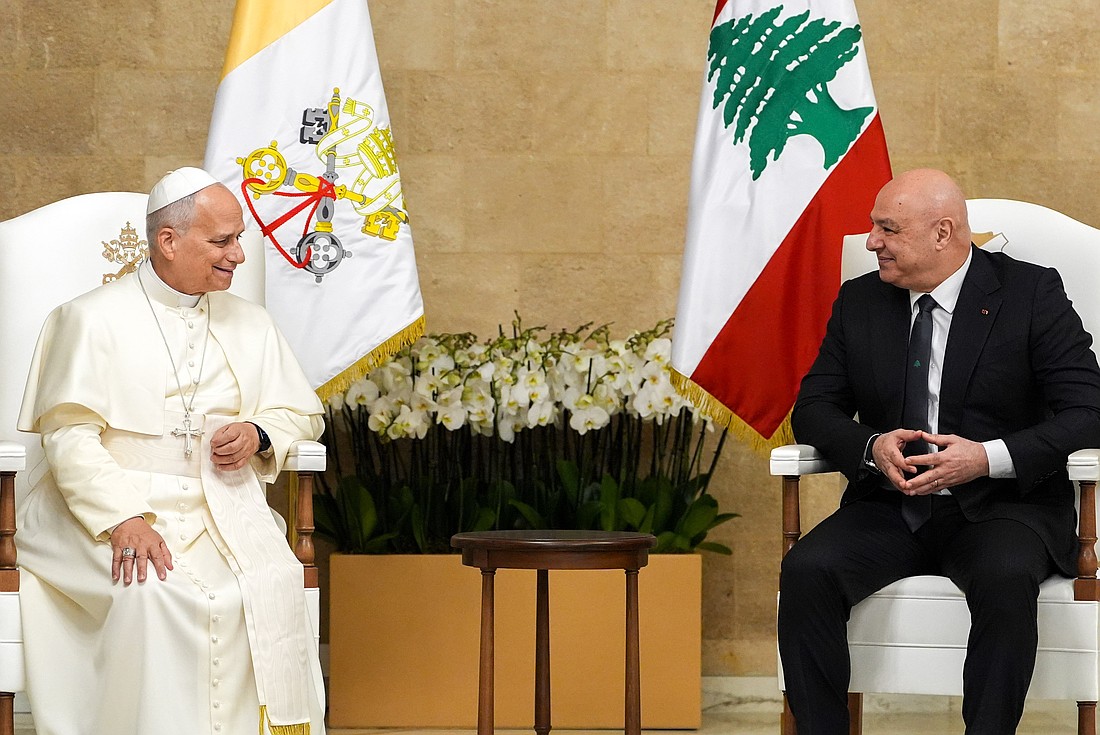
BEIRUT CNS – Acknowledging the existence of "circumstances that are highly complex, conflictual and uncertain," Pope Leo XIV arrived in Lebanon preaching peace.
Just a week before the Pope arrived Nov. 30, Israel had made its latest strike on Lebanon, killing a Hezbollah commander and four militants in a suburb of Beirut.
Arriving from Istanbul, a two-hour flight, Pope Leo was met at the Beirut airport by Lebanese President Joseph Aoun, Prime Minister Nawaf Salam and Cardinal Bechara Rai, patriarch of the Maronite Catholic Church, the largest of the Catholic Churches in Lebanon.
After a 21-cannon salute and the playing of the Lebanese and Vatican anthems, they headed to the presidential palace in Beirut.
Hundreds of people lined the streets near the presidential palace to see the Pope, and many stayed even when a heavy rain began. The rain also did not stop a dance troupe outside the palace from performing a traditional "dabke" dance featuring rhythmic stomping, which made a literal splash.
After the private meetings, the president and the Pope addressed about 400 government officials, as well as religious, business, cultural and civic leaders.
Not mentioning Israel by name, Pope Leo praised the Lebanese as "a people who do not give up, but in the face of trials, always know how to rise again with courage."
"Your resilience is an essential characteristic of authentic peacemakers, for the work of peace is indeed a continuous starting anew," the Pope said. "Moreover, the commitment and love for peace know no fear in the face of apparent defeat, are not daunted by disappointment, but look ahead, welcoming and embracing all situations with hope."
"It takes tenacity to build peace," Pope Leo said. "It takes perseverance to protect and nurture life."
After two years of political tensions, the Lebanese parliament finally elected a president in January. The country also has experienced a prolonged economic crisis.
"You have suffered greatly from the consequences of an economy that kills," the Pope said, using a phrase Pope Francis often employed, as well as from "the radicalization of identities and conflicts.
"But you have always wanted, and known how, to start again," Pope Leo told the leaders.
That effort, he said, requires reconciliation, which only comes from honest dialogue.
"Truth and reconciliation only ever grow together, whether in a family, between different communities and the various people of a country, or between nations," he said.
For many Lebanese "there are times when it is easier to flee, or simply more convenient to move elsewhere," he said. "It takes real courage and foresight to stay or return to one's own country and to consider even somewhat difficult situations worthy of love and dedication."
Lebanon, which hosts more refugees per capita than any other nation, is experiencing "an exodus of young people and families," the Pope noted.
The Church, he said, "does not want anyone to be forced to leave their country. Moreover, the Church wants those who wish to return home to be able to do so safely."
The leaders of Lebanon and other countries in the region must ask themselves what they can do to encourage young people to stay and work for peace in their homelands rather than seeking it elsewhere, the Pope said.
"In this regard," he said, "Christians and Muslims together, and all religious and civil components of Lebanese society, are called to play their part, and to commit themselves to raising awareness of this issue within the international community."
While most Lebanese are Muslim, Christians make up at least 33% of the country's population. The Vatican estimates Catholics number more than 2 million; in addition to the Maronites, the Catholic community also includes Melkite, Armenian, Syriac, Chaldean and Latin-rite Catholics.
Aoun, in his speech at the meeting, said that "if Christians in Lebanon were to disappear, the delicate balance" of strong Christian and Muslim communities living side by side "would collapse and with-it justice."
"Similarly, any harm to the Muslim community in Lebanon would also destabilize the equation and undermine justice as well," the president said. "The fall of Lebanon, precipitated by the loss of any of its integral components, would foster the rise of extremism, violence and bloodshed both in our region and in the world."
The motto of the Pope's trip was "Blessed are the peacemakers."
Catholic journalism is needed now more than ever. Please consider supporting this work by signing up for a SUBSCRIPTION (click HERE) or making a DONATION to The Monitor (click HERE). Thank you for your contribution.
Related Stories
Monday, December 29, 2025


E-Editions
Events
BEIRUT CNS – Acknowledging the existence of "circumstances that are highly complex, conflictual and uncertain," Pope Leo XIV arrived in Lebanon preaching peace.
Just a week before the Pope arrived Nov. 30, Israel had made its latest strike on Lebanon, killing a Hezbollah commander and four militants in a suburb of Beirut.
Arriving from Istanbul, a two-hour flight, Pope Leo was met at the Beirut airport by Lebanese President Joseph Aoun, Prime Minister Nawaf Salam and Cardinal Bechara Rai, patriarch of the Maronite Catholic Church, the largest of the Catholic Churches in Lebanon.
After a 21-cannon salute and the playing of the Lebanese and Vatican anthems, they headed to the presidential palace in Beirut.
Hundreds of people lined the streets near the presidential palace to see the Pope, and many stayed even when a heavy rain began. The rain also did not stop a dance troupe outside the palace from performing a traditional "dabke" dance featuring rhythmic stomping, which made a literal splash.
After the private meetings, the president and the Pope addressed about 400 government officials, as well as religious, business, cultural and civic leaders.
Not mentioning Israel by name, Pope Leo praised the Lebanese as "a people who do not give up, but in the face of trials, always know how to rise again with courage."
"Your resilience is an essential characteristic of authentic peacemakers, for the work of peace is indeed a continuous starting anew," the Pope said. "Moreover, the commitment and love for peace know no fear in the face of apparent defeat, are not daunted by disappointment, but look ahead, welcoming and embracing all situations with hope."
"It takes tenacity to build peace," Pope Leo said. "It takes perseverance to protect and nurture life."
After two years of political tensions, the Lebanese parliament finally elected a president in January. The country also has experienced a prolonged economic crisis.
"You have suffered greatly from the consequences of an economy that kills," the Pope said, using a phrase Pope Francis often employed, as well as from "the radicalization of identities and conflicts.
"But you have always wanted, and known how, to start again," Pope Leo told the leaders.
That effort, he said, requires reconciliation, which only comes from honest dialogue.
"Truth and reconciliation only ever grow together, whether in a family, between different communities and the various people of a country, or between nations," he said.
For many Lebanese "there are times when it is easier to flee, or simply more convenient to move elsewhere," he said. "It takes real courage and foresight to stay or return to one's own country and to consider even somewhat difficult situations worthy of love and dedication."
Lebanon, which hosts more refugees per capita than any other nation, is experiencing "an exodus of young people and families," the Pope noted.
The Church, he said, "does not want anyone to be forced to leave their country. Moreover, the Church wants those who wish to return home to be able to do so safely."
The leaders of Lebanon and other countries in the region must ask themselves what they can do to encourage young people to stay and work for peace in their homelands rather than seeking it elsewhere, the Pope said.
"In this regard," he said, "Christians and Muslims together, and all religious and civil components of Lebanese society, are called to play their part, and to commit themselves to raising awareness of this issue within the international community."
While most Lebanese are Muslim, Christians make up at least 33% of the country's population. The Vatican estimates Catholics number more than 2 million; in addition to the Maronites, the Catholic community also includes Melkite, Armenian, Syriac, Chaldean and Latin-rite Catholics.
Aoun, in his speech at the meeting, said that "if Christians in Lebanon were to disappear, the delicate balance" of strong Christian and Muslim communities living side by side "would collapse and with-it justice."
"Similarly, any harm to the Muslim community in Lebanon would also destabilize the equation and undermine justice as well," the president said. "The fall of Lebanon, precipitated by the loss of any of its integral components, would foster the rise of extremism, violence and bloodshed both in our region and in the world."
The motto of the Pope's trip was "Blessed are the peacemakers."
Catholic journalism is needed now more than ever. Please consider supporting this work by signing up for a SUBSCRIPTION (click HERE) or making a DONATION to The Monitor (click HERE). Thank you for your contribution.