


How the conclave works: It's guided by a rule book and a prayer book
April 30, 2025 at 2:00 p.m.
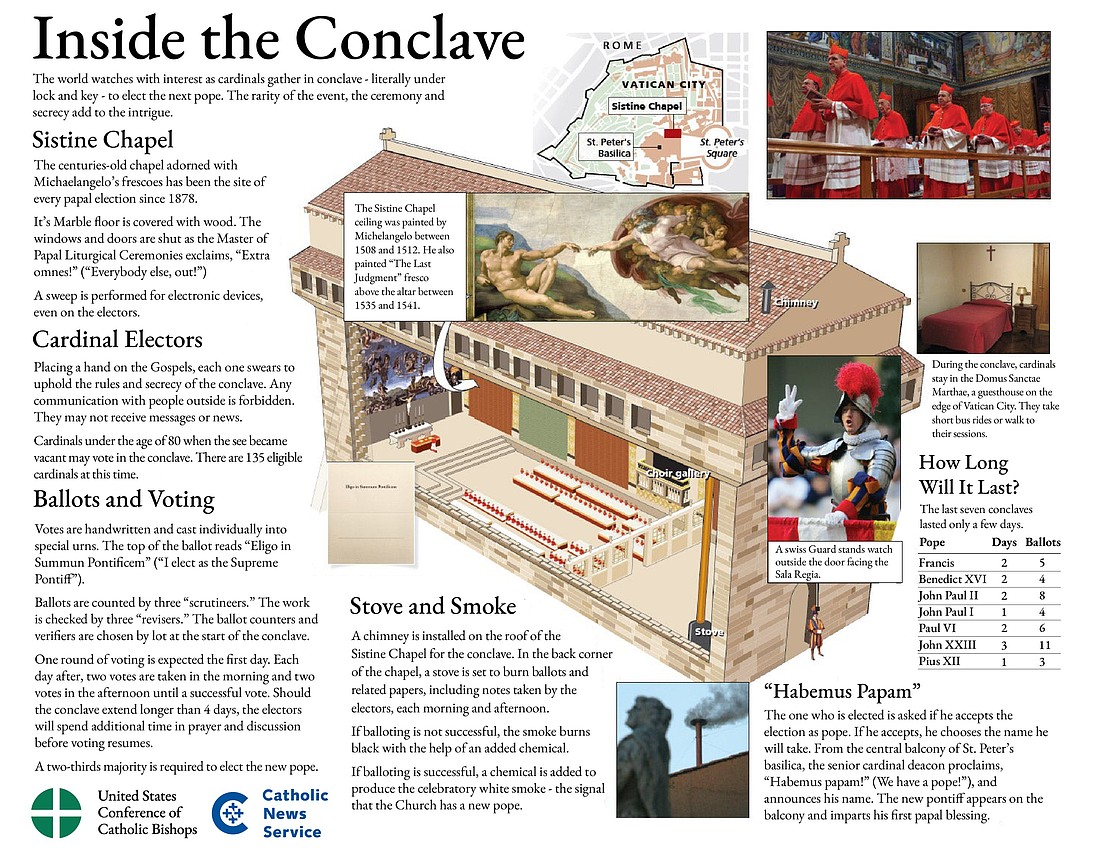
VATICAN CITY CNS – The conclave to elect a new Pope, scheduled to begin May 7, is governed by two texts: a rule book and a prayer book.
The rule book is the apostolic constitution, "Universi Dominici Gregis" ("Shepherd of the Lord's Whole Flock"), which was issued by St. John Paul II in 1996 and amended by Pope Benedict XVI in 2007 and again in 2013.
The prayer book is the "Ordo Rituum Conclavis" ("Rites of the Conclave"), which was approved by St. John Paul II in 1998, but not released until after his death in 2005. If Pope Francis made any adjustments to the rites, they had not been announced as of April 30.
The "Ordo Rituum Conclavis," which has prayers in Latin with an Italian translation, begins by noting that the election of a Pope "is prepared for and takes place with liturgical actions and constant prayer."
The rites of the conclave begin with the public Mass "for the election of the Roman pontiff," which was to be celebrated at 10 a.m. May 7 in St. Peter's Basilica. Cardinal Giovanni Battista Re, dean of the College of Cardinals, will be the main celebrant.
According to the "Ordo," Cardinal Re will begin by praying: "O God, eternal pastor, you who govern your people with a father's care, give your Church a pontiff acceptable to you for his holiness of life and wholly consecrated to the service of your people."
The Mass for the election of the Pope is the only rite in the book to be celebrated publicly before the new Pope is presented to the world.
After celebrating the morning Mass, the rule book calls for the cardinals to gather in the late afternoon in the Pauline Chapel of the Apostolic Palace and then process into the Sistine Chapel.
Cardinal Pietro Parolin, the highest-ranking member of the College of Cardinals who is under the age of 80 and eligible to enter the conclave, addresses the cardinals: "After having celebrated the divine mysteries, we now enter into conclave to elect the Roman pontiff. The whole Church, united with us in prayer, invokes the grace of the Holy Spirit so that we elect a worthy pastor of the entire flock of Christ."
In a procession behind the cross, the cardinals walk into the Sistine Chapel singing a litany of saints of the East and West and a series of invocations to Christ with the refrain, "Save us, Lord."
When everyone is in his place in the chapel, the cardinals chant the ancient invocation of the Holy Spirit, "Veni, Creator Spiritus."
The cardinals then take an oath to "faithfully and scrupulously observe" the rules for electing a Pope. Each swears that if he is elected, he will "faithfully fulfill the Petrine ministry as pastor of the universal Church and will strenuously affirm and defend the spiritual and temporal rights as well as the freedom of the Holy See."
They also promise to keep everything having to do with the election secret.
When the last cardinal has placed his hand on the Book of the Gospels and sworn the oath, Archbishop Diego Ravelli, Vatican master of liturgical ceremonies, says: "Extra omnes," ordering all those not directly involved in the conclave out of the Sistine Chapel.
During their general congregation meetings, the cardinals selected Italian Cardinal Raniero Cantalamessa, retired preacher of the papal household who at 90 is not eligible to vote in the conclave, to remain inside the chapel to offer a reflection on their responsibilities in electing a new Pope.
After the meditation, he and Archbishop Ravelli will leave the chapel.
The cardinals decide together whether they will cast one ballot the first evening; traditionally they have done so, burning the ballots with a chemical additive that produces black smoke pouring from the Sistine Chapel chimney.
After that, two ballots can be cast each morning and two each afternoon until a candidate garners two-thirds of the votes. On the fourth day, if no one has been elected, the cardinals pause for extended prayer.
Each day of the conclave, the cardinals recite morning and evening prayer together and concelebrate Mass. They have time for prayer before each ballot is cast and before the ballots are counted.
As each cardinal places his vote in an urn on a table in front of Michelangelo's fresco of the Last Judgment, he promises that his vote was cast for the candidate he believes deserves to be elected.
If the first ballot of the morning or of the afternoon session does not result in an election, a second vote begins immediately, and the two ballots are burned together.
When someone reaches the two-thirds threshold – 89 votes if, as reported, 133 cardinals enter the conclave – he will be asked by Cardinal Parolin, "Do you accept your canonical election as supreme pontiff?"
Neither the "Ordo" nor the rule book provides a formula for the assent and neither recognizes the possibility that the person elected will refuse. The second question asked is: "With what name do you wish to be called?"
If the elected man already is a bishop, once he accepts the office, he "immediately is the bishop of the Church of Rome, the true Pope and head of the college of bishops; he acquires full and supreme power over the universal Church."
The ballots, along with the cardinals' notes or running tallies of the votes, are burned with a chemical additive to produce white smoke and announce to the world that there has been a successful election.
The cardinals approach the new Pope and pay homage to him, then sing the "Te Deum" hymn of thanks to God.
Then the senior cardinal deacon, French Cardinal Dominique Mamberti, prefect of the Apostolic Signature, the Holy See's highest court, goes to the central balcony of St. Peter's Basilica and declares to the public, "Habemus papam" ("We have a Pope").
The Church needs quality Catholic journalism now more than ever. Please consider supporting this work by signing up for a SUBSCRIPTION (click HERE) or making a DONATION to The Monitor (click HERE). Thank you for your support.
Related Stories
Saturday, December 13, 2025
E-Editions
Events
VATICAN CITY CNS – The conclave to elect a new Pope, scheduled to begin May 7, is governed by two texts: a rule book and a prayer book.
The rule book is the apostolic constitution, "Universi Dominici Gregis" ("Shepherd of the Lord's Whole Flock"), which was issued by St. John Paul II in 1996 and amended by Pope Benedict XVI in 2007 and again in 2013.
The prayer book is the "Ordo Rituum Conclavis" ("Rites of the Conclave"), which was approved by St. John Paul II in 1998, but not released until after his death in 2005. If Pope Francis made any adjustments to the rites, they had not been announced as of April 30.
The "Ordo Rituum Conclavis," which has prayers in Latin with an Italian translation, begins by noting that the election of a Pope "is prepared for and takes place with liturgical actions and constant prayer."
The rites of the conclave begin with the public Mass "for the election of the Roman pontiff," which was to be celebrated at 10 a.m. May 7 in St. Peter's Basilica. Cardinal Giovanni Battista Re, dean of the College of Cardinals, will be the main celebrant.
According to the "Ordo," Cardinal Re will begin by praying: "O God, eternal pastor, you who govern your people with a father's care, give your Church a pontiff acceptable to you for his holiness of life and wholly consecrated to the service of your people."
The Mass for the election of the Pope is the only rite in the book to be celebrated publicly before the new Pope is presented to the world.
After celebrating the morning Mass, the rule book calls for the cardinals to gather in the late afternoon in the Pauline Chapel of the Apostolic Palace and then process into the Sistine Chapel.
Cardinal Pietro Parolin, the highest-ranking member of the College of Cardinals who is under the age of 80 and eligible to enter the conclave, addresses the cardinals: "After having celebrated the divine mysteries, we now enter into conclave to elect the Roman pontiff. The whole Church, united with us in prayer, invokes the grace of the Holy Spirit so that we elect a worthy pastor of the entire flock of Christ."
In a procession behind the cross, the cardinals walk into the Sistine Chapel singing a litany of saints of the East and West and a series of invocations to Christ with the refrain, "Save us, Lord."
When everyone is in his place in the chapel, the cardinals chant the ancient invocation of the Holy Spirit, "Veni, Creator Spiritus."
The cardinals then take an oath to "faithfully and scrupulously observe" the rules for electing a Pope. Each swears that if he is elected, he will "faithfully fulfill the Petrine ministry as pastor of the universal Church and will strenuously affirm and defend the spiritual and temporal rights as well as the freedom of the Holy See."
They also promise to keep everything having to do with the election secret.
When the last cardinal has placed his hand on the Book of the Gospels and sworn the oath, Archbishop Diego Ravelli, Vatican master of liturgical ceremonies, says: "Extra omnes," ordering all those not directly involved in the conclave out of the Sistine Chapel.
During their general congregation meetings, the cardinals selected Italian Cardinal Raniero Cantalamessa, retired preacher of the papal household who at 90 is not eligible to vote in the conclave, to remain inside the chapel to offer a reflection on their responsibilities in electing a new Pope.
After the meditation, he and Archbishop Ravelli will leave the chapel.
The cardinals decide together whether they will cast one ballot the first evening; traditionally they have done so, burning the ballots with a chemical additive that produces black smoke pouring from the Sistine Chapel chimney.
After that, two ballots can be cast each morning and two each afternoon until a candidate garners two-thirds of the votes. On the fourth day, if no one has been elected, the cardinals pause for extended prayer.
Each day of the conclave, the cardinals recite morning and evening prayer together and concelebrate Mass. They have time for prayer before each ballot is cast and before the ballots are counted.
As each cardinal places his vote in an urn on a table in front of Michelangelo's fresco of the Last Judgment, he promises that his vote was cast for the candidate he believes deserves to be elected.
If the first ballot of the morning or of the afternoon session does not result in an election, a second vote begins immediately, and the two ballots are burned together.
When someone reaches the two-thirds threshold – 89 votes if, as reported, 133 cardinals enter the conclave – he will be asked by Cardinal Parolin, "Do you accept your canonical election as supreme pontiff?"
Neither the "Ordo" nor the rule book provides a formula for the assent and neither recognizes the possibility that the person elected will refuse. The second question asked is: "With what name do you wish to be called?"
If the elected man already is a bishop, once he accepts the office, he "immediately is the bishop of the Church of Rome, the true Pope and head of the college of bishops; he acquires full and supreme power over the universal Church."
The ballots, along with the cardinals' notes or running tallies of the votes, are burned with a chemical additive to produce white smoke and announce to the world that there has been a successful election.
The cardinals approach the new Pope and pay homage to him, then sing the "Te Deum" hymn of thanks to God.
Then the senior cardinal deacon, French Cardinal Dominique Mamberti, prefect of the Apostolic Signature, the Holy See's highest court, goes to the central balcony of St. Peter's Basilica and declares to the public, "Habemus papam" ("We have a Pope").
The Church needs quality Catholic journalism now more than ever. Please consider supporting this work by signing up for a SUBSCRIPTION (click HERE) or making a DONATION to The Monitor (click HERE). Thank you for your support.