


Pope: Science needs greater support, protection from manipulation
February 23, 2023 at 8:18 p.m.
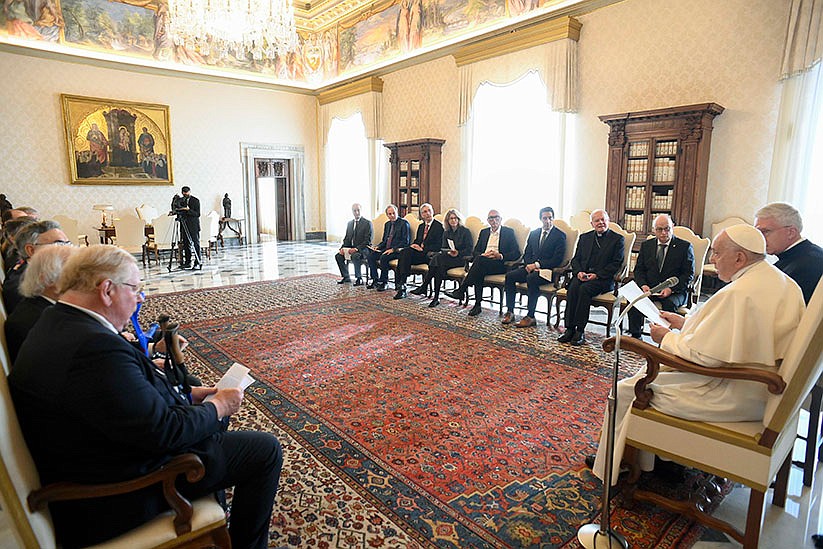
In his written address, the Pope expressed his appreciation for their visit Feb. 23, "which allows me once more to express the esteem of the Holy See for scientific research and, in particular, for the work of the Max Planck Society, in which thousands of individuals, within a variety of institutes, are committed to the advancement of the sciences and progress in specific areas of research."
According to the Vatican press office, the Pope handed his guests the text of his speech but did not read it to them "because of a severe cold."
In the text, Pope Francis said that "support for pure science must be defended and, if possible, increased."
The Pope, who specialized in chemistry at a technical high school and worked briefly as a technician, drew a distinction in his speech between applied science, which is research focused on a particular goal and practical outcomes, and "pure" science, which is research for the sake of discovery and knowledge.
"Indeed, without prejudice to applied science, pure science should be recognized as a public good whose contributions are to be placed at the service of the common good," he wrote.
Pope Francis emphasized the importance of considering the ethics, responsibility and impact on humanity and society of scientific and technological advancement, particularly in the developing field of so-called "hybrid thinking," which combines human and computer thinking.
"Hybrid thinking," proposed as "a means of preventing human beings from being supplanted by artificial intelligence, raises important issues both for ethics and for society as a whole," he wrote.
"It should be recognized that a fusion between human cognitive capacities and the computational power of machines could substantially modify the (human) species," he wrote, which is why it is imperative "to raise the issue of ultimate meaning, namely the direction toward which all this is moving."
The Catholic Church can never accept any kind of principle or approach in science and technology that "makes no room for moral judgment concerning what is good or evil," he wrote.
"The kind of responsibility that today we need to return to the fore of our culture is responsibility for the care of others, which is more than simply accounting for results achieved," the Pope wrote.
"For, in the end, we are responsible not only for what we do, but also, and above all, for what we can do, and yet choose not to do," he wrote.
Related Stories
Friday, January 02, 2026




E-Editions
Events
In his written address, the Pope expressed his appreciation for their visit Feb. 23, "which allows me once more to express the esteem of the Holy See for scientific research and, in particular, for the work of the Max Planck Society, in which thousands of individuals, within a variety of institutes, are committed to the advancement of the sciences and progress in specific areas of research."
According to the Vatican press office, the Pope handed his guests the text of his speech but did not read it to them "because of a severe cold."
In the text, Pope Francis said that "support for pure science must be defended and, if possible, increased."
The Pope, who specialized in chemistry at a technical high school and worked briefly as a technician, drew a distinction in his speech between applied science, which is research focused on a particular goal and practical outcomes, and "pure" science, which is research for the sake of discovery and knowledge.
"Indeed, without prejudice to applied science, pure science should be recognized as a public good whose contributions are to be placed at the service of the common good," he wrote.
Pope Francis emphasized the importance of considering the ethics, responsibility and impact on humanity and society of scientific and technological advancement, particularly in the developing field of so-called "hybrid thinking," which combines human and computer thinking.
"Hybrid thinking," proposed as "a means of preventing human beings from being supplanted by artificial intelligence, raises important issues both for ethics and for society as a whole," he wrote.
"It should be recognized that a fusion between human cognitive capacities and the computational power of machines could substantially modify the (human) species," he wrote, which is why it is imperative "to raise the issue of ultimate meaning, namely the direction toward which all this is moving."
The Catholic Church can never accept any kind of principle or approach in science and technology that "makes no room for moral judgment concerning what is good or evil," he wrote.
"The kind of responsibility that today we need to return to the fore of our culture is responsibility for the care of others, which is more than simply accounting for results achieved," the Pope wrote.
"For, in the end, we are responsible not only for what we do, but also, and above all, for what we can do, and yet choose not to do," he wrote.