


Religious freedom: Top U.S., Vatican officials explain why its defense is crucial
September 30, 2020 at 7:17 p.m.
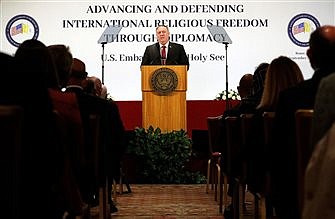
"There has never been a more critical time to advance and defend international religious freedom" as it continues to come under attack in almost every part of the world, said Callista Gingrich, U.S. ambassador to the Holy See, giving examples of violations occurring in Myanmar, Nicaragua, Nigeria, Saudi Arabia and China.
The United States will continue to forge partnerships with others to promote religious freedom because upholding this right "is not just morally necessary, it is a national security imperative," helping nations be safer and more prosperous, she said in her opening remarks at the event Sept. 30.
The ambassador opened the two-hour symposium, "Advancing and Defending International Religious Freedom Through Diplomacy," which was livestreamed on Facebook and featured keynote speakers and a panel of experts who attended in-person, including U.S. Secretary of State Mike Pompeo.
Pompeo was in Italy to hold talks with Italian Prime Minister Giuseppe Conte and with Cardinal Pietro Parolin, Vatican Secretary of State. Pope Francis, who received Pompeo in 2019, was not scheduled to meet Pompeo this year with the U.S. presidential election being just five weeks away.
[[In-content Ad]]
A reporter asked Archbishop Paul Gallagher, the Vatican foreign minister, if such a meeting could have been seen as a way to use the Vatican to influence the elections.
"That's one of the reasons why the Holy Father is not receiving the secretary of state," the archbishop responded, according to AP.
In his talk at the symposium, Pompeo called on leaders of all religions to stand up to violations against religious freedom.
Citing the example of Father Bernhard Lichtenberg of Berlin, who was a vocal critic of the Nazi regime and was arrested in 1941, jailed and died en route to Dachau, Pompeo urged "all faith leaders to exhibit a similar bold moral witness – for the sake of religious freedom, human dignity and peace."
Pompeo said, "The United States can and does play its part in speaking up for those oppressed. We shine light on abuses, punish those responsible and encourage others to join our advocacy."
"But for all that nation-states can do, ultimately, our efforts are constrained by the realities of world politics," he said. "Countries must sometimes make compromises to advance good ends, leaders come and go, priorities change."
This is why the Church, which "is in a different position," must act because "earthly considerations shouldn't discourage principled stances based on eternal truths," Pompeo said, adding that so many Catholics have long used their principles "in service of human dignity."
For instance, he said, St. John Paul II "bore witness to his flock's suffering and challenged tyranny," demonstrating "how the Holy See can move our world in a more humane direction."
He asked that the Church and people of faith "be so bold in our time."
In his talk, Archbishop Gallagher said that protecting religious freedom "remains an indispensable part of the scope and activity of the Holy See."
The Vatican has been "assiduously and constantly attentive to abuses to religious liberty" in all of its forms, from physical persecution and murder to the "ever more common tendency, especially found in the West," of attacking religious freedom through "silencing" and ideologies of “tolerance.”
These "trends," he said, are part of what is often called "'political correctness,' which are taking ever larger liberties in the name of 'tolerance' and 'non-discrimination.'"
"Rather, these inflexible ideologies, which are quick to denounce religious beliefs and persons that do not accept their position as 'hateful,' are themselves rather 'intolerable' and 'discriminatory' against the freedom of religion," the archbishop said.
"If I were a cynic, I would say that it seems that some of those who should be defending and promoting religious liberty either lack the willingness truly to do so or seem to be kowtowing to the prevalent ideological forces that see the exercise of religious liberty as a threat their own concept of liberty, which is understood in large part as the ability do whatever one wants, affirming oneself without any restriction whatsoever, including civil, natural and especially divine law," he said.
When asked after his talk why he made no mention of China and violations against religious freedom, Archbishop Gallagher said, "We don't name and blame – it's one of the principles of Vatican diplomacy," according to AP.
Sam Brownback, U.S. ambassador-at-large for religious freedom, said in his talk that "the key to peace in many of the conflicts around the world today is protection of religious freedom for all," pointing to agreements made in Sudan and Israel's pacts with the UAE and Bahrain.
"If we don't do this, if the world doesn't do this, there will be more conflict in the world, there will be more violence and more killing in the world," he said.
Closing the conference, Cardinal Parolin said, "Attacks on religious freedom are often driven by fear and ideology," either by authoritarian regimes or the "politically correct that silence and condemn those religious beliefs traditions and practices that clash with their progressive ideology."
It is important to reflect on the reasons for this type of intolerance as well as the "shrinking public space for dialogue for and with those who practice their beliefs openly," the cardinal said.
"The degree of the respect for freedom of religion in the public sphere is a clear indicator of the health of any society," he said, "and it is also a litmus test for the level of respect that exists for all other fundamental human rights as well."
Related Stories
Thursday, January 01, 2026

E-Editions
Events
"There has never been a more critical time to advance and defend international religious freedom" as it continues to come under attack in almost every part of the world, said Callista Gingrich, U.S. ambassador to the Holy See, giving examples of violations occurring in Myanmar, Nicaragua, Nigeria, Saudi Arabia and China.
The United States will continue to forge partnerships with others to promote religious freedom because upholding this right "is not just morally necessary, it is a national security imperative," helping nations be safer and more prosperous, she said in her opening remarks at the event Sept. 30.
The ambassador opened the two-hour symposium, "Advancing and Defending International Religious Freedom Through Diplomacy," which was livestreamed on Facebook and featured keynote speakers and a panel of experts who attended in-person, including U.S. Secretary of State Mike Pompeo.
Pompeo was in Italy to hold talks with Italian Prime Minister Giuseppe Conte and with Cardinal Pietro Parolin, Vatican Secretary of State. Pope Francis, who received Pompeo in 2019, was not scheduled to meet Pompeo this year with the U.S. presidential election being just five weeks away.
[[In-content Ad]]
A reporter asked Archbishop Paul Gallagher, the Vatican foreign minister, if such a meeting could have been seen as a way to use the Vatican to influence the elections.
"That's one of the reasons why the Holy Father is not receiving the secretary of state," the archbishop responded, according to AP.
In his talk at the symposium, Pompeo called on leaders of all religions to stand up to violations against religious freedom.
Citing the example of Father Bernhard Lichtenberg of Berlin, who was a vocal critic of the Nazi regime and was arrested in 1941, jailed and died en route to Dachau, Pompeo urged "all faith leaders to exhibit a similar bold moral witness – for the sake of religious freedom, human dignity and peace."
Pompeo said, "The United States can and does play its part in speaking up for those oppressed. We shine light on abuses, punish those responsible and encourage others to join our advocacy."
"But for all that nation-states can do, ultimately, our efforts are constrained by the realities of world politics," he said. "Countries must sometimes make compromises to advance good ends, leaders come and go, priorities change."
This is why the Church, which "is in a different position," must act because "earthly considerations shouldn't discourage principled stances based on eternal truths," Pompeo said, adding that so many Catholics have long used their principles "in service of human dignity."
For instance, he said, St. John Paul II "bore witness to his flock's suffering and challenged tyranny," demonstrating "how the Holy See can move our world in a more humane direction."
He asked that the Church and people of faith "be so bold in our time."
In his talk, Archbishop Gallagher said that protecting religious freedom "remains an indispensable part of the scope and activity of the Holy See."
The Vatican has been "assiduously and constantly attentive to abuses to religious liberty" in all of its forms, from physical persecution and murder to the "ever more common tendency, especially found in the West," of attacking religious freedom through "silencing" and ideologies of “tolerance.”
These "trends," he said, are part of what is often called "'political correctness,' which are taking ever larger liberties in the name of 'tolerance' and 'non-discrimination.'"
"Rather, these inflexible ideologies, which are quick to denounce religious beliefs and persons that do not accept their position as 'hateful,' are themselves rather 'intolerable' and 'discriminatory' against the freedom of religion," the archbishop said.
"If I were a cynic, I would say that it seems that some of those who should be defending and promoting religious liberty either lack the willingness truly to do so or seem to be kowtowing to the prevalent ideological forces that see the exercise of religious liberty as a threat their own concept of liberty, which is understood in large part as the ability do whatever one wants, affirming oneself without any restriction whatsoever, including civil, natural and especially divine law," he said.
When asked after his talk why he made no mention of China and violations against religious freedom, Archbishop Gallagher said, "We don't name and blame – it's one of the principles of Vatican diplomacy," according to AP.
Sam Brownback, U.S. ambassador-at-large for religious freedom, said in his talk that "the key to peace in many of the conflicts around the world today is protection of religious freedom for all," pointing to agreements made in Sudan and Israel's pacts with the UAE and Bahrain.
"If we don't do this, if the world doesn't do this, there will be more conflict in the world, there will be more violence and more killing in the world," he said.
Closing the conference, Cardinal Parolin said, "Attacks on religious freedom are often driven by fear and ideology," either by authoritarian regimes or the "politically correct that silence and condemn those religious beliefs traditions and practices that clash with their progressive ideology."
It is important to reflect on the reasons for this type of intolerance as well as the "shrinking public space for dialogue for and with those who practice their beliefs openly," the cardinal said.
"The degree of the respect for freedom of religion in the public sphere is a clear indicator of the health of any society," he said, "and it is also a litmus test for the level of respect that exists for all other fundamental human rights as well."