


UPDATE: Church responds as Hurricane Eta leaves death, destruction in Central America
November 4, 2020 at 3:36 p.m.
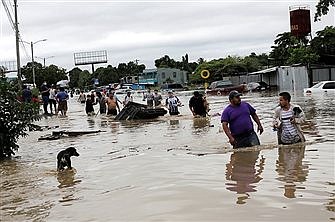
Caritas, the Church's charitable agency, is responding to Hurricane Eta, which hit Nicaragua Nov. 3 and threatened to provoke devastating flooding and destruction as it moved through Central America.
Hurricane Eta made landfall on the Mosquito Coast of northeastern Nicaragua near the municipality of Puerto Cabezas, where strong winds ripped the roofs off of buildings.
Father Francisco Chavarría, Caritas director in Nicaragua, told Catholic News Service that the agency was working with parishes along the Coco River, which forms the border with Honduras and is home to indigenous Mayangna and Miskito peoples. Caritas Nicaragua was working with the support of Trócaire – the overseas development agency of the Irish Catholic Church – and Catholic Relief Services, the U.S. bishops' international relief and development agency.
Timothy Hansell, country manager in Nicaragua for CRS, said Nov. 4 that the indigenous Miskito and Mayangna communities affected by the storm already were extremely vulnerable.
"We do not yet know the full extent of the impact, as many are isolated and do not have phones or electricity, but we are seeing some photos of the destruction that has left families with nothing," he said.
On Nov. 6, it was reported that landslides and flooding caused by the storm left at least people dead in Guatemala. Hundreds were in shelters and more than 33,000 people had been impacted. In Honduras, 360,000 people had been impacted, with 3,500 needing temporary shelter.
While the storm weakened as it slowly traversed through Nicaragua and Honduras, Hansell said continuing heavy rain will continue to cause massive flooding that destroys homes and people's livelihoods.
"We will need to support the communities with water, sanitation and hygiene, food aid, and seeds to restart the agricultural cycle to guarantee food security," he said.
Auxiliary Bishop Silvio José Baez of Managua, Nicaragua, tweeted Nov. 2: "I lift up my prayer to the Lord for our brothers of Nicaragua's north Caribbean in the face of the imminent arrival of Hurricane #Eta. May God protect the region's population and the Nicaraguan people who have suffered so much."
At least 19 chapels were being used as shelters, along with a seminary and Carmelite convent, according a Caritas planning document.
Hurricane Eta reached Category 4 strength with sustained winds of 110 miles per hour as it slowly moved along the Nicaragua coast. It moved inland as a Category 2 storm, according to news reports. As of Nov. 6, the storm had become a tropical depression and was moving toward Cuba.
Caritas officials say hurricanes are common in Central America, but such a strong storm has not battered the region since Hurricane Mitch dumped unprecedented precipitation on Central America in 1998, leaving 9,000 dead and causing enormous damage to property and infrastructure.
In Honduras, flooding in the northern part of the country had been reported as a tropical depression preceded Hurricane Eta's pending arrival.
Parishes, which formed teams to respond to the coronavirus pandemic, were ready to act again, said Father Germán Calix, director of Caritas Honduras.
The rains this year, he said, came after four years of drought and helped farmers, but more precipitation could cause mudslides and other disasters.
Related Stories
Thursday, January 01, 2026



E-Editions

Events
Caritas, the Church's charitable agency, is responding to Hurricane Eta, which hit Nicaragua Nov. 3 and threatened to provoke devastating flooding and destruction as it moved through Central America.
Hurricane Eta made landfall on the Mosquito Coast of northeastern Nicaragua near the municipality of Puerto Cabezas, where strong winds ripped the roofs off of buildings.
Father Francisco Chavarría, Caritas director in Nicaragua, told Catholic News Service that the agency was working with parishes along the Coco River, which forms the border with Honduras and is home to indigenous Mayangna and Miskito peoples. Caritas Nicaragua was working with the support of Trócaire – the overseas development agency of the Irish Catholic Church – and Catholic Relief Services, the U.S. bishops' international relief and development agency.
Timothy Hansell, country manager in Nicaragua for CRS, said Nov. 4 that the indigenous Miskito and Mayangna communities affected by the storm already were extremely vulnerable.
"We do not yet know the full extent of the impact, as many are isolated and do not have phones or electricity, but we are seeing some photos of the destruction that has left families with nothing," he said.
On Nov. 6, it was reported that landslides and flooding caused by the storm left at least people dead in Guatemala. Hundreds were in shelters and more than 33,000 people had been impacted. In Honduras, 360,000 people had been impacted, with 3,500 needing temporary shelter.
While the storm weakened as it slowly traversed through Nicaragua and Honduras, Hansell said continuing heavy rain will continue to cause massive flooding that destroys homes and people's livelihoods.
"We will need to support the communities with water, sanitation and hygiene, food aid, and seeds to restart the agricultural cycle to guarantee food security," he said.
Auxiliary Bishop Silvio José Baez of Managua, Nicaragua, tweeted Nov. 2: "I lift up my prayer to the Lord for our brothers of Nicaragua's north Caribbean in the face of the imminent arrival of Hurricane #Eta. May God protect the region's population and the Nicaraguan people who have suffered so much."
At least 19 chapels were being used as shelters, along with a seminary and Carmelite convent, according a Caritas planning document.
Hurricane Eta reached Category 4 strength with sustained winds of 110 miles per hour as it slowly moved along the Nicaragua coast. It moved inland as a Category 2 storm, according to news reports. As of Nov. 6, the storm had become a tropical depression and was moving toward Cuba.
Caritas officials say hurricanes are common in Central America, but such a strong storm has not battered the region since Hurricane Mitch dumped unprecedented precipitation on Central America in 1998, leaving 9,000 dead and causing enormous damage to property and infrastructure.
In Honduras, flooding in the northern part of the country had been reported as a tropical depression preceded Hurricane Eta's pending arrival.
Parishes, which formed teams to respond to the coronavirus pandemic, were ready to act again, said Father Germán Calix, director of Caritas Honduras.
The rains this year, he said, came after four years of drought and helped farmers, but more precipitation could cause mudslides and other disasters.