


Pope, U.S. bishops 'saddened' by Turkish court ruling on Hagia Sophia
July 16, 2020 at 8:37 p.m.
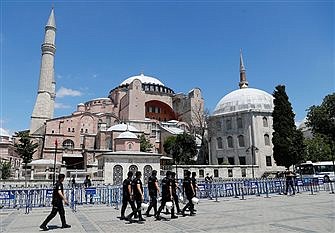
U.S. bishops echoes his statement and urged Turkish President Recep Tayyip Erdogan "to reverse this unnecessary and painful decision and restore Hagia Sophia as a place of prayer and reflection for all peoples."
While commemorating the International Day of the Sea during his Sunday Angelus address July 12, Pope Francis told pilgrims in St. Peter's Square that "the sea carries me a little farther away in my thoughts: to Istanbul."
"I think of Hagia Sophia, and I am very saddened," he said.
Erdogan issued a decree to hand over control of Hagia Sophia to the country's Directorate of Religious Affairs after Turkey's highest court revoked its status as a museum July 10.
In a video message after the court ruling, Erdogan said Hagia Sophia will remain "open to all locals, foreigners, Muslims and non-Muslims."
On July 14, Archbishop Jose H. Gomez of Los Angeles, president of the U.S. Conference of Catholic Bishops, and Bishop Joseph C. Bambera of Scranton, Pennsylvania, chairman of the USCCB's Committee on Ecumenical and Interreligious Affairs, said in a statement: "Since its foundation as a Christian cathedral in 537, Hagia Sophia has been one of the world's great artistic and spiritual treasures. For many years now, this beautiful and cherished site has served as a museum where people of all faiths can come to experience the sublime presence of God. It has also stood as a sign of good will and peaceful coexistence between Christians and Muslims and an expression of humanity's longings for unity and love.
Other world and religious leaders, including Ecumenical Patriarch Bartholomew of Constantinople, criticized the ruling. His Orthodox patriarchate is based in Istanbul.
In a homily during a June 30 divine liturgy, the patriarch warned that the decision "will push millions of Christians around the world against Islam."
It is "absurd and harmful that Hagia Sophia, from a place that now allows the two peoples to meet us and admire its greatness, can again become a reason for contrast and confrontation," he said, according to Fides news agency.
Echoing the patriarch's words, Ioan Sauca, interim general secretary of the World Council of Churches, expressed his concern that the decision will "inevitably create uncertainties, suspicions and mistrust, undermining all our efforts to bring people of different faiths together at the table of dialogue and cooperation."
In a July 11 letter to Erdogan, Sauca urged the Turkish president to reverse his decision "in the interest of promoting mutual understanding, respect, dialogue and cooperation and avoiding cultivating old animosities and divisions."
The decision was strongly condemned by Archbishop Elpidophoros of the New York-based Greek Orthodox Archdiocese of America, who called the decision "the worst example of religious chauvinism."
"By shuttering Hagia Sophia as a monument, Turkey has shut the window that (Mustafa Kemal) Ataturk opened to the world," he tweeted July 10.
The cathedral, founded by Emperor Justinian I on the site of two earlier Churches, was the world's largest at its dedication in 537.
Hagia Sophia remained a cathedral for the Byzantine Empire until 1453, when it served as a mosque following the Ottoman capture of Constantinople, today's Istanbul, for nearly five centuries.
Under Ataturk, the founder of modern Turkey, it then became a museum in 1935. It was declared a World Heritage site by UNESCO in 1985.
Audrey Azoulay, director general of UNESCO, issued a statement July 10 saying the decision was "regrettable" and "made without any form of dialogue or prior notice."
"UNESCO calls upon the Turkish authorities to initiate dialogue without delay, in order to prevent any detrimental effect on the universal value of this exceptional heritage, the state of conservation of which will be examined by the World Heritage Committee at its next session," Azoulay said.
Critics of the move have also accused Erdogan's government of using the decision to boost support for his governing Justice and Development party amid economic hardships exacerbated by the COVID-19 pandemic.
Follow Arocho on Twitter: @arochoju
Related Stories
Friday, January 02, 2026


E-Editions

Events
U.S. bishops echoes his statement and urged Turkish President Recep Tayyip Erdogan "to reverse this unnecessary and painful decision and restore Hagia Sophia as a place of prayer and reflection for all peoples."
While commemorating the International Day of the Sea during his Sunday Angelus address July 12, Pope Francis told pilgrims in St. Peter's Square that "the sea carries me a little farther away in my thoughts: to Istanbul."
"I think of Hagia Sophia, and I am very saddened," he said.
Erdogan issued a decree to hand over control of Hagia Sophia to the country's Directorate of Religious Affairs after Turkey's highest court revoked its status as a museum July 10.
In a video message after the court ruling, Erdogan said Hagia Sophia will remain "open to all locals, foreigners, Muslims and non-Muslims."
On July 14, Archbishop Jose H. Gomez of Los Angeles, president of the U.S. Conference of Catholic Bishops, and Bishop Joseph C. Bambera of Scranton, Pennsylvania, chairman of the USCCB's Committee on Ecumenical and Interreligious Affairs, said in a statement: "Since its foundation as a Christian cathedral in 537, Hagia Sophia has been one of the world's great artistic and spiritual treasures. For many years now, this beautiful and cherished site has served as a museum where people of all faiths can come to experience the sublime presence of God. It has also stood as a sign of good will and peaceful coexistence between Christians and Muslims and an expression of humanity's longings for unity and love.
Other world and religious leaders, including Ecumenical Patriarch Bartholomew of Constantinople, criticized the ruling. His Orthodox patriarchate is based in Istanbul.
In a homily during a June 30 divine liturgy, the patriarch warned that the decision "will push millions of Christians around the world against Islam."
It is "absurd and harmful that Hagia Sophia, from a place that now allows the two peoples to meet us and admire its greatness, can again become a reason for contrast and confrontation," he said, according to Fides news agency.
Echoing the patriarch's words, Ioan Sauca, interim general secretary of the World Council of Churches, expressed his concern that the decision will "inevitably create uncertainties, suspicions and mistrust, undermining all our efforts to bring people of different faiths together at the table of dialogue and cooperation."
In a July 11 letter to Erdogan, Sauca urged the Turkish president to reverse his decision "in the interest of promoting mutual understanding, respect, dialogue and cooperation and avoiding cultivating old animosities and divisions."
The decision was strongly condemned by Archbishop Elpidophoros of the New York-based Greek Orthodox Archdiocese of America, who called the decision "the worst example of religious chauvinism."
"By shuttering Hagia Sophia as a monument, Turkey has shut the window that (Mustafa Kemal) Ataturk opened to the world," he tweeted July 10.
The cathedral, founded by Emperor Justinian I on the site of two earlier Churches, was the world's largest at its dedication in 537.
Hagia Sophia remained a cathedral for the Byzantine Empire until 1453, when it served as a mosque following the Ottoman capture of Constantinople, today's Istanbul, for nearly five centuries.
Under Ataturk, the founder of modern Turkey, it then became a museum in 1935. It was declared a World Heritage site by UNESCO in 1985.
Audrey Azoulay, director general of UNESCO, issued a statement July 10 saying the decision was "regrettable" and "made without any form of dialogue or prior notice."
"UNESCO calls upon the Turkish authorities to initiate dialogue without delay, in order to prevent any detrimental effect on the universal value of this exceptional heritage, the state of conservation of which will be examined by the World Heritage Committee at its next session," Azoulay said.
Critics of the move have also accused Erdogan's government of using the decision to boost support for his governing Justice and Development party amid economic hardships exacerbated by the COVID-19 pandemic.
Follow Arocho on Twitter: @arochoju