


Vatican City State is pesticide-free, imports green energy
December 22, 2020 at 5:49 p.m.
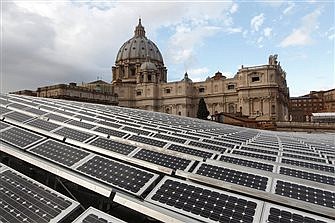
The Vatican's reforestation program has seen 300 trees of various species planted over the past three years, and "an important milestone" is the tiny nation "has achieved its goal of being pesticide-free," Father Rafael Garcia de la Serrana Villalobos, told Vatican News in mid-December. He also said the electricity the Vatican imports is produced entirely from renewable sources.
The walled-in area of Vatican City State covers about 109 acres, including extensive gardens, and the papal property at Castel Gandolfo extends over 135 acres, including about 17 acres of formal gardens, residences and a working farm.
Father de la Serrana said their new watering system for the Vatican Gardens has saved about 60 percent of water resources.
"We are promoting green economy policies, that is, circular economy policies, such as the transformation of organic waste and bio-waste into quality compost, and a waste management policy based on the concept of considering it not as waste but as a resource," he said.
The Vatican no longer sells single-use plastic products and about 65 percent of regular waste is being successfully separated for recycling, he said; the goal for 2023 is to reach 75 percent.
About 99 percent of its hazardous waste is properly collected, "allowing 90 percent of waste to be sent for recovery, thus giving value to the policy of treating waste as a resource and no longer as waste," he said.
Used cooking oils are collected to produce fuel, and the Vatican is studying other ways to further recover urban waste so it can be "transformed into a resource, both thermal and electrical, as well as the transformation of hospital waste into fuel, thus avoiding its management as hazardous waste," he said.
"There will be a gradual replacement of the car fleet with electric or hybrid-powered vehicles," he said.
These and other projects are part of the Vatican's goal of achieving net-zero carbon emissions. Pope Francis pledged the city state would reach this goal before 2050.
Pope Francis was one of dozens of leaders contributing to the Climate Ambition Summit, held online Dec. 12, in which they renewed or strengthened investment pledges and commitments to cut greenhouse gas emissions and achieve carbon neutrality.
The Pope was one of about two dozen leaders who announced a commitment for net-zero emissions, which would be achieving a balance between greenhouse gas emissions produced and greenhouse gas emissions taken out of the atmosphere, for example by switching to "green" energy and sustainable agriculture, increasing energy efficiency and reforestation.
Father de la Serrana told Vatican News that "climate neutrality can be achieved by Vatican City State primarily through the use of natural sinks, such as soil and forests, and by offsetting emissions produced in one area by reducing them in another. Of course, this is done by investing in renewable energy, energy efficiency or other clean technologies such as electric mobility."
Related Stories
Wednesday, December 31, 2025




E-Editions
Events
The Vatican's reforestation program has seen 300 trees of various species planted over the past three years, and "an important milestone" is the tiny nation "has achieved its goal of being pesticide-free," Father Rafael Garcia de la Serrana Villalobos, told Vatican News in mid-December. He also said the electricity the Vatican imports is produced entirely from renewable sources.
The walled-in area of Vatican City State covers about 109 acres, including extensive gardens, and the papal property at Castel Gandolfo extends over 135 acres, including about 17 acres of formal gardens, residences and a working farm.
Father de la Serrana said their new watering system for the Vatican Gardens has saved about 60 percent of water resources.
"We are promoting green economy policies, that is, circular economy policies, such as the transformation of organic waste and bio-waste into quality compost, and a waste management policy based on the concept of considering it not as waste but as a resource," he said.
The Vatican no longer sells single-use plastic products and about 65 percent of regular waste is being successfully separated for recycling, he said; the goal for 2023 is to reach 75 percent.
About 99 percent of its hazardous waste is properly collected, "allowing 90 percent of waste to be sent for recovery, thus giving value to the policy of treating waste as a resource and no longer as waste," he said.
Used cooking oils are collected to produce fuel, and the Vatican is studying other ways to further recover urban waste so it can be "transformed into a resource, both thermal and electrical, as well as the transformation of hospital waste into fuel, thus avoiding its management as hazardous waste," he said.
"There will be a gradual replacement of the car fleet with electric or hybrid-powered vehicles," he said.
These and other projects are part of the Vatican's goal of achieving net-zero carbon emissions. Pope Francis pledged the city state would reach this goal before 2050.
Pope Francis was one of dozens of leaders contributing to the Climate Ambition Summit, held online Dec. 12, in which they renewed or strengthened investment pledges and commitments to cut greenhouse gas emissions and achieve carbon neutrality.
The Pope was one of about two dozen leaders who announced a commitment for net-zero emissions, which would be achieving a balance between greenhouse gas emissions produced and greenhouse gas emissions taken out of the atmosphere, for example by switching to "green" energy and sustainable agriculture, increasing energy efficiency and reforestation.
Father de la Serrana told Vatican News that "climate neutrality can be achieved by Vatican City State primarily through the use of natural sinks, such as soil and forests, and by offsetting emissions produced in one area by reducing them in another. Of course, this is done by investing in renewable energy, energy efficiency or other clean technologies such as electric mobility."