


In fall meeting, U.S. bishops examine challenges faced by Church, society
November 12, 2019 at 4:05 p.m.
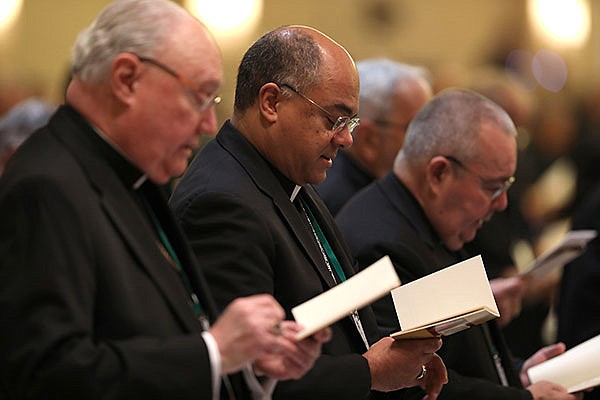
BALTIMORE – At the start of their Nov. 11-13 meeting in Baltimore, U.S. bishops discussed many of the challenges they face in the Church and the nation. Pressing issues raised by the bishops included the priesthood shortage, gun violence, young people leaving the Church and the need to provide support services for pregnant women.
Archbishop Christophe Pierre, papal nuncio to the United States, mentioned some of these challenges in his opening remarks, along with the need to welcome migrants and fight racism. He also urged the bishops not just to focus on the challenges before them but to consider how they could further develop collegiality and collaboration with one another.
In his final address as president of the U.S. Conference of Catholic Bishops, Cardinal Daniel N. DiNardo of Galveston-Houston told his fellow bishops that it has been "an honor to serve you, even in the difficult times."
The 70-year-old prelate thanked the bishops, whom he called brothers, for the last three years and was thanked by them in return when the group gave him a standing ovation at the end of his nine-minute presentation.
"Let's begin anew," he said, at the close of his address, veering away from prepared remarks, and quoting St. Augustine.
The bishops also voted overwhelmingly on a revised set of strategic priorities to take them into the next decade. They also discussed upcoming votes during their gathering, such as news materials to complement "Forming Consciences for Faithful Citizenship," their long-standing guide to help Catholics form their consciences in public life, including voting.
Retired Army Col. Anita Raines, who chairs the National Advisory Council, said in a report to the bishops that the group supported the prelates' effort to promulgate its "Faithful Citizenship" document and supplemental materials.
To help ensure the document's wide distribution to parishes and individuals, the council recommended the USCCB implement "a strong communications strategy fully leveraging social media."
This wasn't the only mention of social media during the start of the meeting.
Auxiliary Bishop Robert E. Barron of Los Angeles, chairman of the bishops' Committee on Evangelization and Catechesis, urged the bishops to promote social media in their dioceses as one way to link young people with the Church. He said the Church is losing young people in greater numbers and must face the challenges of how to get the religiously unaffiliated, or "nones," particularly young people, back to the Catholic Church.
He offered a five-step plan of sorts to bring young people back to the Church: for the Church to lead with its social justice work, getting young people involved with caring for those in need, working in soup kitchens, prison ministries, helping the homeless; for the Church to promote its own writers and artists to show people the beauty of the Catholic faith; to stop dumbing down the faith for young Catholics; on the parish level, for Catholics to start recognizing that their parishes are not just places where they experience the sacraments, but missionary grounds; and social media ministry outreach.
The bishops also heard about societal issues such as gun violence. Bishop Frank J. Dewane of Venice, Fla., chairman of the U.S. bishops' Committee on Domestic Justice and Human Development, said Catholic clergy and lay leaders can play a role in bringing together people along the rural-urban divide to build understanding of the need for sensible policies that can end the scourge of gun violence.
The bishop outlined the USCCB's long-held stance of the need for "common sense" legislation that governs the availability of guns. But he also said it was time for people to come together so that there is greater understanding of how gun violence affects urban communities in particular.
He told Catholic News Service that the USCCB's work on the legislative front was important, but that a pastoral response to gun violence was needed. "It's time for a different approach," he said.
In a new approach for pro-life efforts, bishops were invited to devote a year of service to pregnant women starting next March. Parishes, the bishops heard, can be one of the first places a woman facing an unexpected or challenging pregnancy can turn to for assistance.
The bishops also heard about plans to revise the U.S. Conference of Catholic Bishops' existing Program of Priestly Formation for U.S. dioceses.
In his homily at the Nov. 11 Mass in the hotel ballroom, Cardinal DiNardo stressed that St. Martin of Tours, whose feast was celebrated that day, offered them a fitting example.
He said little is known about what the saint wrote in the late 300s but plenty is known about what he did: "reconciling the Christian community and reconciling the clergy, even then."
"Brothers, we have someone to imitate tonight," he told them.
Contributing to this report was Rhina Guidos, Mark Pattison and Dennis Sadowski.
Related Stories
Friday, January 09, 2026


E-Editions
Events
BALTIMORE – At the start of their Nov. 11-13 meeting in Baltimore, U.S. bishops discussed many of the challenges they face in the Church and the nation. Pressing issues raised by the bishops included the priesthood shortage, gun violence, young people leaving the Church and the need to provide support services for pregnant women.
Archbishop Christophe Pierre, papal nuncio to the United States, mentioned some of these challenges in his opening remarks, along with the need to welcome migrants and fight racism. He also urged the bishops not just to focus on the challenges before them but to consider how they could further develop collegiality and collaboration with one another.
In his final address as president of the U.S. Conference of Catholic Bishops, Cardinal Daniel N. DiNardo of Galveston-Houston told his fellow bishops that it has been "an honor to serve you, even in the difficult times."
The 70-year-old prelate thanked the bishops, whom he called brothers, for the last three years and was thanked by them in return when the group gave him a standing ovation at the end of his nine-minute presentation.
"Let's begin anew," he said, at the close of his address, veering away from prepared remarks, and quoting St. Augustine.
The bishops also voted overwhelmingly on a revised set of strategic priorities to take them into the next decade. They also discussed upcoming votes during their gathering, such as news materials to complement "Forming Consciences for Faithful Citizenship," their long-standing guide to help Catholics form their consciences in public life, including voting.
Retired Army Col. Anita Raines, who chairs the National Advisory Council, said in a report to the bishops that the group supported the prelates' effort to promulgate its "Faithful Citizenship" document and supplemental materials.
To help ensure the document's wide distribution to parishes and individuals, the council recommended the USCCB implement "a strong communications strategy fully leveraging social media."
This wasn't the only mention of social media during the start of the meeting.
Auxiliary Bishop Robert E. Barron of Los Angeles, chairman of the bishops' Committee on Evangelization and Catechesis, urged the bishops to promote social media in their dioceses as one way to link young people with the Church. He said the Church is losing young people in greater numbers and must face the challenges of how to get the religiously unaffiliated, or "nones," particularly young people, back to the Catholic Church.
He offered a five-step plan of sorts to bring young people back to the Church: for the Church to lead with its social justice work, getting young people involved with caring for those in need, working in soup kitchens, prison ministries, helping the homeless; for the Church to promote its own writers and artists to show people the beauty of the Catholic faith; to stop dumbing down the faith for young Catholics; on the parish level, for Catholics to start recognizing that their parishes are not just places where they experience the sacraments, but missionary grounds; and social media ministry outreach.
The bishops also heard about societal issues such as gun violence. Bishop Frank J. Dewane of Venice, Fla., chairman of the U.S. bishops' Committee on Domestic Justice and Human Development, said Catholic clergy and lay leaders can play a role in bringing together people along the rural-urban divide to build understanding of the need for sensible policies that can end the scourge of gun violence.
The bishop outlined the USCCB's long-held stance of the need for "common sense" legislation that governs the availability of guns. But he also said it was time for people to come together so that there is greater understanding of how gun violence affects urban communities in particular.
He told Catholic News Service that the USCCB's work on the legislative front was important, but that a pastoral response to gun violence was needed. "It's time for a different approach," he said.
In a new approach for pro-life efforts, bishops were invited to devote a year of service to pregnant women starting next March. Parishes, the bishops heard, can be one of the first places a woman facing an unexpected or challenging pregnancy can turn to for assistance.
The bishops also heard about plans to revise the U.S. Conference of Catholic Bishops' existing Program of Priestly Formation for U.S. dioceses.
In his homily at the Nov. 11 Mass in the hotel ballroom, Cardinal DiNardo stressed that St. Martin of Tours, whose feast was celebrated that day, offered them a fitting example.
He said little is known about what the saint wrote in the late 300s but plenty is known about what he did: "reconciling the Christian community and reconciling the clergy, even then."
"Brothers, we have someone to imitate tonight," he told them.
Contributing to this report was Rhina Guidos, Mark Pattison and Dennis Sadowski.