


Widening the welcome to special needs children
July 29, 2019 at 12:37 p.m.
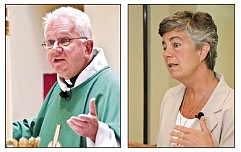
On Sept. 6, parish catechetical leaders rang in the new school year learning how to extend their ministry to children with physical, intellectual, and emotional disabilities.
Nearly 100 directors, coordinators, and catechists from across the diocese gathered at the parish of St. David the King, Princeton Junction, for a six-hour professional day featuring two veteran teachers of special needs students, Mercy Sister Kathleen Schipani and Holy Cross Father Richard Hockman, who celebrated the Mass.
Administrator of the Department for Pastoral Care for Persons with Disabilities in the Archdiocese of Philadelphia, Sister Kathleen taught disabled children and adults for more than 30 years and set up the archdiocese’s catechetical program specific to their needs.
She promised the morning session would “be as practical and helpful as possible but we must also begin by considering how and why we do this. Jesus said, ‘Let the children come to me. ’ With these words, He charged us to bring all individuals to the Church.”
This charge poses challenges for parents and catechists as more children are diagnosed with developmental disorders, such as autism, which require modification of teaching strategies, educational materials, and classroom environment so these children can succeed.
Sister Kathleen’s presentation, based on the 1978 Pastoral Statement of the U.S. Catholic Bishops on People with Disabilities and the 1995 Guidelines for the Celebration of the Sacraments with Persons with Disabilities, introduced 13 categories of disabilities named by the Individuals with Disabilities Education Act (IDEA) and offered many practical suggestions on how to make a catechetical program inclusive to children who learn differently from those in the mainstream.
Her primary lesson of the day directed the audience to be open and to speak with sensitivity to families and children often set apart by labels, stereotypes, and separate classrooms.
“We must try to relate to children with disabilities as people first,” said Sister Kathleen, “Don’t ask, ’What’s his problem?’ or fail to look at or address the child by name. Mothers know if you’re identifying her child as a child or a disability.”
Often parents of special needs children fail to enroll their children in religious education programs, saying, “I don’t see any children like mine in your parish,” which is why special needs children often do not receive their sacraments, depriving them of the full benefits of their faith.
Her program included a bibliography of print and on-line resources to help the catechetical leaders widen the welcome to the special needs community in their own parishes.
Over lunch Annie Lauer, a representative from Loyola Press, introduced new publications, including flip books, puzzles, and picture books, which are tailored to the needs of children with developmental disabilities.
“I’ve given my life to this program,” said Holy Cross Father Richard Hockman, referring to Special Religious Development (SPRED) of the Archdiocese of Chicago, a program founded for persons with developmental disabilities by Father Jim McCarthy in 1960.
SPRED has evolved into a religious education program which integrates persons with developmental or learning disabilities “into small faith-based communities,” said Father Hockman, “which rely on a one-on-one relationship between a volunteer catechist and a special friend. ”
Based on methods developed by Maria Montessori, weekly meetings, lasting for two to three hours, consist of story-telling and make use of symbols and movement, which Father Hockman stated, “ is the way our friends with disabilities can learn.” Scripture readings are not read, but done in gesture and song.
An adult group for those 21 and over would have up to eight friends with an equal number of volunteers. SPRED offers sessions to prepare children for sacraments. SPRED has 30 communities throughout the world.
Father Hockman trained for the SPRED ministry in 1978 and works for the program in the Diocese of Scranton, where he serves as Superior of the Holy Cross Community at King’s College in Wilkes-Barre, Pa.
At day’s end, cathechists headed back to their parishes with insight and strategies to make their programs more inclusive. Barbara Evans, DRE at St. Denis Parish, Manasquan, commented, “I like the ideas of the inclusiveness – there’s more community than with separation. These resources empower us to help address these needs.”
Pedro Moncada, a catechist from St. Anthony of Padua Parish, Hightstown, said, “I am new at this so the information will be helpful. I look forward to using the websites and the webinars.”
Michelle McCue, DRE from St. Anthony Parish, Red Bank, had something to consider: “I haven’t had a need but this discussion made me realize perhaps I haven’t noticed. It’s raised my awareness.”
[[In-content Ad]]Related Stories
Friday, December 19, 2025




E-Editions
Events
On Sept. 6, parish catechetical leaders rang in the new school year learning how to extend their ministry to children with physical, intellectual, and emotional disabilities.
Nearly 100 directors, coordinators, and catechists from across the diocese gathered at the parish of St. David the King, Princeton Junction, for a six-hour professional day featuring two veteran teachers of special needs students, Mercy Sister Kathleen Schipani and Holy Cross Father Richard Hockman, who celebrated the Mass.
Administrator of the Department for Pastoral Care for Persons with Disabilities in the Archdiocese of Philadelphia, Sister Kathleen taught disabled children and adults for more than 30 years and set up the archdiocese’s catechetical program specific to their needs.
She promised the morning session would “be as practical and helpful as possible but we must also begin by considering how and why we do this. Jesus said, ‘Let the children come to me. ’ With these words, He charged us to bring all individuals to the Church.”
This charge poses challenges for parents and catechists as more children are diagnosed with developmental disorders, such as autism, which require modification of teaching strategies, educational materials, and classroom environment so these children can succeed.
Sister Kathleen’s presentation, based on the 1978 Pastoral Statement of the U.S. Catholic Bishops on People with Disabilities and the 1995 Guidelines for the Celebration of the Sacraments with Persons with Disabilities, introduced 13 categories of disabilities named by the Individuals with Disabilities Education Act (IDEA) and offered many practical suggestions on how to make a catechetical program inclusive to children who learn differently from those in the mainstream.
Her primary lesson of the day directed the audience to be open and to speak with sensitivity to families and children often set apart by labels, stereotypes, and separate classrooms.
“We must try to relate to children with disabilities as people first,” said Sister Kathleen, “Don’t ask, ’What’s his problem?’ or fail to look at or address the child by name. Mothers know if you’re identifying her child as a child or a disability.”
Often parents of special needs children fail to enroll their children in religious education programs, saying, “I don’t see any children like mine in your parish,” which is why special needs children often do not receive their sacraments, depriving them of the full benefits of their faith.
Her program included a bibliography of print and on-line resources to help the catechetical leaders widen the welcome to the special needs community in their own parishes.
Over lunch Annie Lauer, a representative from Loyola Press, introduced new publications, including flip books, puzzles, and picture books, which are tailored to the needs of children with developmental disabilities.
“I’ve given my life to this program,” said Holy Cross Father Richard Hockman, referring to Special Religious Development (SPRED) of the Archdiocese of Chicago, a program founded for persons with developmental disabilities by Father Jim McCarthy in 1960.
SPRED has evolved into a religious education program which integrates persons with developmental or learning disabilities “into small faith-based communities,” said Father Hockman, “which rely on a one-on-one relationship between a volunteer catechist and a special friend. ”
Based on methods developed by Maria Montessori, weekly meetings, lasting for two to three hours, consist of story-telling and make use of symbols and movement, which Father Hockman stated, “ is the way our friends with disabilities can learn.” Scripture readings are not read, but done in gesture and song.
An adult group for those 21 and over would have up to eight friends with an equal number of volunteers. SPRED offers sessions to prepare children for sacraments. SPRED has 30 communities throughout the world.
Father Hockman trained for the SPRED ministry in 1978 and works for the program in the Diocese of Scranton, where he serves as Superior of the Holy Cross Community at King’s College in Wilkes-Barre, Pa.
At day’s end, cathechists headed back to their parishes with insight and strategies to make their programs more inclusive. Barbara Evans, DRE at St. Denis Parish, Manasquan, commented, “I like the ideas of the inclusiveness – there’s more community than with separation. These resources empower us to help address these needs.”
Pedro Moncada, a catechist from St. Anthony of Padua Parish, Hightstown, said, “I am new at this so the information will be helpful. I look forward to using the websites and the webinars.”
Michelle McCue, DRE from St. Anthony Parish, Red Bank, had something to consider: “I haven’t had a need but this discussion made me realize perhaps I haven’t noticed. It’s raised my awareness.”
[[In-content Ad]]